
Speed Is Physics, Not Just Policy
When most drivers think about their speedometer, they think about avoiding a ticket. That framing misses the bigger picture. Every mph reading on that dial represents a physical state your vehicle is in — a state that determines how much road you need to stop, how hard you'll hit something if you can't, and whether you or a pedestrian survives the outcome.
The relationship between speed and stopping distance is not linear. It's exponential. A car traveling 60 mph doesn't need twice the stopping distance of one going 30 mph — it needs roughly four times as much. That's because kinetic energy, the force carrying your vehicle forward, grows with the square of your speed. Double the speed, quadruple the energy that has to be absorbed in a crash or shed through braking.
This is why traffic engineers and safety researchers treat every 5 mph increment seriously. It's not arbitrary caution — it's math.
What Posted Limits Are Actually Based On
Speed limits in the US are set through a process that considers road geometry, sight lines, intersection density, pedestrian activity, and — on most roads — what's known as the 85th percentile speed: the speed at or below which 85% of drivers naturally travel under free-flow conditions. That methodology is debated among traffic safety experts, but the core point stands: limits reflect tested conditions for that specific road design.
A 25 mph limit in a residential neighborhood accounts for narrow lanes, driveways, parked cars blocking sightlines, and children near the roadway. A 70 mph interstate limit assumes wide lanes, controlled access, divided traffic, and clear sightlines. Treating both numbers the same way — as optional suggestions — ignores what they're built to account for.
Special zones carry their own rules. Speed rules in school zones, work zones, and emergency scenes change what's legally and physically safe even when conditions look clear. Fines typically double in these areas — but the more important reason to slow down is that hazards appear with less warning.
~1/3
Of US fatal crashes involve excess speed
According to NHTSA, speeding has been a factor in roughly one-third of all traffic fatalities in the United States for over two decades.
132 ft
Distance covered before braking at 60 mph
At 60 mph with a 1.5-second reaction time, a vehicle travels approximately 132 feet before the driver's foot reaches the brake — before any actual stopping begins.
4x
Kinetic energy increase from doubling speed
Because kinetic energy scales with the square of velocity, doubling your speed quadruples the energy involved in a crash, not merely doubles it.
The Distance You Travel Before You Even Hit the Brakes
Here's a number most drivers underestimate: reaction distance. Before your foot even reaches the brake pedal, your car keeps moving. The average driver takes roughly 1.5 seconds to perceive a hazard and react. At 60 mph, that's about 132 feet of road covered before braking begins — nearly half a football field.
Add braking distance on top of that, and total stopping distance at 60 mph in good conditions can exceed 240 feet. Wet roads, worn tires, or an older vehicle extend that number further. Our in-depth look at reaction time versus braking distance explains why these two phases of stopping are often confused — and why confusing them leads to following too closely.
That's also why following distance matters so much. The three-second rule for following distance is calibrated around these stopping realities. Compress that gap, and you've eliminated the margin your speedometer's current reading actually requires.
When the Speed Limit Isn't the Safe Speed
Driving at exactly the posted limit isn't always appropriate. Conditions — weather, visibility, traffic density, road surface — can make the legal speed physically unsafe. Most US states have what's called a "basic speed law," which requires drivers to travel at a speed that is reasonable and prudent for current conditions, regardless of what the sign says.
Rain is a clear example. Hydroplaning can begin at speeds as low as 35 mph, and wet roads extend stopping distances by 50% or more compared to dry pavement. Driving at the posted highway limit in a heavy downpour may be technically legal — and genuinely dangerous.
Night driving compounds the problem. Fatal crash rates rise significantly after dark even though traffic volume drops. Headlights typically illuminate 160–250 feet ahead — often less than the stopping distance required at highway speeds. Drivers are, in effect, outrunning their own sight lines.
Check Your Speed When Transitioning Road Types
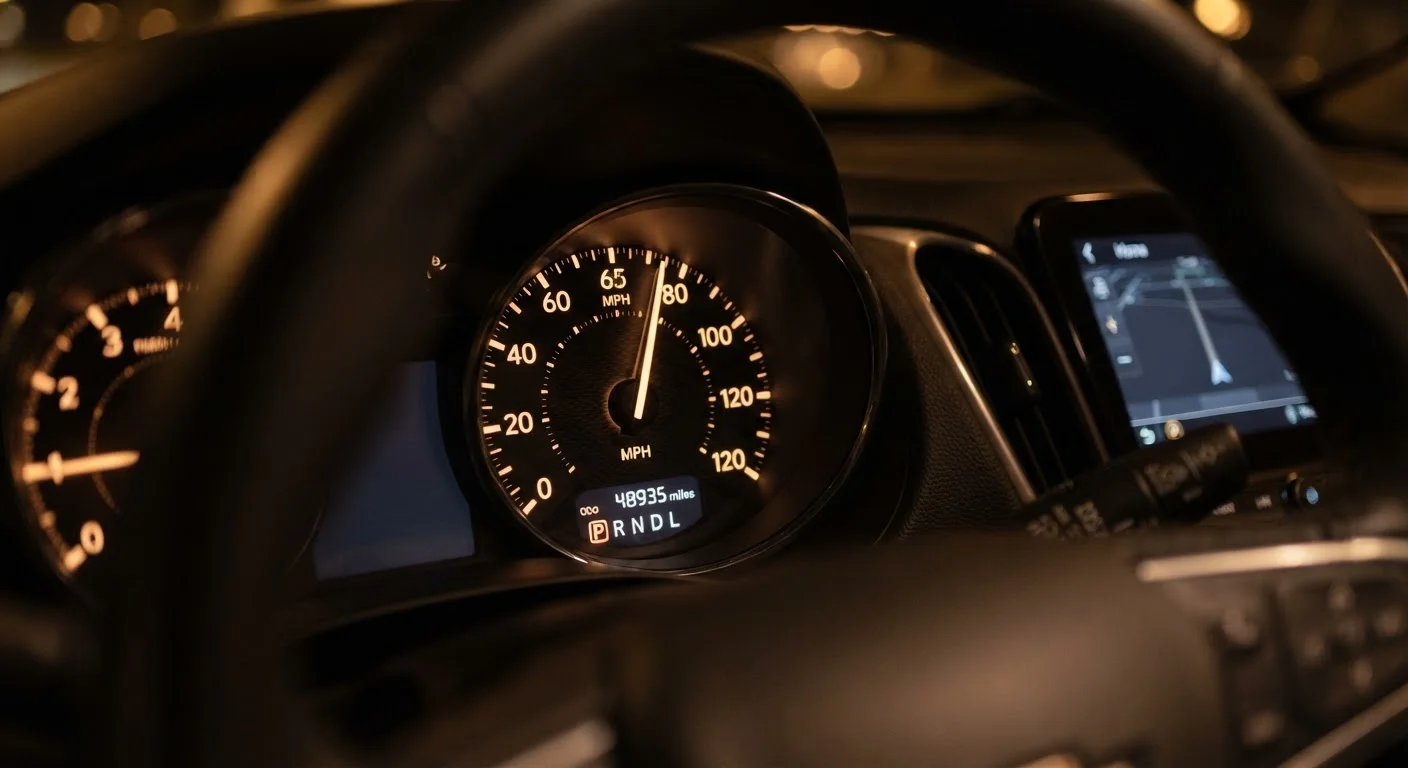
After driving on a highway for 30 or more minutes, your perception of speed drifts — surface streets will feel slower than they are. Make a deliberate habit of glancing at your speedometer within the first quarter-mile after any off-ramp or transition to a lower-speed zone. Don't trust your gut in those moments; trust the dial.
Reading Your Speedometer as a Safety Tool
Practically speaking, treating your speedometer as a safety instrument means checking it regularly rather than guessing your speed — especially when decelerating from highway to surface-street speeds, where the transition often feels slower than it actually is. Many drivers exit a freeway at 55 mph feeling like they're doing 35 mph. That perceptual lag is a known factor in intersection crashes near off-ramps.
It also means understanding that the number you're watching represents a current physical state with consequences. Excess speed is a contributing factor in approximately one-third of all fatal traffic crashes in the United States, according to data from the National Highway Traffic Safety Administration (NHTSA). That proportion has remained stubbornly consistent for years — suggesting it's not a problem of ignorance, but of underestimating what the numbers mean in real terms.
Your speedometer doesn't grade on a curve. Physics doesn't negotiate. Every mph you carry into a hazard is energy that has to go somewhere.