
Why Certain Zones Carry Stricter Rules
Most drivers know to slow down in a school zone, but far fewer can state exactly what the law requires — or realize how sharply penalties can escalate inside these areas. US traffic law carves out three categories of heightened-protection zones: school zones, construction and work zones, and active emergency scenes. Each one shifts the legal standard for speed, following distance, and lane position. Ignorance of the specific rules is not a legal defense, and fines in these zones are typically doubled or tripled compared to standard roadway violations.
The rules described here reflect common patterns across US state laws, but requirements vary by state. Always check your own state's motor vehicle statutes for the exact thresholds that apply where you drive. See our guide to posted speed limits and stopping distance for context on how speed affects crash risk.
| Typical school zone speed limit | 15–25 mph (Varies by state; some states tie activation to visible presence of children) |
| States with a move-over law | All 50 states (Coverage of vehicle types (tow trucks, utility workers) varies by state) |
| Work zone fine multiplier | 2× or more (Most US states; some double or triple fines when workers are present) |
| Typical move-over speed reduction | 20 mph below posted limit (Common threshold; exact figure varies by state statute) |
| Work zone crash injuries (annual, US) | Thousands per year (Federal Highway Administration, work zone safety data) |
School Zones: Speed, Timing, and Pedestrian Rights
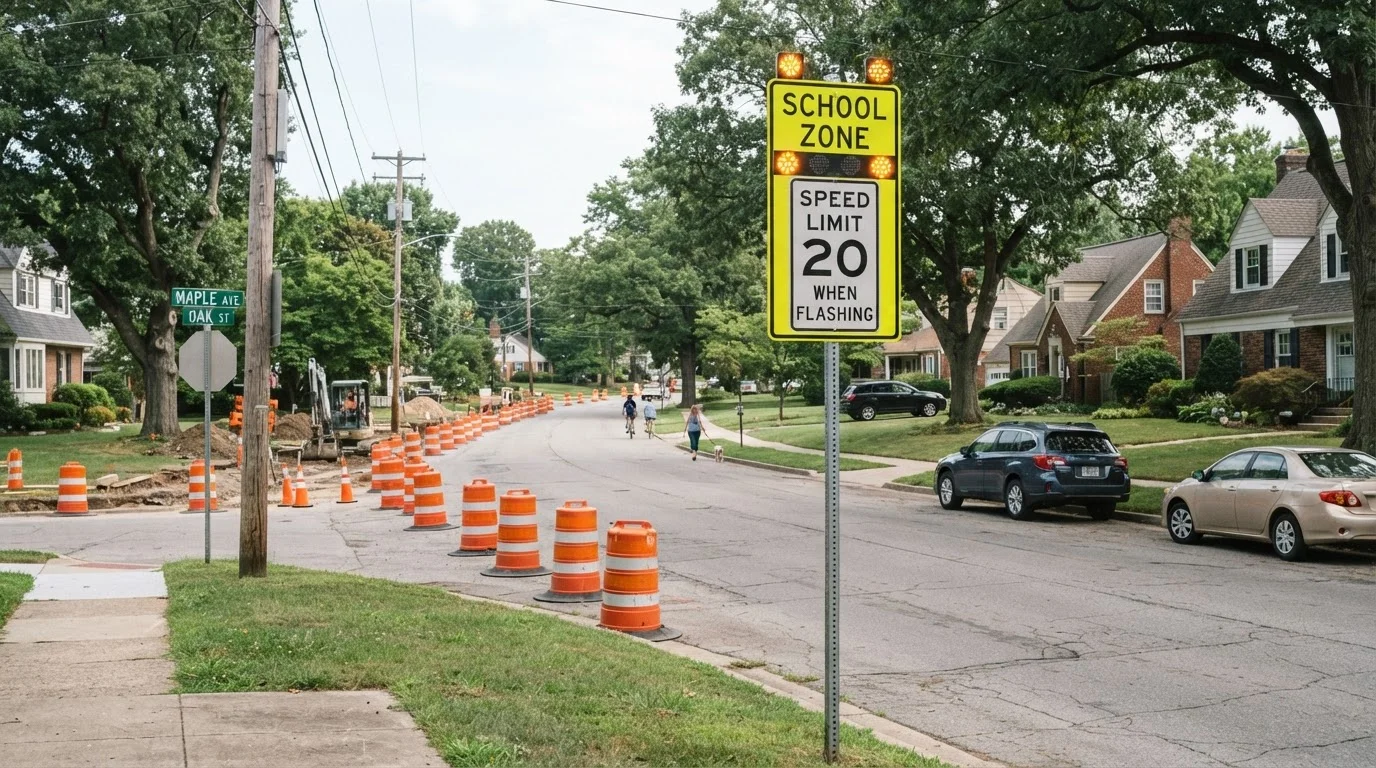
School zone speed limits in the US typically range from 15 to 25 mph, and they commonly apply only during specific hours — usually when children are arriving or departing. Some states activate limits whenever children are visibly present on or near the roadway, regardless of time. Flashing beacons or posted time ranges signal when the reduced limit is in effect.
Within a school zone, drivers must yield to pedestrians in or approaching a crosswalk — this is not optional. Passing a vehicle that has stopped for pedestrians is illegal in virtually every state. Many states also prohibit cell phone use in school zones, even where a hands-free exemption applies elsewhere. Traffic cameras are increasingly deployed in school zones in major metropolitan areas, and violations may be cited without a police officer present.
For a broader look at how urban pedestrian density changes driving demands, see our comparison of city and rural driving risks.
Work Zones: Fines, Workers, and Reduced Margins
Construction and maintenance work zones present a genuine safety hazard for both workers and drivers. According to the Federal Highway Administration, thousands of people are injured and hundreds killed in work zone crashes every year in the US. Most states double the standard fine for speeding in a posted work zone, and several states add license points or mandatory court appearances for violations when workers are present.
Key behaviors the law generally requires in work zones:
- Observe posted reduced speed limits — these are legally enforceable, not advisory suggestions.
- Maintain increased following distance — lanes narrow, debris appears unexpectedly, and traffic can stop without warning. Our article on following distance explains how stopping math changes in tight conditions.
- Obey flaggers and temporary traffic control devices — a flagger has the same legal authority as a traffic signal. Ignoring one is a moving violation.
- Do not use a handheld device — most states extend distracted-driving restrictions into active work zones.
Lane changes near merge points are another common source of work zone crashes. Understanding proper merge technique — covered in our highway merging guide — applies directly here.
Move-Over Laws: Emergency and Stopped Vehicles
Every US state has a move-over law. The core requirement: when you see an emergency vehicle, tow truck, or — in most states — any vehicle with hazard lights stopped on the shoulder, you must either move one lane away from the stopped vehicle or, if a lane change is not safely possible, slow to a speed well below the posted limit (typically 20 mph below, though the exact figure varies by state).
These laws originally covered police, fire, and EMS vehicles. Most states have since expanded coverage to include tow trucks, utility workers, highway maintenance crews, and in some states, any disabled vehicle. Failure to move over is a primary offense — officers can and do stop drivers solely for this violation. Fines range from around $100 to several hundred dollars, and penalties escalate sharply if a worker or officer is struck.
When approaching an active emergency scene, additional rules apply: do not stop to observe, do not use a handheld device to record, and follow any directions given by first responders on scene. Gawking slows traffic and can create secondary crashes.
School Zone
A designated stretch of roadway near a school where reduced speed limits and additional pedestrian protections apply, typically during school arrival and dismissal hours. Exact hours and speed thresholds vary by state.
Work Zone
A section of road where construction, maintenance, or utility work is taking place, marked by signs, cones, or barriers. Speed limits are reduced and penalties for violations are typically doubled when workers are present.
Move-Over Law
A state law requiring drivers approaching a stopped emergency, law enforcement, or service vehicle on the roadway shoulder to shift one lane away or reduce speed significantly. All 50 US states have some version of this law.
Flagger
A trained traffic control worker stationed in a work zone to direct vehicle movement. In most US states, a flagger's directions carry the same legal authority as a traffic signal.
Primary Offense
A traffic violation for which an officer can stop a driver without needing another reason. Move-over violations are primary offenses in most states, meaning no other infraction is needed for a stop.