
The Numbers Tell Two Different Stories
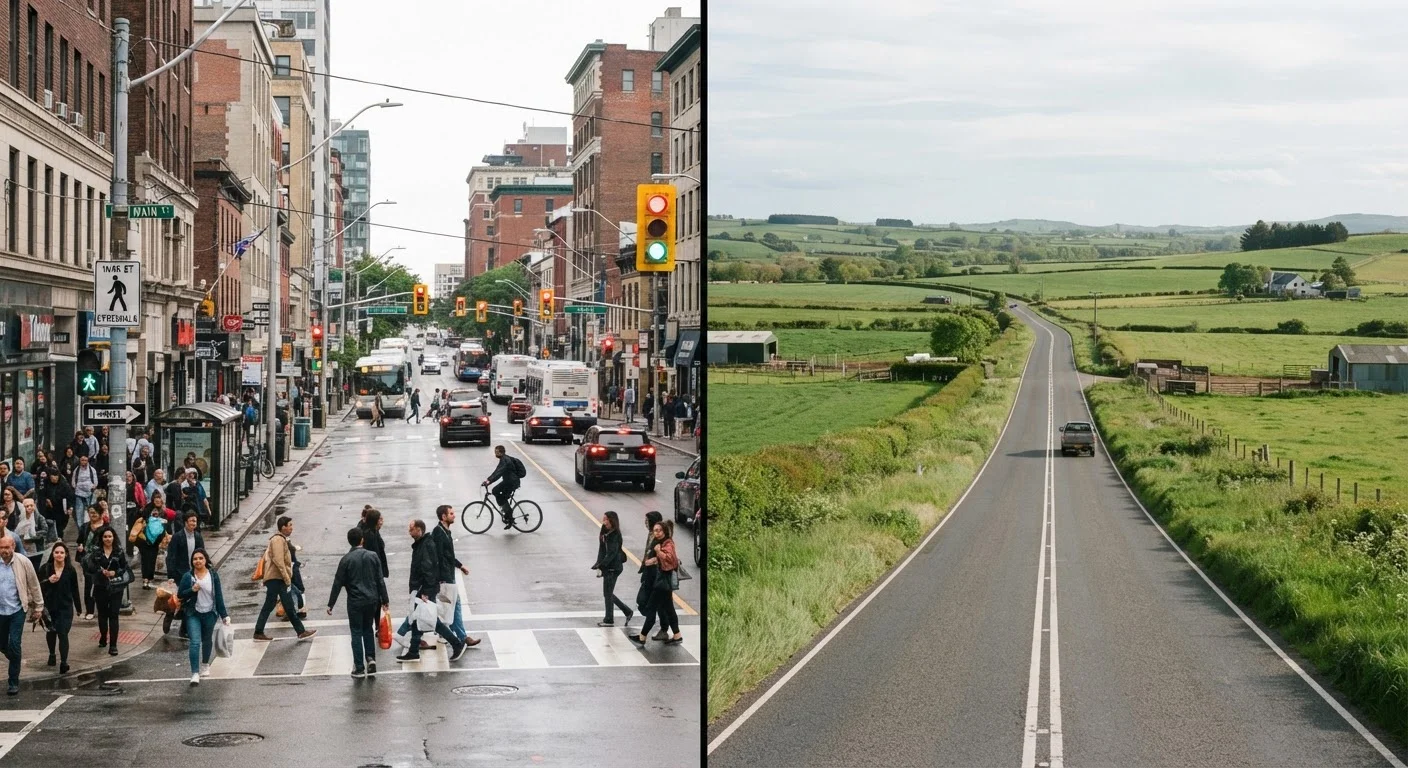
It's tempting to assume that where the cars are densest, the crashes are worst. Urban areas do generate more total crashes simply because of volume. But when researchers look at fatality rates—deaths per mile traveled—rural roads consistently come out far more dangerous. According to the National Highway Traffic Safety Administration (NHTSA), rural roads account for roughly 45% of all vehicle miles traveled in the US but closer to half of all traffic fatalities in recent years.
The reasons aren't mysterious: higher speeds, greater distances from trauma centers, less roadway lighting, and narrower lanes all compound the consequences when something goes wrong outside city limits. Meanwhile, urban crashes are more frequent but often less lethal—lower speeds mean more fender-benders and pedestrian injuries rather than high-speed fatalities.
Understanding this split is the starting point for adapting your driving to each environment. For a deeper look at what the data really says about road danger, see common driving myths American roads keep disproving.
~50%
Rural share of US traffic fatalities
According to NHTSA data, rural roads account for roughly half of US traffic deaths despite carrying far less total traffic volume than urban roads.
1.5M
Annual deer-vehicle collisions in the US
The Insurance Institute for Highway Safety estimates approximately 1.5 million deer-vehicle crashes occur each year, concentrated on rural roadways.
What Makes City Streets Uniquely Dangerous
Urban driving is essentially a high-density coordination problem. The hazards come thick and fast: cyclists filtering between lanes, delivery trucks double-parked mid-block, pedestrians stepping off curbs between parked cars, and intersections where signal timing doesn't guarantee safe passage.
Intersections deserve special attention. Research consistently shows they're the site of a disproportionate share of urban crashes. Running a red light even slightly late, misjudging a gap in oncoming traffic, or failing to yield to a pedestrian in a crosswalk are the scenarios that play out repeatedly. Understanding right-of-way at roundabouts, four-way stops, and uncontrolled intersections is one of the most practical skills any city driver can sharpen.
Stop-and-go traffic also breeds rear-end collisions. Urban drivers tend to underestimate how much following distance they need at low speeds—a three-second gap still applies even at 25 mph. And distraction hits harder in the city because the consequence window is shorter: a glance at a phone for two seconds at city speeds covers enough ground that a pedestrian can appear from nowhere.
City-specific habits that help: scan intersections early and late (not just when you enter), check crosswalks before accelerating on a green, and treat double-parked vehicles as the unpredictable obstacles they are—a door can open, a child can dart out.
What Makes Rural Highways Uniquely Dangerous
Rural roads kill differently. The danger here is often speed combined with complacency. Wide-open roads with few visual cues tempt drivers to drift above posted limits or let following distances shrink because traffic feels sparse. On a two-lane rural highway, an overtaking maneuver that goes wrong—or a deer that steps onto the road—leaves almost no margin for error at 65 mph.
Wildlife crossings are a year-round concern that urban drivers often underestimate. Deer-vehicle collisions alone number roughly 1.5 million per year in the US, with the highest risk at dawn and dusk. Scanning well ahead of your headlights, slowing where signs warn of animal crossings, and understanding that deer often travel in groups are practical tools, not just common sense.
Fatigue is a compounding factor unique to long rural drives. The monotony of a straight, empty highway reduces the natural mental stimulation that keeps city drivers alert. If you're covering significant rural miles, taking breaks every two hours and never driving drowsy are not optional suggestions. Night driving amplifies all of these rural risks substantially.
Emergency access is another reality check. In a rural crash, EMS response times can be two or three times longer than urban equivalents. That alone changes the severity calculus—injuries that are survivable with quick medical intervention in a city become more critical when the nearest trauma center is 40 miles away. Learning to read road hazards before they escalate matters even more when help is far away.
Adapting When the Environment Changes
Many drivers make the mistake of carrying their city habits onto the highway or vice versa. Someone accustomed to urban crawl may be poorly prepared for the sustained attention demands of a long rural two-lane. Someone whose daily commute is highway miles may underestimate city pedestrian density on a weekend trip.
| City Streets | Rural Highways | |
|---|---|---|
| Primary hazard type | Pedestrians, cyclists, intersections | Speed, wildlife, road narrowness |
| Crash frequency | Higher (more total crashes) | Lower (fewer but deadlier crashes) |
| Fatality rate per mile | Lower | Significantly higher |
| Emergency response time | Faster (urban EMS nearby) | Slower (often 20–40+ minutes) |
| Key driver error | Distraction, failure to yield | Speed creep, fatigue, complacency |
| Scanning focus | Lateral—sidewalks, bike lanes, gaps | Forward—distant road, treelines, shoulders |
| Lighting conditions | Generally well-lit | Often unlit; darkness amplifies risk |
The adjustment isn't just about speed—it's about where you look and how often. On city streets, your scan should sweep laterally and include sidewalks, bike lanes, and the gaps between parked cars. On rural highways, your scan should extend further ahead and include road shoulders and treelines where animals may emerge. Adverse weather layers additional risk onto both environments and demands its own set of adjustments.
When transitioning from highway to city, give yourself a deliberate reset: consciously lower your speed expectation, re-engage your lateral scanning, and increase following distance for stop-and-go conditions. When heading from city to rural, set your cruise control or check your speedometer more frequently—speed creep is real and gradual enough that many drivers don't notice it happening.