
Why Intersections Deserve Your Full Attention
According to the Federal Highway Administration, roughly 40 percent of all US traffic crashes occur at or near intersections. That number isn't surprising when you consider what intersections actually are: points where vehicles traveling in different directions share the same space, often at speed, often relying on each other to follow rules that not everyone knows equally well.
Three types of intersections trip up drivers more than any others: roundabouts (still unfamiliar to many American drivers), four-way stops (simple in theory, confusing in practice), and uncontrolled intersections (no signs, no signals — easy to misjudge). Understanding the logic behind each one helps you make faster, safer decisions on the road. If you drive in varied environments, also consider how intersection behavior connects to broader risk — urban and rural roads each carry distinct hazards worth understanding.
How to Navigate Each Intersection Type
The steps below walk through the correct approach for all three intersection types. Apply these in sequence each time you encounter one — including intersections you use every day.
Approach and identify the intersection type
Before you reach the intersection, look for signs, pavement markings, or the physical shape of the road. A circular layout with yield signs indicates a roundabout. Multiple stop signs facing each approach indicate a four-way stop. No signs, no signals, and no markings indicate an uncontrolled intersection. Knowing which type you're dealing with before you arrive gives you time to apply the correct rules.
Navigating a roundabout
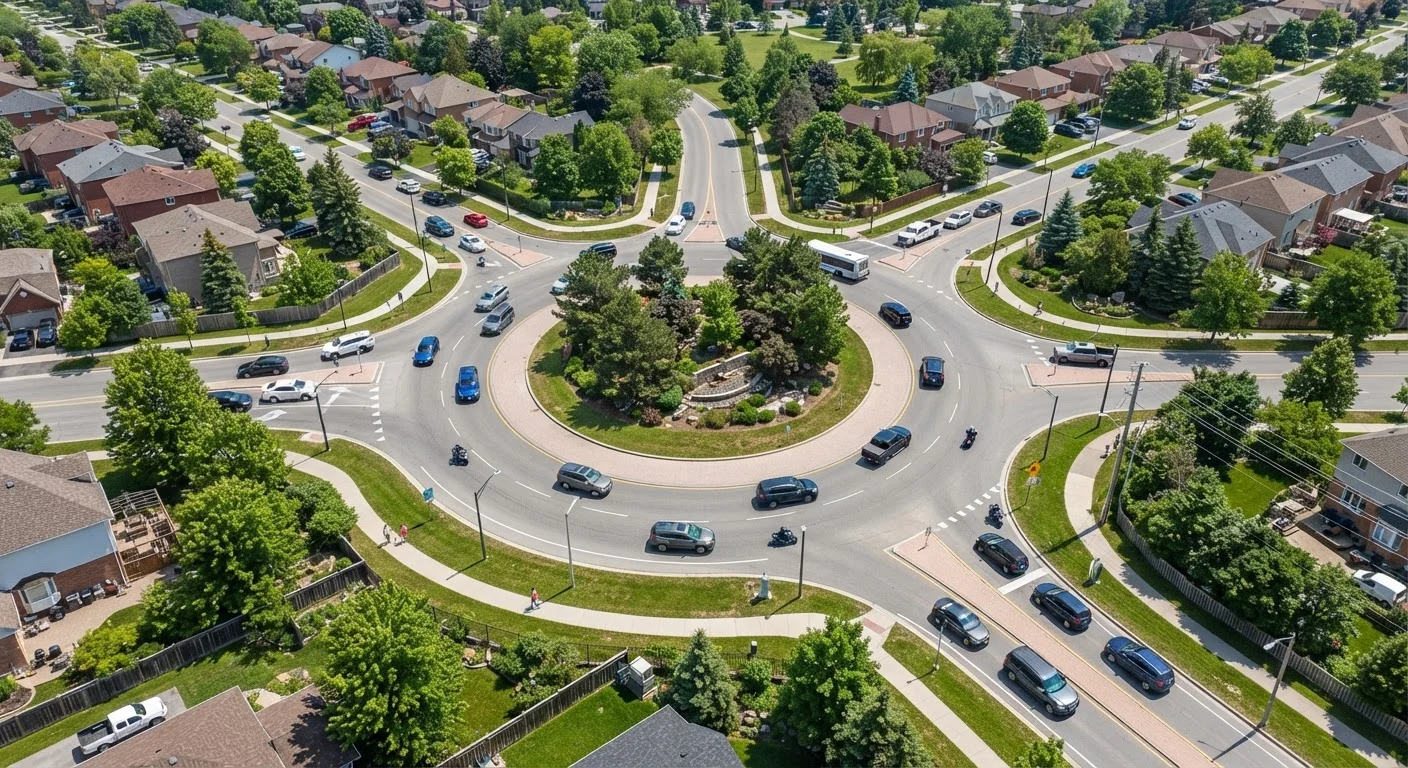
Slow down as you approach — roundabouts typically have advisory speed signs. At the yield line, check for vehicles already circling inside the roundabout. Yield to all traffic in the circle. When there is a safe gap, enter and stay in your lane. Signal right before your intended exit. Yield to pedestrians on the exit crosswalk before leaving the circle.
Navigating a four-way stop
Come to a complete stop behind the stop line. Note the order in which vehicles arrived. The first to arrive goes first. If two vehicles arrive simultaneously, the one on the left yields to the one on the right. If you're turning left and another driver directly across from you is going straight, you must yield to them even if you arrived first.
Navigating an uncontrolled intersection
Treat an uncontrolled intersection — common in rural areas and older neighborhoods — with extra caution. Slow significantly as you approach. Yield to any vehicle already in the intersection. If you arrive at the same time as another vehicle, yield to the vehicle on your right. Check all four directions, including for cyclists and pedestrians, before proceeding at a slow, controlled speed.
Check for pedestrians and cyclists at every type
Regardless of intersection type, always scan for pedestrians and cyclists before accelerating through. In most US states, pedestrians in a crosswalk — even an unmarked one at an intersection — have the right of way. Cyclists may occupy a full lane and should be treated like vehicles at stop-controlled and uncontrolled intersections.
Common Mistakes and How to Avoid Them
Even experienced drivers fall into habits that don't hold up under pressure. Here are the most frequent errors at each intersection type and what to do instead.
Roundabouts
- Stopping inside the circle: Never stop once you're in the roundabout unless traffic ahead forces it. Stopping unexpectedly causes rear-end collisions.
- Failing to signal your exit: Use your right turn signal before your exit lane. Other drivers and pedestrians need that cue.
- Entering too fast: Speed kills in roundabouts. Slow to the posted advisory speed — typically 15–25 mph — before entering.
Four-Way Stops
- Waving others through: Well-intentioned but dangerous. Follow the rules — don't try to improvise courtesy. Another driver may not see your wave and proceed anyway.
- Rolling stops: A rolling stop is not a legal stop. Come to a complete stop before the stop line, not at it.
- Misjudging simultaneous arrivals: If you and another driver arrive at the same moment and you're directly across from each other, both going straight, you may proceed simultaneously. If turning left, yield to oncoming straight-through traffic.
Uncontrolled Intersections
- Assuming you have priority: No sign or signal means no guaranteed right of way. Slow down and be prepared to stop.
- Ignoring pedestrians: Pedestrians in a crosswalk — marked or unmarked — generally have the right of way in most US states. Look before proceeding.
Never "Wave" Another Driver Through
Gesturing for another driver to proceed at a four-way stop or uncontrolled intersection can create a false sense of safety. You may be waving them into the path of a vehicle or cyclist you haven't seen. Follow the right-of-way rules as written — they exist precisely so every driver can predict what others will do.
Maintaining safe following distance approaching any intersection reduces your reaction time buffer — a concept covered in depth in our piece on why following distance matters. The same attentiveness applies in special driving zones — see our guide on what the law expects in school zones and work zones.