
The Numbers Behind the Danger
The first thing most drivers assume is that lighter traffic makes night driving safer. Fewer cars, fewer conflicts — logical enough. But the data tells a very different story.
According to the National Highway Traffic Safety Administration (NHTSA), approximately half of all traffic fatalities in the United States occur during nighttime hours, even though nighttime accounts for a much smaller share of total miles driven. When researchers control for traffic volume and calculate fatal crash rates per mile traveled, driving at night is roughly three times more deadly than driving in daylight.
That gap isn't explained by speed alone. The deadliest conditions after dark involve a combination of factors — most of which have nothing to do with how fast anyone is going. Understanding what actually creates that risk is the first step toward navigating it more safely.
~50%
Of U.S. traffic fatalities occur at night
According to NHTSA, roughly half of all fatal crashes happen during nighttime hours despite significantly lower traffic volumes after dark.
3×
Higher fatal crash rate per mile at night
When adjusted for vehicle miles traveled, nighttime driving carries approximately three times the fatal crash risk of daytime driving, per NHTSA analysis.
160 ft
Typical low-beam headlight range
Standard low-beam headlights illuminate roughly 160 feet ahead — less than the stopping distance needed at 60 mph, creating an inherent visibility gap.
What Darkness Actually Does to Your Vision
Human eyesight is designed for daylight. In low-light conditions, several visual capabilities degrade in ways that directly affect driving performance.
Reduced depth perception. At night, your brain relies more heavily on shadows and contrast to judge distance. Both are harder to read in the dark, making it genuinely more difficult to gauge how far away an object is or how fast it's approaching.
Narrowed peripheral vision. The cells responsible for detecting motion in your peripheral field — called rod cells — perform less reliably in extreme low light. This shrinks your effective field of view at exactly the moment when wide awareness matters most.
The headlight gap. Standard low-beam headlights typically illuminate about 160 feet ahead. At 60 mph, a vehicle needs roughly 200 feet to stop. That means you may be driving faster than your ability to react to something your headlights reveal — a situation sometimes called "overdriving your headlights."
Dirty, misaligned, or aging headlights make this worse. Yellowed headlight lenses can cut light output dramatically. This is one of the simplest and cheapest risks to address.
For more on recognizing hazards before they become emergencies, see our guide to reading the road.
Fatigue and Impairment: The After-Dark Multipliers
Vision alone doesn't explain the full statistical gap between day and night crash rates. Two behavioral factors add significantly to the risk: fatigue and alcohol impairment.
Driver fatigue follows the body's natural circadian rhythm. The most dangerous window — when drowsiness peaks — falls between midnight and 6 a.m. During these hours, reaction time slows, lane-keeping degrades, and drivers are prone to microsleeps, brief involuntary lapses in consciousness that can last several seconds. At highway speeds, a two-second microsleep covers the length of a basketball court. The AAA Foundation for Traffic Safety has found that going without sleep for 20 or more hours produces impairment comparable to a blood alcohol concentration of 0.08% — the legal limit in every U.S. state.
Learn the early warning signs of drowsy driving before your judgment slips.
Alcohol and drug impairment are disproportionately present on nighttime roads. NHTSA data consistently shows that alcohol-involved fatalities are concentrated in late-night and early-morning hours, with the highest rates on weekend nights. Drunk drivers don't announce themselves, which means other drivers bear the burden of compensating for impaired behavior they may not see coming.
Rural Roads and the Compounded Nighttime Risk
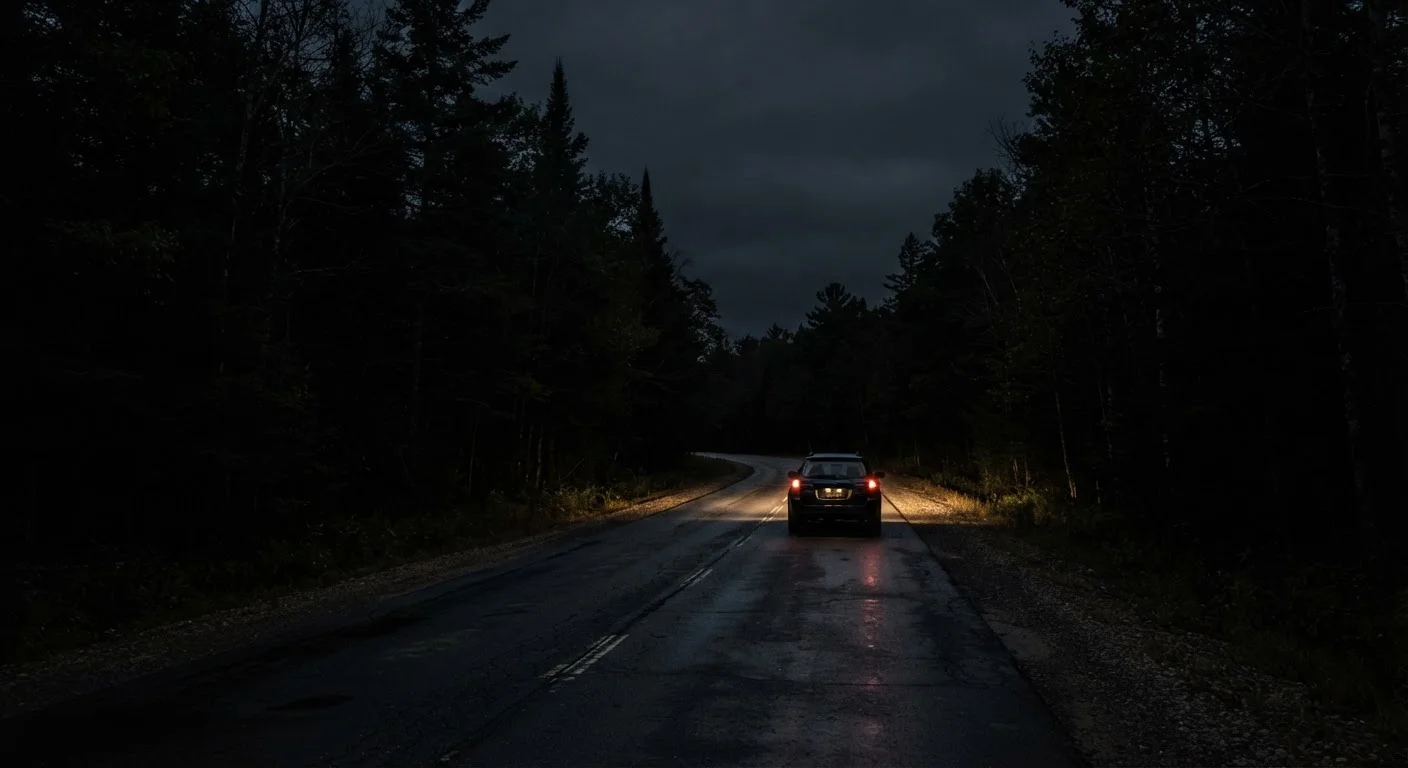
Not all nighttime driving carries equal risk. Rural roads after dark present a compounding set of dangers that urban roads don't. There are no streetlights, speed limits are higher, wildlife crossings are unpredictable, and emergency response times are longer.
NHTSA data shows that rural roads account for a disproportionately large share of fatal crashes, a pattern that intensifies at night. A deer crossing a rural highway, a slower farm vehicle with limited lighting, or a sharp curve with no signage can all become fatal hazards when a driver's sight distance is limited to whatever their headlights can reach.
Urban driving presents its own nighttime challenges — pedestrians wearing dark clothing, cyclists without lights, and complex intersections with reduced visibility — but the absence of ambient light and emergency infrastructure on rural roads elevates the stakes considerably. Understand how urban and rural driving risks differ to better prepare for both.
Practical Adjustments That Actually Help
The factors driving nighttime crash risk are real, but they're not all outside a driver's control. Several practical habits can meaningfully reduce exposure.
- Slow down to match sight distance. If your headlights reveal 160 feet, your speed should allow stopping in that distance. On most roads at night, that means traveling below posted limits, not at them.
- Increase following distance. The standard three-second rule becomes less adequate after dark when reaction time may be slightly slower. Understand how conditions change the following distance math.
- Clean and aim your headlights. Yellowed or misaligned headlights reduce road illumination significantly. Restoration kits for yellowed lenses are inexpensive and widely available.
- Avoid the riskiest hours when possible. If a long drive can be scheduled to avoid midnight-to-6 a.m. travel, that window is worth avoiding.
- Don't dismiss drowsiness. If you feel sleepy, a short rest stop is not a sign of weakness — it's sound judgment. Stimulants like caffeine can temporarily mask fatigue but don't restore the reaction time and decision-making that sleep deprivation degrades.
Night driving will always carry more inherent risk than daytime driving. But many drivers operate after dark under the same habits they use in daylight — same speed, same following distance, same level of attention. Closing that gap between perceived and actual risk is where genuine safety improvement starts.