
Why Standard Driving Habits Fall Short in Severe Weather
Most drivers are reasonably comfortable in everyday conditions — clear roads, good visibility, dry pavement. But severe weather doesn't just make driving harder; it changes the physics of what your car can do. Stopping distances multiply on ice. Your eyes process less information in fog. Wind can push a vehicle sideways in a way that surprises even experienced drivers.
The mistake most people make is treating bad weather like slightly worse normal weather — slowing down a little, driving with more caution — without actually changing their technique. That gap between adjusted instinct and what the conditions actually demand is where crashes happen.
Good preparation starts before you leave. A vehicle with worn tires, cloudy headlights, or streaky wipers is a liability the moment conditions deteriorate. See our seasonal maintenance guide and the pre-trip safety walkthrough for what to check before any drive in uncertain weather.
Driving in Fog: Visibility, Speed, and Lights
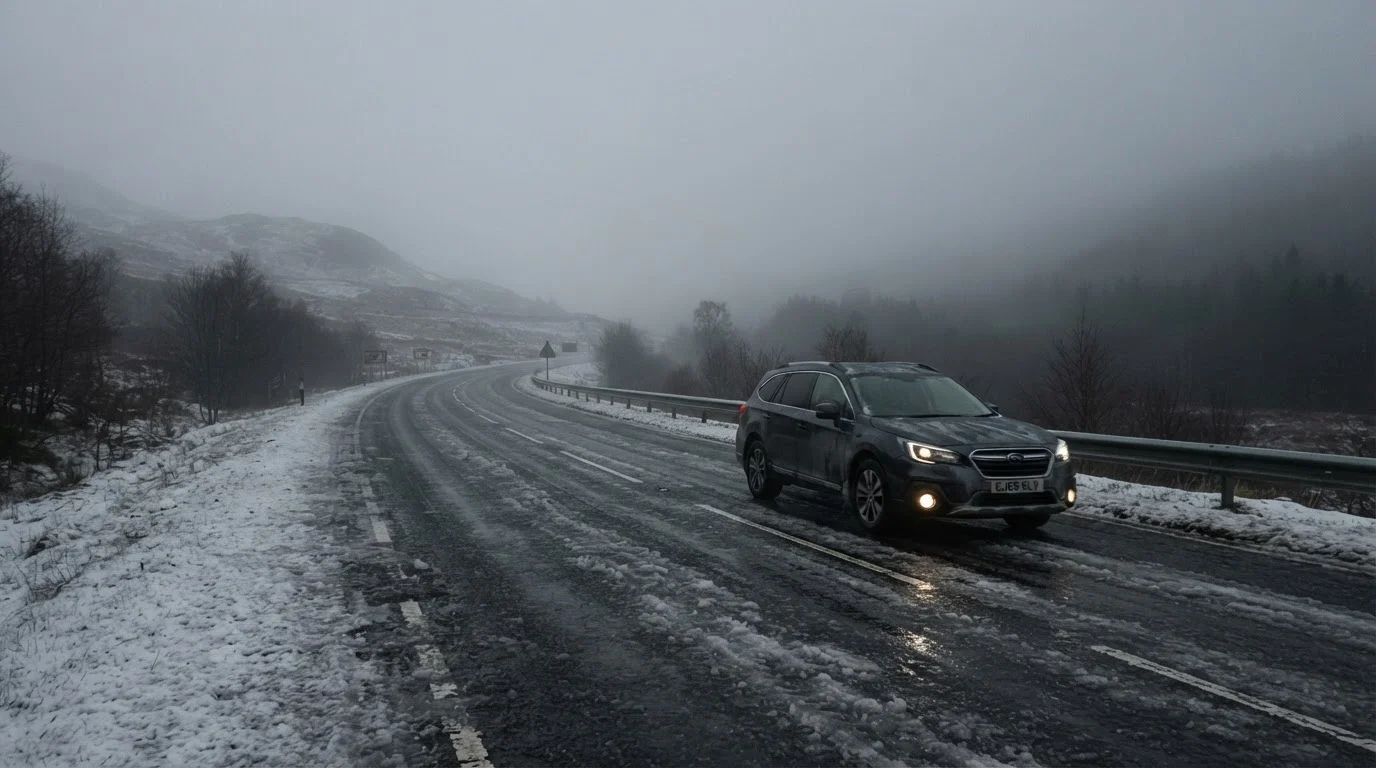
Fog is deceptive. Patches of it can appear instantly, and thick fog can reduce visibility to under 100 feet — far less than the distance needed to stop at highway speeds. The most important adjustment is speed: drive slowly enough that you can stop within the distance you can actually see ahead.
Use low-beam headlights, not high beams. High beams reflect off fog particles and scatter light back at you, reducing visibility further. If your vehicle has dedicated rear fog lights, use them so drivers behind you can gauge distance. Avoid using hazard flashers while moving — in most states, flashing hazards signal a stopped vehicle, which can confuse following drivers.
Increase your following distance substantially — at least double what you'd normally maintain. Fog makes it nearly impossible to judge how quickly a car ahead is slowing. If you hear but cannot see large vehicles nearby, reduce speed further and pull right when safe.
Before entering a known fog zone, check your mirrors and gradually reduce speed so following drivers have time to adjust — don't brake sharply when fog thickens.
Rear-end collisions are disproportionately common in fog because trailing drivers have even less visibility and reaction time than the driver ahead.
On icy roads, use the highest gear that keeps your speed manageable — lower engine RPM reduces wheel spin during acceleration on slick surfaces.
Wheel spin on ice breaks traction instantly; keeping engine output modest through higher gearing helps maintain a steadier, more controlled contact patch.
Also watch for fog-prone locations: low-lying areas, bridges, river crossings, and valley roads where cold air pools. When in doubt, pull off the road at a rest area or safe pull-out — not on the shoulder — and wait for conditions to improve.
Driving on Ice: Traction, Braking, and Control
Ice — whether from freezing rain, black ice, or packed snow — can cut available traction by 80% or more compared to dry pavement. Your most important tool is smoothness. Abrupt steering inputs, hard braking, or sudden acceleration all cause tires to lose their grip and the vehicle to slide.
Accelerate gently from stops, using the lowest gear if you drive a manual. On downhill stretches, slow before the hill rather than braking on it. If your vehicle has ABS (anti-lock brakes, standard on virtually all modern vehicles), apply firm, steady brake pressure in a skid — don't pump the pedal. ABS pulses automatically to prevent wheel lockup.
If you do begin to slide, steer in the direction you want to go and ease off the accelerator gradually. Don't overcorrect — the most common cause of spin-outs is a sharp counter-steer after an initial slide. Also note that bridges and overpasses freeze before road surfaces because cold air circulates underneath them. Treat every bridge cautiously even when nearby roads seem fine.
Black ice — a near-invisible glaze on pavement — typically forms when temperatures are between 25°F and 32°F with moisture present. Shady areas and bridges are especially prone. If your car feels unusually light or unresponsive to steering on what looks like wet road, you may be on black ice. Ease off the accelerator and avoid any sudden movements until you're clear.
Driving in High Winds and Crosswinds
Strong winds — particularly crosswinds — can push a vehicle sideways across a lane unexpectedly. The effect is most pronounced on high-profile vehicles like SUVs, trucks, and vans, and becomes more severe at highway speeds. Even sedan drivers can be caught off guard near highway gaps, overpasses, open fields, or exits from tree-lined corridors where wind suddenly has nothing blocking it.
Never Stop on the Highway Shoulder in Fog
Parking on a highway shoulder in heavy fog is one of the most dangerous things a driver can do. Approaching vehicles may mistake your taillights for moving traffic and follow your lane — directly into your parked car. Use an exit ramp, rest area, or well-lit gas station whenever possible.
Keep both hands on the wheel in a firm but relaxed grip. Tensing up tends to produce overcorrections. Reduce your speed — wind affects vehicle stability more at higher speeds — and increase lateral space from other vehicles, especially large trucks. Trucks can act as a windbreak, but passing or being passed by one can expose your vehicle to a sudden gust.
Watch for environmental cues: swaying trees, blowing debris, dust or smoke moving horizontally. These signal strong, shifting conditions. If your vehicle feels like it's being pushed or you have to actively fight the wheel to stay in your lane, conditions may be beyond safe driving thresholds. High-sided vehicles — particularly rental trucks or trailers — may need to be pulled over if sustained winds exceed roughly 45–50 mph. Check local road condition reports before driving in high-wind events.
Wind also interacts with rain and reduced visibility. For how rain alone affects vehicle handling, see our article on why cars drift in rain even at legal speeds.
When to Pull Over or Not Drive at All
Knowing your limits — and your vehicle's limits — is a genuine driving skill. If visibility drops so low you can't see lane markings, if ice has made steering feel disconnected from the road, or if winds are forcing you to fight for your lane, the right decision may be to stop driving entirely.
If you need to pull over in fog or a storm, use the exit ramp or a designated rest area whenever possible. If you must stop on the shoulder, pull as far right as possible, turn on your hazard lights, and — if it's safe to exit the vehicle — move away from the car and the roadway. Remaining in a stopped vehicle on a highway shoulder carries real risk.
Checking weather and road condition apps before departure gives you the information to make the no-drive decision before you're already out there. State DOT websites and apps like 511 provide real-time road condition reports for most US highways. When severe weather warnings are in effect, delaying travel is not a failure of planning — it's good judgment.
Conditions that fatigue or stress a driver also impair reaction time in ways that compound weather risks. Our article on recognizing drowsy driving signs covers the physical warning signals worth knowing before any difficult drive.
Sharpening your general hazard awareness — how to read the road before a problem becomes an emergency — is covered in Reading the Road: How to Spot Hazards Before They Become Emergencies.