
The Physics Behind the Drift
Your tires stay on the road through friction — the direct contact between rubber and pavement. When water gets between those two surfaces, friction drops dramatically. The tread on your tires is specifically designed to evacuate water from the contact patch, channeling it out through grooves so that rubber can still touch road.
The problem arises when water accumulates faster than the tread can move it. Speed is a major factor: the faster you're going, the less time each section of tire has to push water aside before it rolls forward. Beyond a certain speed — and it varies with conditions — a wedge of water forms at the front of the contact patch and the tire lifts. The car is now floating.
At that moment, turning the wheel has almost no effect. The tires are not connected to the road surface, so there's nothing for the steering to work against. Braking is similarly useless — you can't stop a vehicle that has no ground contact to create stopping friction. This is why hydroplaning is so disorienting: the car feels normal right up until it suddenly doesn't respond at all.
~35 mph
Speed at which hydroplaning can begin on worn tires
Research from the Federal Highway Administration and tire safety literature indicates that significantly worn tires can begin to hydroplane at speeds well below highway minimums.
70%
Of weather-related crash fatalities linked to wet pavement
According to U.S. Department of Transportation data, the majority of weather-related fatal crashes occur on wet roads rather than in snow or ice conditions.
2/32"
Minimum legal tread depth in most U.S. states
The National Highway Traffic Safety Administration notes that tires at this threshold offer significantly reduced wet-road grip compared to tires with 4/32" or more of remaining tread.
Why Legal Speed Isn't Always Safe Speed
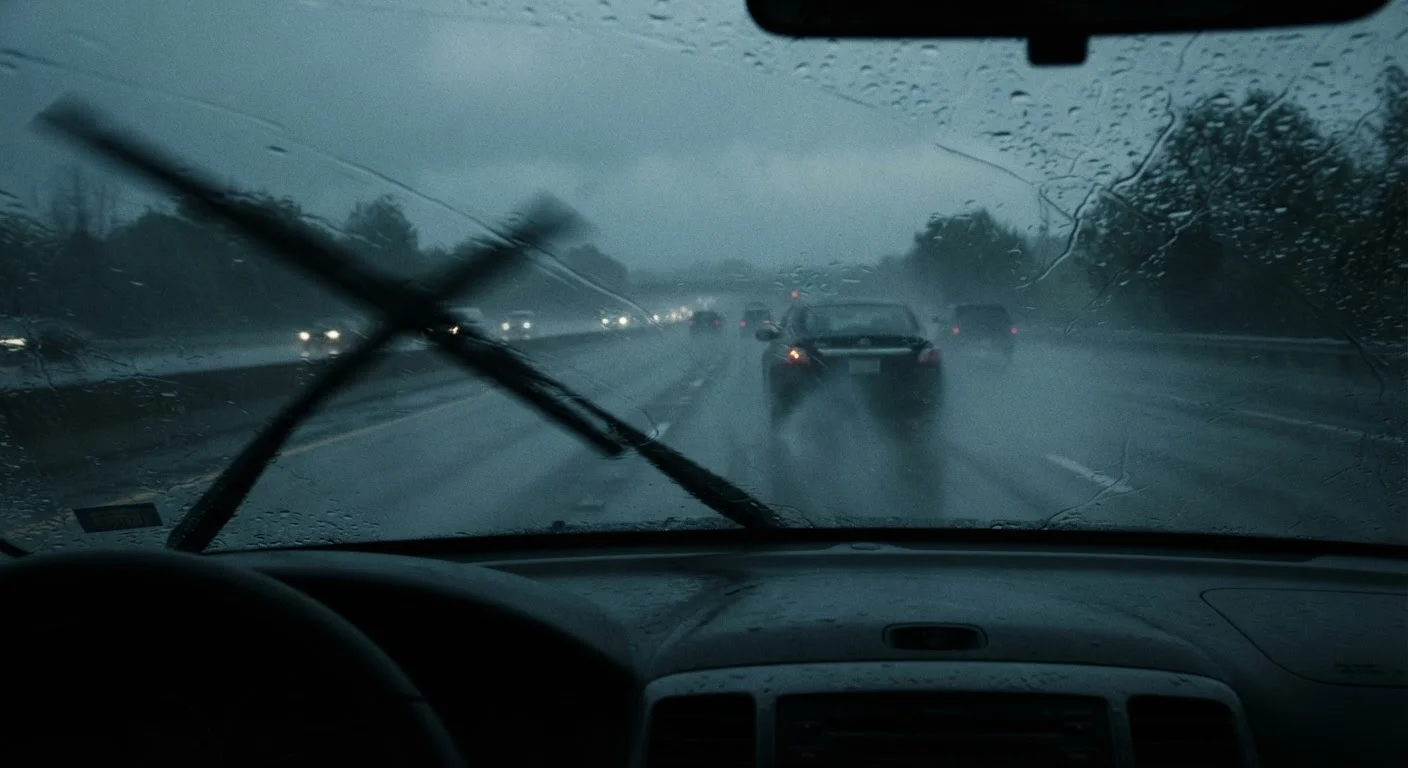
Posted speed limits are set for ideal conditions — dry pavement, good visibility, normal traffic. They are not recalibrated for rain. That means a 55 mph highway limit was not calculated with three inches of standing water in the right lane in mind.
Studies and real-world crash data consistently show that wet-road crashes spike disproportionately relative to how much rain actually falls. A light rain after a dry spell can be especially deceptive, because motor oil and road grime mix with the first moisture to create a slicker-than-expected surface before heavy rain eventually washes it away.
The legal speed and the safe speed in rain are two different numbers. Understanding what your speedometer really tells you about stopping distance helps explain why even small speed reductions make a meaningful difference in wet conditions. Slowing to 45 mph on a rain-soaked freeway isn't timidity — it's physics working in your favor.
What Raises Your Risk (and What Lowers It)
Several factors that are entirely within a driver's control determine how vulnerable a vehicle is to hydroplaning:
- Tire tread depth: The single biggest variable. Bald or worn tires cannot channel water effectively. Checking tread with a quarter — if Washington's head is fully visible, you're at or near replacement time — is a fast, free test.
- Tire pressure: Underinflated tires deform in ways that trap water. Tire pressure affects handling in rain in ways most drivers underestimate, including raising the speed at which hydroplaning begins.
- Speed: Every mph reduction lowers the water-wedge risk. Slowing down before you reach deep water — not during a skid — is the effective window.
- Road positioning: Water pools in wheel ruts, low spots, and near lane markings. Where possible, following a path slightly outside the rut left by the vehicle ahead can reduce water depth under your tires.
- Cruise control: Disengaging it in wet conditions removes the risk of automatic throttle application during a hydroplane event.
For a broader view of how to adapt your driving to demanding conditions, see how the same principles apply to fog, ice, and high winds.
What to Do When It Happens
Recognizing a hydroplane event is the first challenge. The steering may suddenly feel vague or light. The rear of the car might begin to drift. Engine RPMs can rise if driven wheels lose road contact. These are the signals.
The correct response runs counter to instinct for many drivers:
- Do not brake hard. Locking the wheels while floating makes directional control worse, not better.
- Ease off the accelerator. Reducing power lets the car slow naturally, giving tires a chance to re-establish contact.
- Hold the wheel steady. Keep it aimed where you want to go. Avoid sharp corrections.
- Wait. As speed drops, the tires will usually find the road again within a short distance.
Defensive driving habits — including scanning ahead for standing water and maintaining following distance — give you the time and space to avoid the situation entirely, which is always preferable to managing it after the fact.
Understanding these dynamics doesn't require an engineering background. It just requires knowing that the laws of physics apply on wet roads regardless of what the speed limit sign says.