
The Contact Patch: The Physics Behind the Problem
Your tire only touches the road through a small area called the contact patch — roughly the size of a human hand for a typical passenger car tire. Everything your car does — accelerate, brake, turn — happens through that patch. Tire pressure determines its size and shape.
At the correct PSI, the contact patch is broad and flat, distributing load evenly across the tread. Drop below the recommended pressure and the center of the tread lifts slightly, pushing load to the outer edges. The tire "shoulders" do the work they weren't designed to do. Go above the recommended pressure and the opposite happens: the center bows outward, reducing overall contact area and concentrating load in a narrow strip down the middle.
Neither scenario gives you the grip your tires were engineered to provide.
25%
Under-inflation threshold before TPMS warns
According to NHTSA guidelines, most TPMS systems are only required to alert drivers when pressure falls 25% below the vehicle manufacturer's recommended level.
1–2 PSI
Typical monthly pressure loss in a passenger tire
Tires naturally lose pressure through normal permeation of air through the rubber, independent of any puncture or valve issue.
~1 PSI
Pressure change per 10°F temperature shift
The Tire Industry Association notes that pressure drops roughly 1 PSI for every 10-degree Fahrenheit drop in ambient temperature.
What Under-Inflation Does to Your Car
Most drivers are more likely to run low than high — tires naturally lose about 1–2 PSI per month, and the effect builds gradually enough that it rarely feels dramatic until something goes wrong.
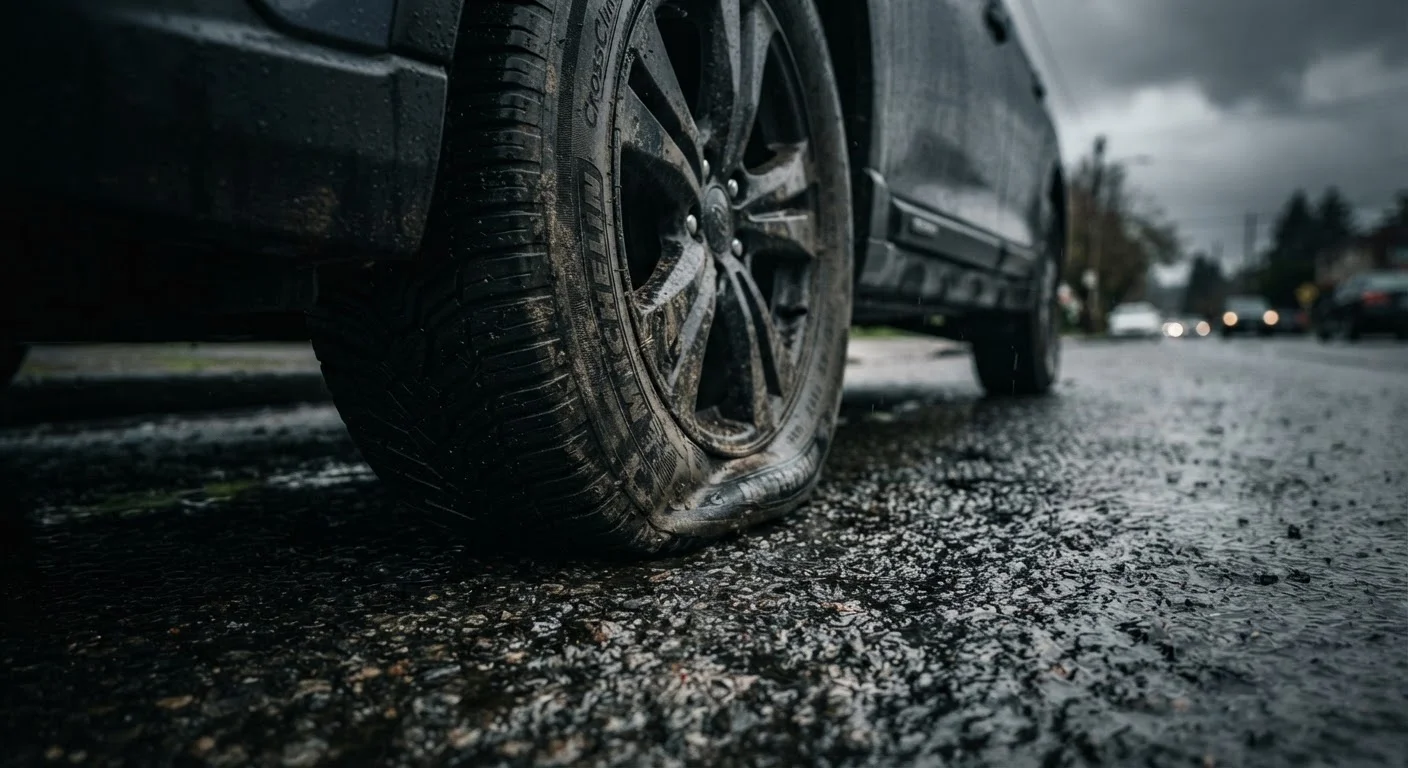
With under-inflated tires, cornering feels sluggish and the car may "push" — meaning it resists turning as sharply as you'd expect. Braking distances increase because the deformed contact patch generates uneven friction forces. The tire also runs hotter than normal, which accelerates tread wear and, at sustained highway speeds, raises the risk of a blowout — a sudden, catastrophic loss of pressure. NHTSA data has consistently linked significantly under-inflated tires to increased crash and blowout risk.
For wet-road driving, the handling effect is especially significant. Hydroplaning risk rises when tires can't properly channel water away from the contact patch — and a softened, deformed tread makes that drainage worse.
What Over-Inflation Does to Your Car
Over-inflation gets less attention, partly because it doesn't feel as obviously wrong. The car may actually feel more responsive at first — tighter steering, less rolling resistance — but the trade-off is a smaller, stiffer contact patch with significantly less grip.
In corners, an over-inflated tire breaks loose more suddenly and with less warning than a properly inflated one. The car's handling becomes "twitchy" — small steering inputs produce larger responses, and the transition from grip to skid happens faster. On rough or uneven road surfaces, the rigid tire transmits more shock to the suspension and rim, increasing wear and the risk of impact damage.
Over-inflated tires also wear the center of the tread faster than the edges — a telltale pattern that's worth knowing. Uneven tread wear is one of the clearest indicators that pressure has been off for a while.
Checking Pressure the Right Way
The correct pressure for your vehicle is on the driver's door jamb sticker — not the number printed on the tire sidewall, which is the tire's maximum rated pressure. Many drivers check that sidewall number and assume it's the target. It isn't.
Check pressure when tires are cold: before driving or after the car has sat for at least three hours. Heat from driving causes air to expand, pushing readings higher and masking under-inflation. A basic, quality dial or digital gauge is accurate enough for this task and costs very little.
Don't rely solely on your car's Tire Pressure Monitoring System (TPMS). That dashboard warning light typically doesn't activate until pressure is 25% or more below the recommended level — already a meaningful safety deficit. Monthly manual checks catch problems the TPMS won't flag in time.
Proper pressure also works hand-in-hand with other tire maintenance. Services like rotation, balancing, and alignment all depend on consistent, correct inflation to deliver the handling and wear life they're designed to provide.