
Three Services, Three Different Jobs
Ask a service writer to explain the difference between rotation, balancing, and alignment, and you'll likely get a quick answer — but most drivers leave without fully understanding what each one actually does. That's a problem, because they address completely different issues, and skipping one doesn't mean the others will cover for it.
The short version: rotation is about where your tires sit on the car, balancing is about how evenly your wheel-and-tire assembly spins, and alignment is about the angle at which your wheels meet the road. Each service has its own interval, its own warning signs, and its own consequences if neglected. For a broader view of where these tasks fit into your overall maintenance schedule, see the Year-Round Car Care roadmap.
5,000–7,500 mi
Typical tire rotation interval
Most vehicle manufacturers recommend rotation within this mileage range; consult your owner's manual for your specific vehicle's guidance.
~$20–$50
Typical cost of a tire rotation
Costs vary by region and shop type; some retailers include rotation free with tire purchases.
Up to 20%
Potential tire life reduction from misalignment
Industry estimates suggest significant misalignment can reduce tire lifespan noticeably, though the exact figure depends on severity and driving conditions.
Tire Rotation: Spreading the Wear Evenly
Your tires don't wear at the same rate. Front tires take on steering forces and tend to wear faster — especially on front-wheel-drive vehicles where they also handle acceleration. Left and right tires wear differently depending on road crown and driving patterns. Rotation swaps tires between positions — front to rear, side to side, or a diagonal pattern — so no single tire bears a disproportionate load over time.
The practical benefit is straightforward: a set of evenly worn tires lasts longer than one where two tires are worn out and two still have tread life left. Most manufacturers recommend rotating every 5,000 to 7,500 miles. Your owner's manual — which most drivers underuse — has the exact interval for your vehicle. For more on reading those schedules, see how to use your owner's manual.
One thing rotation doesn't do: fix a wear problem that's already there. If your tires are wearing unevenly before a rotation, that's a signal something else — pressure, alignment, or suspension — needs attention first.
Wheel Balancing: Eliminating Vibration
Even a brand-new tire isn't perfectly uniform in weight. Small variations in the rubber and the wheel itself mean the assembly can be slightly heavier on one side. When that imbalance spins at highway speed, you feel it as a vibration — usually in the steering wheel or through the seat — that often appears in a certain speed range and can fade above or below it.
Balancing is done by mounting the wheel on a spin-balancing machine, identifying where the heavy spots are, and attaching small weights to the wheel rim to compensate. It's typically done whenever new tires are installed and whenever vibration appears. It's also a good idea after hitting a significant pothole, since that kind of impact can knock a wheel weight loose.
Unaddressed imbalance wears down tires faster and puts unnecessary stress on wheel bearings and suspension components — so what starts as a minor annoyance can compound into a larger repair bill.
Wheel Alignment: Getting the Angles Right
Alignment has nothing to do with spinning — it's about geometry. The wheels on your car are set at precise angles relative to each other and to the road. When those angles drift out of spec, tires no longer roll cleanly; instead, they scrub sideways slightly with every mile, wearing unevenly and making the car harder to control.
The most common signs of misalignment are the car pulling to one side, the steering wheel sitting off-center when driving straight, or tread wear that's heavy on one edge of a tire. A significant impact — a pothole, a curb strike — can knock alignment off quickly. Normal wear on suspension components can shift it gradually over time.
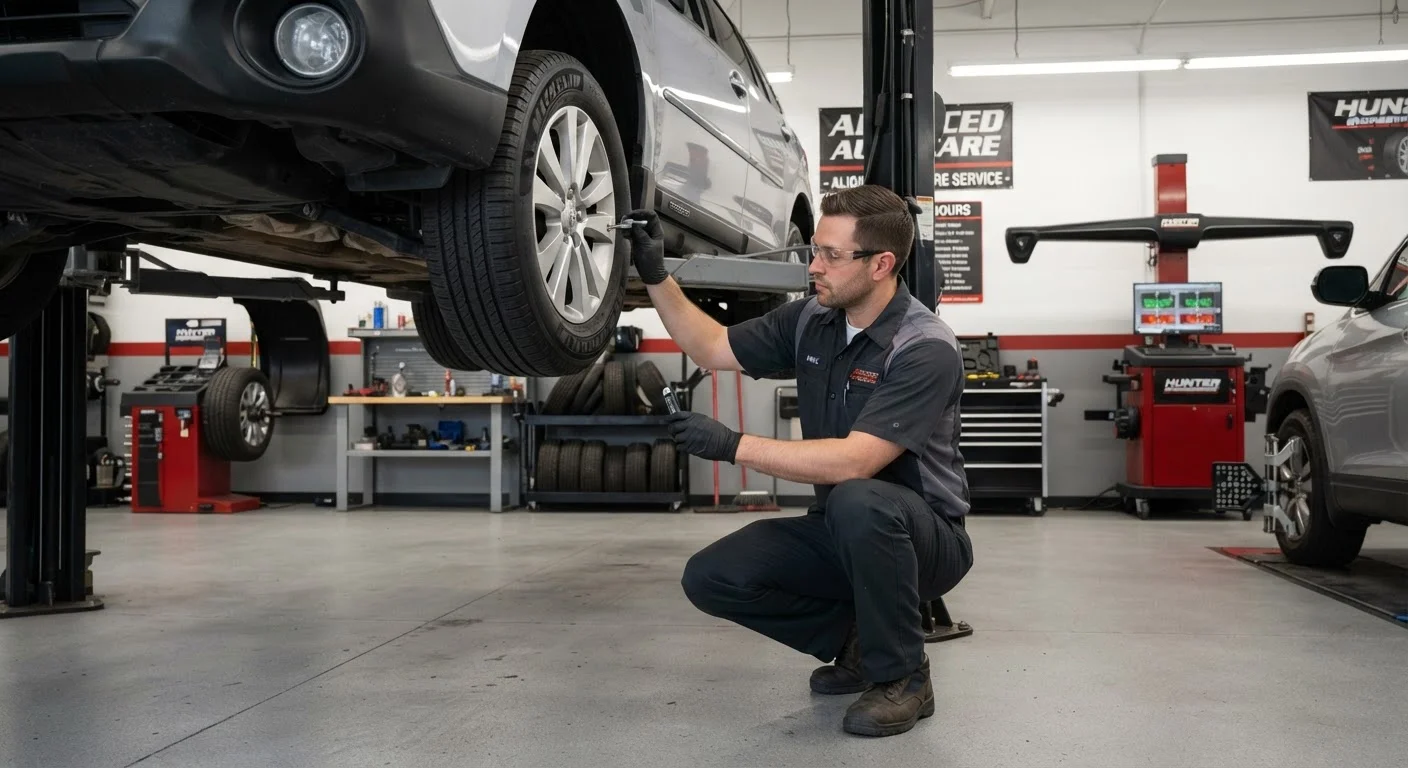
Alignment is measured and corrected using a specialized rack that reads camber (the inward or outward tilt of the tire), toe (whether the fronts of the tires point inward or outward), and caster (the angle of the steering axis). This is not a job that can be done reliably at home — it requires dedicated equipment and a trained technician. For guidance on choosing where to have this done, the dealership vs. independent mechanic comparison is worth reading.
If you're seeing uneven tread patterns already, what uneven tire wear actually points to can help you diagnose the underlying cause before it gets worse.
How These Services Work Together
None of these services replaces the others, but they're most effective when done as part of a consistent maintenance routine. Rotating tires on schedule reduces uneven wear. Balancing ensures each rotation starts with properly tuned wheels. Alignment keeps the geometry correct so rotation and balancing have their full effect.
A useful habit: have alignment checked whenever you install new tires or after any significant road impact. Balance when vibration appears or with new tire installations. Rotate on the mileage schedule your manufacturer recommends. That cadence, followed consistently, is what keeps tire costs predictable and handling reliable.
Tire pressure also plays a role in how evenly your tires wear and how your car handles — see what happens to handling when tire pressure is off for more on that piece of the puzzle.