
Why Format Matters as Much as the Art Itself
Most people choose wall art by subject first — a landscape they love, a print that matches their palette — and format second. That's worth rethinking. The format determines how a piece sits in a room: its visual weight, how it interacts with light, and whether it reads as decorative accent or architectural anchor.
Before picking a format, consider three things: the size of your wall, your room's dominant light source (see how lighting affects color and mood), and the design style you're working within. If you're still pinning down your overall aesthetic, decoding your interior design style is a useful starting point.
Framed Prints: Flexible, Detailed, and Easy to Change
Framed prints — whether photographic, illustrated, or fine-art reproductions — are the most adaptable format available. The frame itself carries significant design weight: a thin metal frame reads modern and minimal; a wide ornate frame shifts the same image toward traditional. Paper-based prints reproduce color and fine detail with exceptional accuracy, making them well-suited for photography and illustrations where subtlety matters.
The main limitation is glass glare. In rooms with strong directional light, a print behind standard glass can become a mirror in the wrong sense. Anti-reflective glass addresses this but adds cost. Framed prints also tend to read smaller than their physical dimensions suggest, since the frame creates a visual border that contains rather than expands.
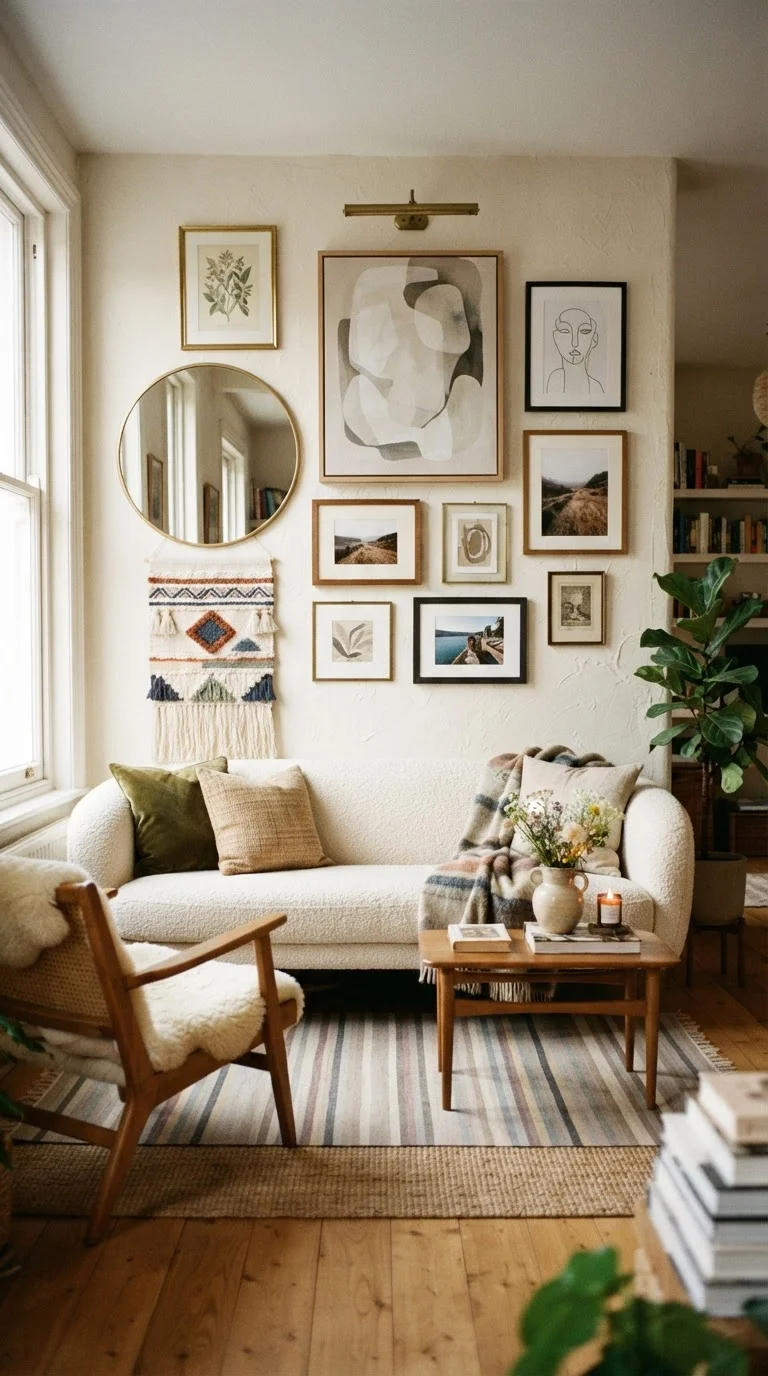
For anyone building a multi-piece arrangement, framed prints are the natural building block. Our guide to arranging a gallery wall without the guesswork walks through spacing, layout, and hanging strategy in practical detail.
Canvas: Presence, Texture, and No Glass Required
Canvas prints — ink applied directly to stretched canvas — remove the glass barrier entirely. The result is a matte, slightly textured surface that absorbs rather than reflects light. This makes canvas particularly well-suited to rooms with multiple windows or overhead lighting where glare is a recurring problem.
Canvas also tends to read larger than an equivalent-sized framed print because there's no frame drawing the eye inward. A single large-format canvas can anchor an entire wall without additional pieces — effective in open-plan living areas or above a sofa. The trade-off is that canvas is less forgiving of detailed, small-scale imagery; fine lines and subtle gradients show less clearly on a textured surface than on paper behind glass.
| Framed Prints | Canvas | Tapestries | Mirrors | |
|---|---|---|---|---|
| Visual weight | Medium — frame contains the image | High — expands to fill the wall | Medium-low — soft and receding | Variable — frame style drives weight |
| Glare from light | Common with standard glass | None — matte surface | None — fabric surface | Intentional reflection |
| Detail reproduction | Excellent — paper is precise | Good — texture softens fine lines | Limited — bold imagery works best | Not applicable |
| Best wall size | Any — scales by quantity | Medium to large walls | Medium walls and above | Any — especially small spaces |
| Renter-friendliness | Good with lightweight hangers | Moderate — heavier pieces | Excellent — rod or clip hung | Moderate — weight varies |
| Acoustic effect | None | Minimal | Absorbs sound noticeably | None |
| Perceived room size | Neutral | Neutral to slightly smaller | Neutral | Expands perceived space |
Tapestries: Warmth, Texture, and Acoustic Benefit
Woven tapestries occupy a different category entirely. They're fabric hung on a wall, which means they contribute physical texture that no print or canvas can replicate. In rooms with hard floors, bare walls, and minimal soft furnishings, a tapestry absorbs sound and reduces echo in a measurable way — a practical benefit that purely visual formats don't offer.
Tapestries work particularly well in bedrooms, where the softness of the format complements textiles already present. They're also genuinely renter-friendly: most hang from a rod or clips with minimal wall damage. The visual trade-off is reduced image precision — detailed photographic content doesn't translate well to woven fabric, so tapestries favor bold patterns, geometric designs, and graphic imagery.
For bedroom applications specifically, building a bedroom space that supports rest explores how textiles and wall treatments work together.
Mirrors: Light, Depth, and Functional Art
A mirror is the only wall art format that actively changes the perceived dimensions of a room. By reflecting light and duplicating visual depth, a well-placed mirror can make a narrow hallway feel wider, a dark room feel brighter, or a low ceiling appear higher. This makes mirrors uniquely functional among decorative wall options.
Frame style matters as much with mirrors as with prints — an arched rattan frame reads bohemian; a frameless beveled edge reads contemporary; an ornate gilded frame skews traditional or maximalist. Placement is equally important: a mirror that reflects a cluttered corner amplifies the clutter. Positioned to reflect a window or a visually pleasing section of the room, it doubles the effect of your best design decisions.
Mirrors also pair well with accent wall strategies — for a look at when a strong focal wall succeeds and when it backfires, see our honest take on accent walls.
How to Choose Based on Your Space
Use the comparison table above as a starting framework, then layer in these practical filters:
- Small rooms: Mirrors and single large-format canvases avoid the visual clutter that multiple framed prints can create in a tight space.
- Bright, light-filled rooms: Canvas and tapestries handle strong light without glare; glass-fronted prints may need anti-reflective treatment.
- Rental spaces: Tapestries (rod-hung) and lightweight prints with adhesive hangers minimize wall damage.
- Maximalist or layered aesthetics: Tapestries mixed with framed prints create rich, collected-looking walls; mirrors add dimension without visual noise.
- Minimalist spaces: A single large canvas or a statement mirror typically reads cleaner than a cluster of smaller framed pieces.