

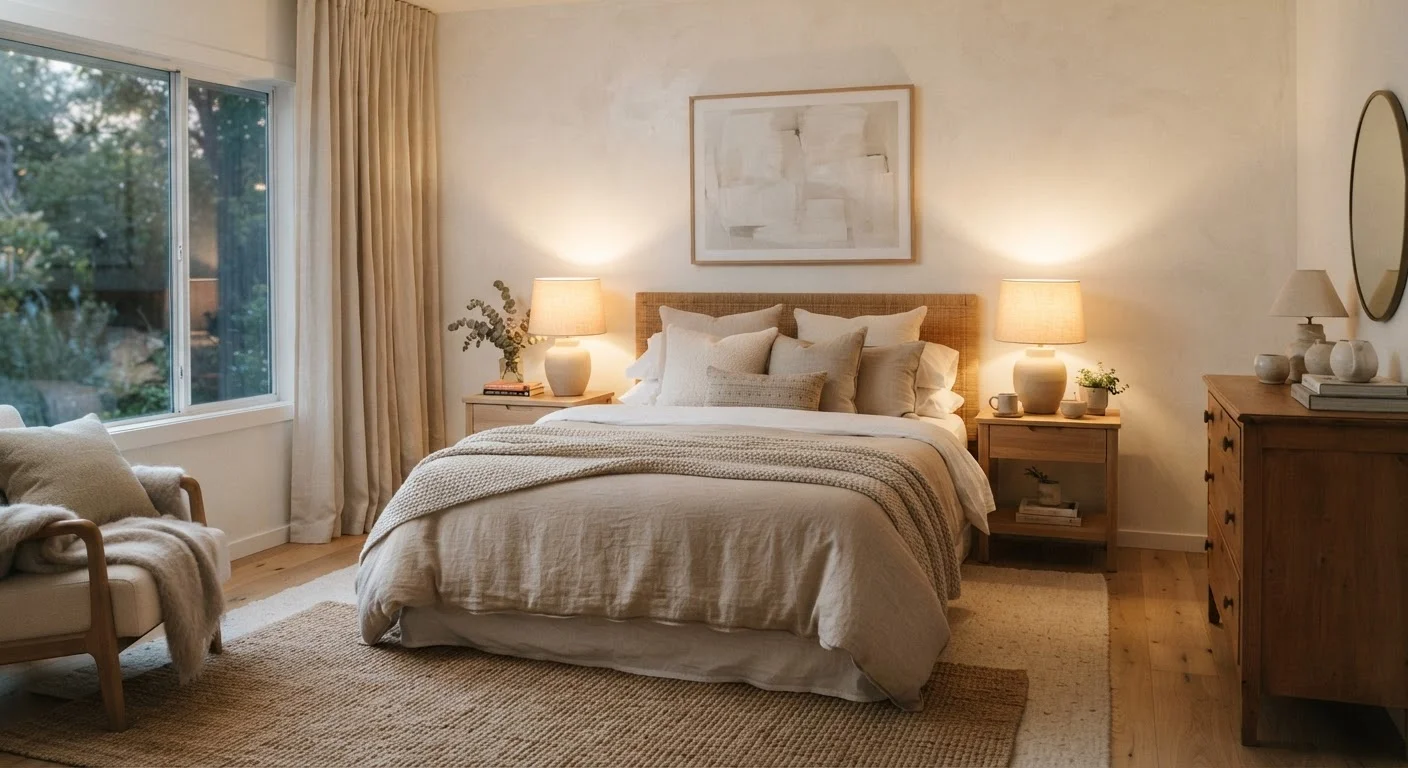
Start With the Bed: Your Anchor Piece
Every decision in a bedroom radiates outward from the bed. Its size, position, and how it's dressed sets the visual tone for the entire room. Before purchasing side tables, lamps, or art, establish what your bed will look like — both the frame and the bedding layered on top.
For the frame, consider scale relative to your room. A platform bed with a low profile can make ceilings feel taller. An upholstered headboard adds softness and acts as built-in wall décor. If your room is on the smaller side, a bed with built-in storage underneath solves two problems at once.
Bedding deserves real thought. A fitted sheet, a top sheet or duvet, two or three pillow combinations, and a throw at the foot of the bed create the layered, hotel-like look that most people aim for. Stick to a palette of two or three complementary tones — neutral foundations with one accent color give you flexibility to update with seasons. For a deeper look at how to layer soft furnishings effectively, see layering principles that make rooms feel pulled together.
When layering bedding, treat the duvet or comforter as your main color statement, then pull one color from it for pillowcases and a contrasting tone for your throw. This creates cohesion without requiring everything to match exactly.
Color repetition across textiles creates visual continuity that reads as intentional design — a principle used consistently in interior styling.
Before committing to a wall color, tape a large sample swatch (at least 12x12 inches) and observe it at three different times of day — morning, afternoon, and in the evening with your artificial lights on. Colors shift dramatically depending on light source.
Paint color is perceived differently under daylight versus incandescent or LED light, and small chips on a store card almost never replicate what a full wall will look like.
Layout and Flow: How Furniture Placement Shapes the Room
Good bedroom layout is about clear paths and a sense of calm — not fitting in the maximum number of pieces. The bed typically looks strongest centered on the longest wall, not adjacent to a window or door if possible. This placement creates symmetry and makes the room feel intentional.
Leave at least 24–30 inches of walkable clearance on each side of the bed that you regularly access. This isn't just comfort — it's safety. Nightstands don't have to match, but they should be close in height to the mattress top so lamps are at a useful level when you're reading.
Avoid crowding additional seating or a desk into a small bedroom if it disrupts flow. A single armchair in a corner can work beautifully; forcing in a full desk setup typically makes the space feel like an office, not a retreat. If a desk is non-negotiable, position it facing the wall rather than the bed — a subtle cue to your brain that separates work mode from sleep mode.
The lessons from decorating compact rooms without cramping them apply directly here: furniture floating away from walls sometimes makes a tight room feel more spacious, not less.
Lighting for Rest: Layers That Work Around the Clock
Overhead lighting alone — especially a single ceiling fixture in the center of the room — tends to produce flat, harsh illumination that works against the relaxed atmosphere a bedroom needs. A layered lighting approach uses three types together: ambient (general fill light), task (reading or grooming light), and accent (decorative, atmospheric glow).
Dimmable overhead lighting or a ceiling fan with a dimmable kit handles ambient needs. Bedside lamps with warm-toned bulbs (look for color temperatures around 2700–3000K) provide task light without the blue-spectrum disruption associated with cooler, brighter bulbs at night. A small lamp on a dresser or a string of warm lights behind or around the headboard adds an accent layer that makes the room feel finished.
Where possible, use smart bulbs or plug-in dimmer switches so you can adjust intensity as the evening winds down. This single change — dimming lights an hour before bed — is one of the most-cited sleep hygiene recommendations from sleep researchers. For a full breakdown of how light quality affects perception and mood in a room, see our guide on natural and artificial light in interior design.
Color, Texture, and Textiles: Setting the Mood
Wall color is often the first instinct when decorating, but it's actually one of the last things to decide. Textiles — bedding, curtains, rugs, and throw pillows — introduce color, pattern, and warmth far more economically and reversibly than paint.
That said, bedroom wall color does matter. Cooler, muted tones (soft blues, greens, warm grays, and clay-adjacent neutrals) are consistently associated with a calmer environment. This doesn't mean your bedroom has to be beige — a deep moody green or a dusty terracotta can feel just as restful when the saturation is kept low and the lighting is warm.
A rug anchors the space and adds acoustic softness — especially valuable in rooms with hard floors. Position it so at least the front two-thirds of the bed sit on the rug, extending 18–24 inches past either side of the bed. Curtains hung close to the ceiling and wide past the window frame make windows appear larger and ceilings taller. Blackout liners add function without sacrificing style. For a detailed breakdown of textile choices and how to layer them, visit textile choices that transform a room.
Personal Touches That Keep the Space Feeling Like Yours
A bedroom without personality can feel like a hotel room — pleasant, but hollow. The goal is curation rather than display. Choose items that genuinely mean something to you, and give each one enough space to be noticed.
A gallery wall works well above a dresser or on a wall that doesn't compete with the bed — keep frames in one or two finish tones for cohesion. A single piece of art above the headboard can anchor the whole room if it's appropriately scaled (aim for roughly two-thirds the width of the bed or headboard).
Plants bring life and texture without clutter. Low-maintenance varieties suited to lower-light conditions — pothos, snake plants, or peace lilies — work well in bedrooms. For guidance on matching plants to your room's specific conditions, see houseplants as décor by room condition.
Books, candles, a small tray on a nightstand — these functional-decorative items signal lived-in warmth. Avoid displaying everything you own. Rotate items seasonally so the room continues to feel fresh.
Storage as Décor: Reducing Visual Clutter Intentionally
Clutter in the bedroom — visible piles, overloaded surfaces, doors that won't close — directly competes with the restful environment you're trying to create. Research into sleep environments consistently highlights visual calm as a meaningful factor in wind-down and sleep quality.
Built-in or closet storage is ideal, but not always available. A dresser with a clean top surface doubles as a display area when you limit what sits on it. Baskets tucked under benches or inside open shelving contain things without hiding them entirely. Hooks on the back of a door handle robes and bags without consuming floor space.
For larger-scope bedroom upgrades that involve built-ins or structural changes, understand what's involved before starting — our overview of home improvement projects covers how to evaluate scope, permits, and when to bring in a licensed professional.
Ultimately, the bedroom that works best is the one you can maintain. Décor that's beautiful but impractical becomes clutter over time. Choose storage solutions that match how you actually live, not just how the room looks on day one.