
Why Small Living Rooms Feel Cramped — and What's Actually Causing It
The cramped feeling in a small living room rarely comes from the room's dimensions alone. More often, it's the result of a few compounding decisions: furniture that's too large for the footprint, too many competing visual elements, inadequate lighting, and an underused vertical dimension. Understanding these causes makes the fixes straightforward rather than overwhelming.
One of the most persistent misconceptions is that small rooms demand small furniture across the board. In reality, one anchor piece — a properly scaled sofa, for example — gives the room structure. Surrounding it with a collection of tiny, mismatched pieces creates visual busyness that actually makes a room feel more congested. You can dig into more of these common assumptions at The Myths People Believe About Small-Space Decorating.
The goal isn't to make the room look bigger by tricking the eye with every possible trick simultaneously. It's to make thoughtful decisions in each category — layout, color, light, storage, and decor — so the room feels intentional and comfortable to live in every day.
Don't Block Natural Light Sources
Heavy drapes or oversized furniture placed in front of windows dramatically shrinks the perceived size of a room. Keep window areas as clear as possible and opt for sheer or light-filtering window treatments. Natural light is the single most effective tool for making a small room feel larger.
What You'll Need Before You Start
Before rearranging furniture or painting walls, take stock of what you're working with. Gather your tools and clarify your room's fixed constraints.
What you will need
Tape measure
Measure furniture dimensions and room footprint before purchasing or repositioning anything.
Graph paper or free room-planning app
Sketch a to-scale floor plan so you can test furniture arrangements before moving heavy pieces.
Large mirror
Reflects light and depth to visually expand the room.
Floor lamp or table lamps
Layer lighting at multiple heights to replace reliance on a single overhead fixture.
With these basics in place, you're ready to work through the steps methodically rather than reactively.
Use Mirrors to Amplify Depth
A large mirror placed opposite a window reflects both natural light and the room's depth, effectively doubling the visual space. Even a well-placed mirror leaning against a wall creates this effect without requiring any installation. Choose a mirror that feels proportional to the wall it occupies.
Step-by-Step: Decorating Your Small Living Room
Follow these steps in order. The early steps — mapping and auditing — are the most important and the easiest to skip. Resist that temptation. Decisions made with accurate measurements and a clear plan produce results that last.
Map the Room Before Moving Anything
Sketch your room to scale on graph paper or in a free online room planner. Mark windows, doorways, and any fixed elements like radiators or outlets. Note which walls receive natural light and at what time of day. This map becomes your planning tool — a step that saves hours of trial-and-error furniture shuffling.
Audit Your Furniture for Scale
In small living rooms, proportion is everything. Oversized sectionals and bulky armchairs consume floor space and visual weight simultaneously. Lay everything out on your floor plan and identify any piece whose footprint takes up more than one-third of the usable floor area on its own. Consider swapping massive pieces for furniture with exposed legs, which allows sightlines to pass beneath and creates a floating, lighter effect.
Choose a Restrained, Cohesive Color Palette
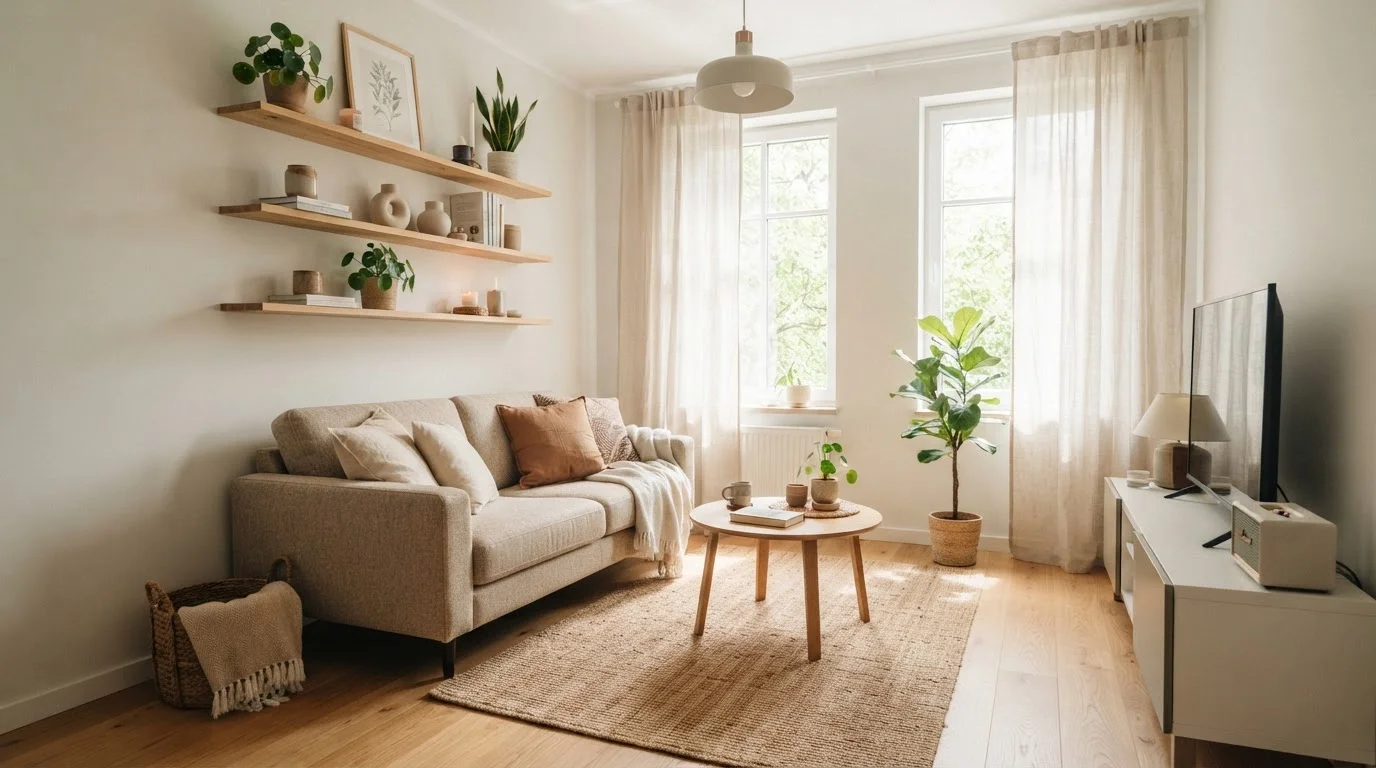
Lighter wall colors — soft whites, warm creams, pale grays, and muted sage — reflect light and visually push walls outward. However, you don't need to strip every room of personality. A single accent wall in a deeper tone or bold textiles can add depth without shrinking the space. Keeping the main field of color consistent across walls and large furniture pieces maintains visual flow. For more on avoiding the common mistake of matching everything too rigidly, see why matching everything often holds décor back.
Activate Vertical Space
Small rooms have just as much vertical real estate as larger ones — most people just don't use it. Install floating shelves or a tall bookcase that draws the eye upward. Hang curtains close to the ceiling (not just above the window frame) and let them fall to the floor — this elongates the wall and makes ceilings feel higher. For guidance on when open shelving serves you better than closed storage, open shelving versus closed cabinets is worth a read.
Layer Your Lighting
A single overhead light fixture flattens a room and emphasizes its boundaries. Introduce at least two additional light sources at different heights: a floor lamp in a corner, table lamps on side tables, or under-shelf LED strips. Multiple light sources create zones within the room, which paradoxically makes it feel larger by giving different areas their own sense of purpose.
Edit Decor and Add Intentional Accents
Clutter is the fastest way to make a small room feel chaotic. Edit ruthlessly: every object on a surface should be either functional or genuinely meaningful. Use one or two larger decorative items rather than a scatter of small ones — grouped small objects read as visual noise from a distance. Adding a single well-chosen plant brings organic texture without consuming floor space. For pairing plants with the right room conditions, choosing the right houseplant for each room offers practical guidance. When you're ready to style the room as a whole, the principles in layering décor for a pulled-together look apply directly here.
Avoid Floating Furniture Away From Walls Carelessly
While pulling furniture slightly away from walls can sometimes improve flow, doing so without a clear sightline plan often just fragments a small space. In very compact rooms, anchoring key pieces like sofas against a wall preserves the open floor area that makes the room feel breathable.