
Why Small-Space Decorating Myths Persist
Small homes and apartments are where most decorating anxiety lives. With limited square footage, every decision feels higher stakes — and that anxiety makes people vulnerable to rules that sound authoritative but rarely hold up in practice.
Many of these myths originated from real observations applied too broadly. Yes, a pale wall reflects more light than a dark one. But "always use light paint" ignores how color, contrast, and furniture scale interact. The result is a generation of small rooms painted the same off-white, stuffed with spindly furniture, and feeling neither spacious nor personal.
The guide Decorating a Small Living Room Without Making It Feel Cramped covers layout and lighting strategies in depth. But before any of that work pays off, it helps to clear the misconceptions getting in the way.
Myth
You should always use light, neutral colors in a small room to make it feel bigger.
Fact
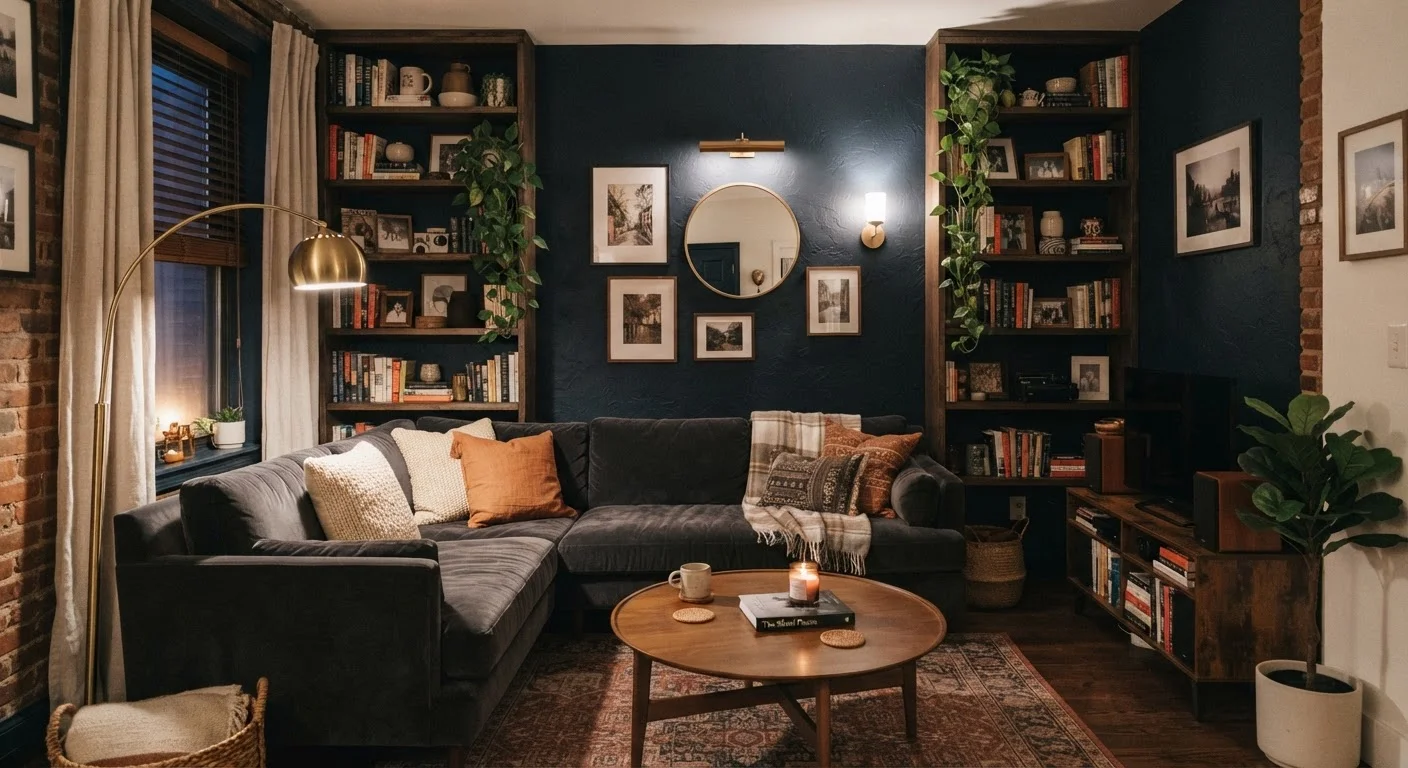
Dark colors used with intention can make a small room feel richer and more enveloping — not just smaller.
Light colors do reflect more light, which can help a room feel airy. But rooms painted in universally pale tones often feel flat and undefined — especially when natural light is limited. A deep navy, forest green, or charcoal on a single wall or all four can create a sense of depth and coziness that reads as intentional design rather than a cramped mistake. The key variables are lighting quality and contrast, not color alone.
Myth
Small rooms need small furniture so they don't feel overwhelmed.
Fact
One or two appropriately scaled larger pieces typically look better — and function better — than a room crowded with undersized furniture.
The instinct to shrink everything down leads to a common outcome: a room that looks busy and cluttered rather than spacious. Petite furniture pieces scattered throughout a room create more visual interruptions, not fewer. A single well-proportioned sofa or a substantial dining table anchors the room and communicates scale clearly. The actual footprint of a large piece is often comparable to the combined footprint of the smaller alternatives it replaces.
Myth
Mirrors always make a small space look bigger — the more, the better.
Fact
Mirrors help when placed deliberately to reflect light or a specific view; random or excessive mirror use creates visual confusion.
A large mirror positioned across from a window or a natural focal point can convincingly extend the visual depth of a room. But mirrors reflecting clutter, a blank wall, or the back of a door don't create the illusion of space — they just duplicate what's already visually noisy. Thoughtful placement of one or two mirrors is far more effective than covering surfaces with them and hoping for a spatial effect.
Myth
Rugs in small rooms should be small to avoid overwhelming the space.
Fact
An undersized rug is one of the most common decorating mistakes — a larger rug that grounds the furniture grouping visually expands a room.
A rug that's too small floats in the middle of a room without connecting to anything, making the space feel more fragmented, not more open. Interior designers consistently recommend sizing up: in a living room, all front legs of the furniture should sit on the rug, or the rug should extend generously beyond the furniture edges. This defines the zone, gives the eye a complete picture, and makes the room feel pulled together rather than cramped.
Myth
You should avoid patterns in a small space because they make it feel busier.
Fact
Pattern used consistently and at the right scale adds visual interest without shrinking a room.
The real issue isn't pattern — it's competing patterns at mismatched scales. A single large-scale pattern repeated across a small room (on a rug, a throw, or wallpaper) actually reads more expansively than a collection of small, busy prints. Pattern can also draw the eye to specific areas — upward toward a ceiling, or toward a focal point — that work in a small room's favor. The bedroom decorating guide covers how to layer pattern and texture in compact sleeping spaces without visual overwhelm.
Myth
Clutter-free means bare — small spaces should have minimal decor.
Fact
Editing thoughtfully is not the same as stripping a room bare; layered, curated decor makes small spaces feel livable rather than sterile.
Minimalism is a valid design approach, but it's not a spatial requirement. A small room with nothing on the walls, no plants, and no personal objects can feel uncomfortable rather than calm. The goal is intentional curation: fewer pieces that each carry visual weight or personal meaning, arranged to lead the eye rather than stop it. Vertical arrangements — shelves with varied heights, artwork grouped rather than isolated — accomplish this while keeping floor space clear.
Putting the Corrections Into Practice
Debunking myths is only useful if you replace them with workable principles. Here's how to translate each correction into real decorating decisions.
On color: If you want to try a dark wall, start with a single accent wall behind a sofa or bed. Pair it with warm-toned lighting — not harsh overhead fluorescents — and notice how the room shifts from flat to intimate. For more on building a cohesive color story, see Why Matching Everything Is Holding Your Décor Back.
On furniture: Measure before you buy. A sofa that's proportional to the wall it sits against reads as intentional. Two loveseats that were supposed to save space but crowd the walkway read as cluttered. Legs matter too — furniture raised off the floor visually opens up a room.
On vertical space: Hang curtains as close to the ceiling as possible, even in rooms with standard eight-foot ceilings. Install shelving all the way up, not just at eye level. This pulls the eye upward and signals more height than the room technically has.
On storage: The Open Shelving vs. Closed Cabinets guide is worth reading before committing to either approach in a small space. Both can work — the question is how disciplined you are about what's displayed.
Small spaces reward intentionality over accumulation. Each piece should earn its place — not because minimalism is a virtue, but because visual noise in a compact room is harder to escape than in a large one. The goal isn't to make a small room look big. It's to make it feel considered.
This article provides general decorating guidance for informational purposes. Results will vary depending on individual room dimensions, lighting conditions, and personal style preferences.