
What Layering Actually Means in Interior Design
A room that looks effortlessly styled isn't the result of expensive furniture or a designer's instinct that most people simply don't have. It's the result of a process: building a space in deliberate visual stages, the same way you'd layer clothing for texture and warmth. Each layer serves a purpose — structural, functional, or expressive — and together they create the sense of depth and intention that makes a room feel complete.
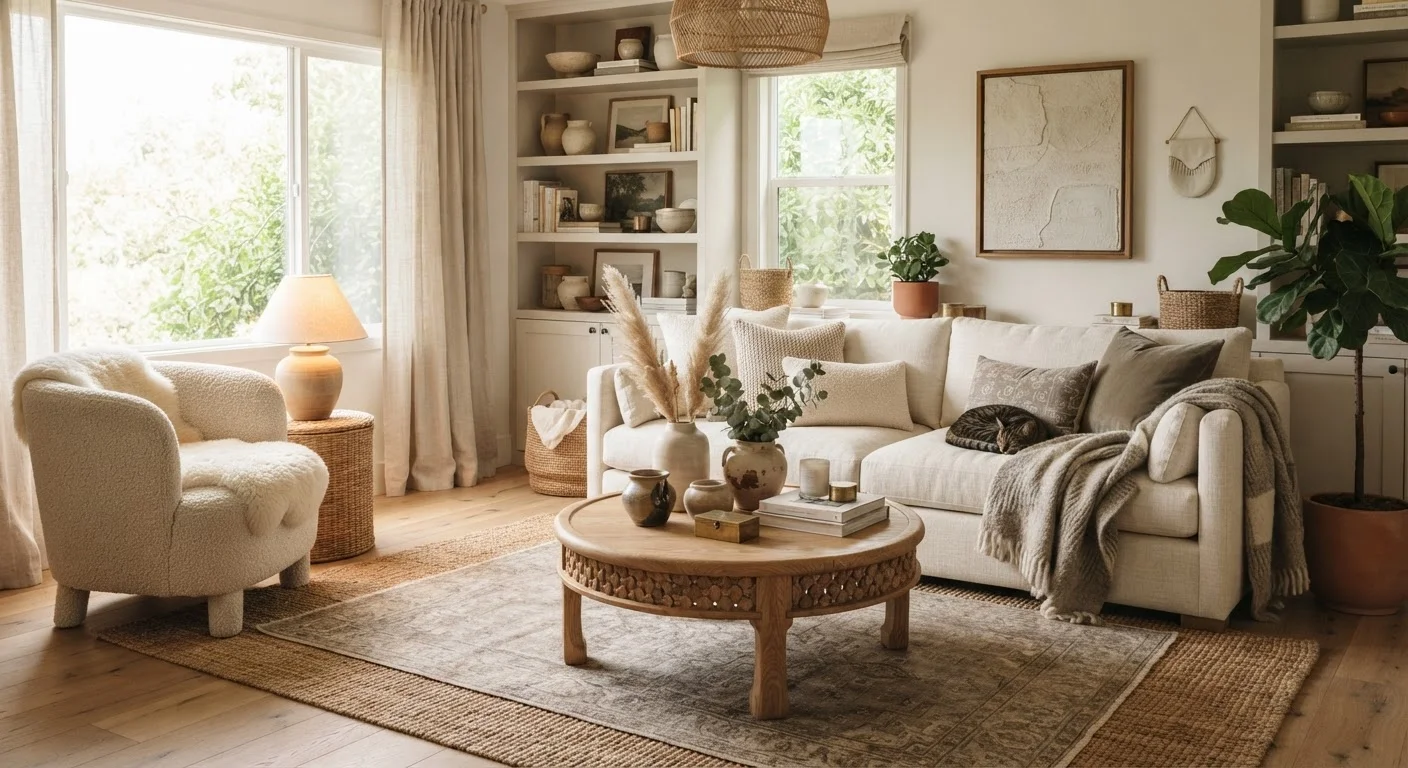
The process moves from large to small. Walls, floors, and major furniture anchor the space. Lighting, window treatments, and rugs soften and define zones. Smaller objects — throw pillows, books, plants, ceramics — add personality and fine detail. When these stages are thoughtfully built, the room reads as a whole rather than a collection of separate purchases. For more on applying these ideas in a specific context, see our guide to bedroom décor.
The Core Principles That Make Layering Work
Understanding a few foundational principles gives you a repeatable framework you can apply in any room, on any budget.
Establish a color thread before adding objects
Without a unifying color logic, individual pieces — no matter how attractive on their own — will compete visually. A color thread doesn't mean everything matches; it means one or two hues recur across the room in different forms, creating continuity. This is what allows varied textures and styles to coexist without chaos.
Vary the scale of objects within each zone
Groupings of same-size objects flatten a surface visually. Mixing tall, medium, and small elements within a vignette — a lamp, a mid-height plant, a small bowl — creates movement and draws the eye through the composition. The contrast in scale is what makes a grouping feel curated rather than crowded.
Contrast textures deliberately, not randomly
Texture is what makes a room feel tactilely rich and visually interesting, but it needs contrast to register. Smooth against rough, matte against sheen, woven against solid — these pairings create the friction that keeps the eye engaged. A room of all-soft or all-hard finishes reads as monotonous, even when the palette is beautiful.
Use odd-numbered groupings on surfaces and shelves
Odd numbers — threes and fives especially — are more visually dynamic than even pairs, which can feel symmetrical to the point of stiffness. This principle, long observed in design practice, works because uneven groupings create a natural visual tension that the eye wants to resolve, holding attention longer.
Layer lighting across multiple sources at different heights
Overhead lighting alone flattens a room. Introducing floor lamps, table lamps, and task lighting at different heights creates visual warmth and depth, especially in the evening. Each light source also creates a pool of focus that helps define zones within an open-plan space.
Edit ruthlessly — less is more than you think
Layering is not the same as accumulating. The final and often most important step is removing anything that disrupts the room's visual logic — pieces that compete rather than contribute, or surfaces so loaded with objects that nothing reads clearly. Restraint is what separates a layered room from a cluttered one.
These principles don't require starting from scratch. Most can be applied incrementally — adding a rug, regrouping objects, or pulling one consistent color through existing accessories — without significant cost. If you're working with a compact space, our article on small living rooms shows how layering adapts to tighter dimensions.
Quick Ways to Start Layering Today
You don't need a renovation to begin applying these ideas. The following actions target the highest-leverage points in a typical room and can make a meaningful visual difference quickly.
Secondhand and vintage pieces are especially useful here — an older ceramic, a worn leather book, or a weathered wood tray adds the kind of patina that makes layered rooms feel collected rather than assembled. Our guide to secondhand furniture covers what translates well and what to inspect before buying.
For rooms with wall space to work with, a gallery arrangement is one of the most effective ways to add a layered vertical element. Gallery walls done right walks through the planning and spacing process so the result looks cohesive rather than haphazard.