
Why Secondhand Furniture Is Worth the Hunt
Shopping for secondhand furniture can feel like a gamble, but for homeowners willing to look carefully, it's one of the most effective ways to build a home that feels collected and personal rather than catalog-ready. Thrift stores, estate sales, Facebook Marketplace, and consignment shops are full of pieces made with materials and craftsmanship that would cost significantly more to replicate new.
The challenge is knowing what separates a genuine find from a future headache. Unlike buying new, you can't rely on a return policy or product guarantee — so your inspection skills become your best tool. This guide walks through exactly what to look for, what to prioritize, and what to walk away from without hesitation.
If you're also rethinking your overall room layout before adding anything new, the room refresh checklist is a smart first stop.
Look for solid wood — and know how to identify it
Solid wood is the hallmark of a secondhand piece worth pursuing. It sands, stains, and paints well, holds hardware firmly, and rarely fails structurally unless it's been seriously neglected. Run your hand along edges and undersides — solid wood will feel consistent and heavier than you expect for its size.
Particleboard and MDF (medium-density fiberboard), by contrast, are common in mass-produced furniture and don't hold up well once they've been disassembled, exposed to moisture, or simply aged. Swollen drawer bottoms, chipped edges that reveal a gray or tan interior, and a hollow sound when tapped are all signs of lower-quality materials that rarely justify restoration effort.
Solid wood sands, stains, and refinishes well — particleboard rarely survives a second life.
Check the frame on upholstered pieces before anything else
When evaluating a sofa, armchair, or ottoman, the fabric is almost irrelevant — what matters is the frame underneath. Sit in it. Push on the arms. Rock it gently. A well-built frame won't wobble, creak, or shift. Kiln-dried hardwood frames (often found in older American-made pieces) are particularly durable and worth seeking out.
Press your nose into the cushions and fabric, too. Musty, smoky, or pet odors can be difficult to fully eliminate even with professional cleaning. Similarly, inspect seams and tufting closely for any evidence of pest activity — small dark droppings, shed casings, or tiny holes in fabric are red flags that no cleaning will fully resolve.
A solid upholstered frame is more important than fabric — you can reupholster, but not rebuild.
Assess joints, drawers, and hardware for structural integrity
Pull out every drawer and push it back in. It should glide smoothly without sticking or tilting. Open cabinet doors and check that they hang level. Look at the joints where legs meet aprons on tables and chairs — dovetail joints and mortise-and-tenon construction (visible as interlocking wood cuts) indicate quality craftsmanship that typically outlasts decades of use.
Loose joints can often be re-glued, and hardware can always be replaced, so don't let a missing pull or slightly sticky drawer be a dealbreaker. What you can't easily fix is a warped tabletop, a cracked leg, or a frame where the glue has failed in multiple places at once.
Dovetail joinery and mortise-and-tenon construction signal pieces built to last generations.
Think about scale before you fall in love with something
The single most common mistake when buying secondhand is purchasing emotionally and ignoring proportions. A beautiful farmhouse dining table means nothing if it overwhelms your dining room, and a petite occasional chair loses its appeal if it looks like doll furniture next to your sectional.
Before any shopping trip, measure your space and note the dimensions of existing anchor pieces. Bring a tape measure to estate sales. Take photos of the piece next to yourself for a rough sense of scale. For smaller rooms especially, proportion is non-negotiable — the guide to decorating a small living room covers scale considerations in practical detail.
Bring a tape measure — scale is the variable most buyers forget until it's too late.
Recognize which styles translate into modern homes
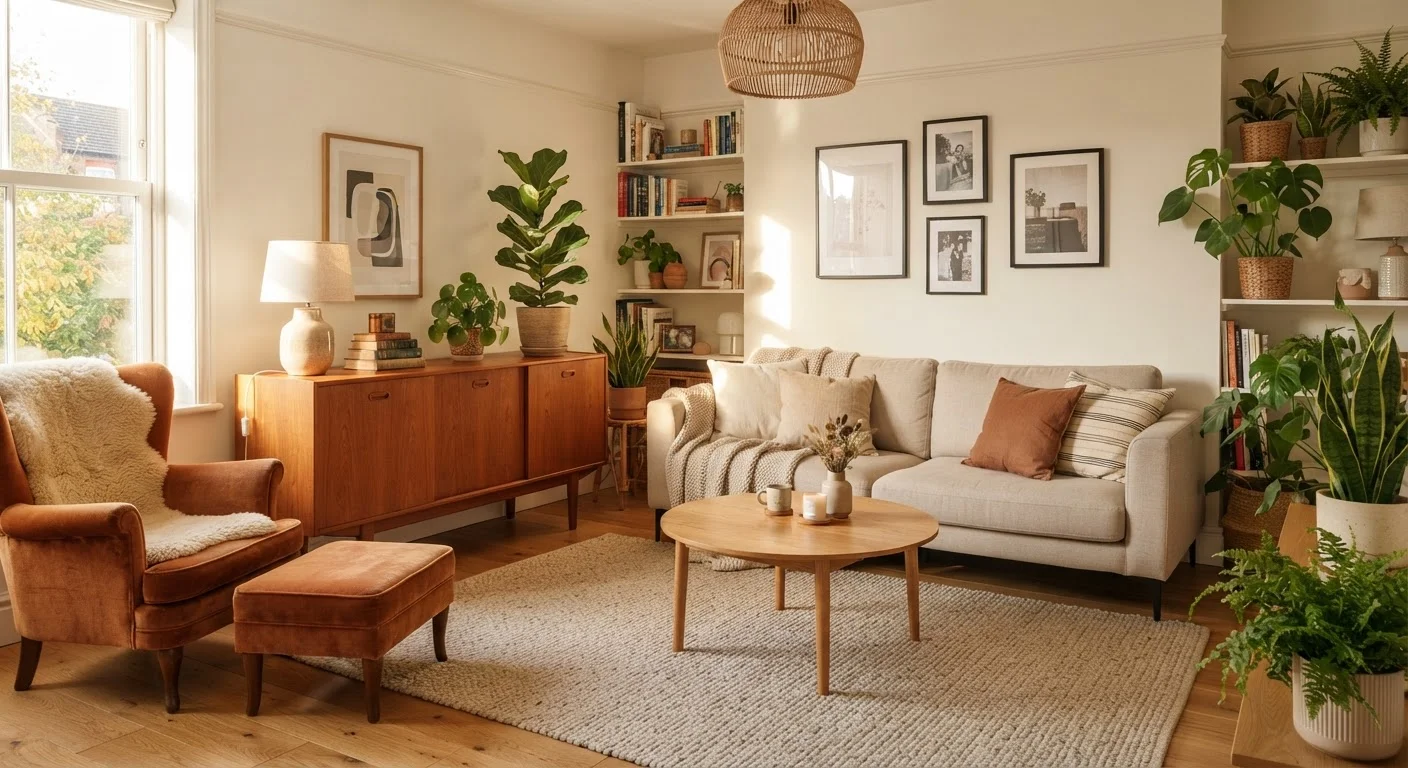
Not every vintage aesthetic blends easily into a contemporary room. Mid-century modern silhouettes — tapered legs, clean lines, low profiles — tend to integrate naturally across a wide range of current design styles. Industrial pieces in metal and reclaimed wood are similarly versatile. Pieces with strong geometric forms, neutral wood tones, or minimal ornamentation give you room to layer in your own personality through textiles and accessories.
Heavily ornate Victorian furniture, mirrored surfaces, and pieces with very specific stylistic signatures (such as southwestern motifs or 1990s pastel lacquer) are harder to integrate without making them the focal point. That's not impossible, but it requires a more deliberate approach. For ideas on how to build a layered, cohesive look with mixed-era pieces, see layering décor principles.
Mid-century silhouettes and industrial materials blend into modern rooms with minimal effort.
Know which problems are fixable — and which ones aren't
Part of becoming a confident secondhand buyer is learning the difference between a cosmetic issue and a structural one. Scratches, outdated paint colors, worn finish, ugly hardware, and tired upholstery fabric are all fixable with relatively modest investment of time or money. A dining chair that needs re-gluing, a dresser that needs new drawer pulls, or a side table that could use a coat of chalk paint — these are entirely reasonable projects.
Water damage that has penetrated deeply into wood (look for warping, staining that runs with the grain, or a musty smell that doesn't dissipate), major structural breaks, and signs of past infestation are different matters. These either require professional intervention or aren't worth the cost and risk. Be honest with yourself about how much restoration you actually want to take on.
Scratches and worn finishes are cosmetic — warping, infestation signs, and deep water damage rarely are.
Bringing It All Together
Secondhand furniture works best when it's chosen with intention. A single well-made vintage piece — a solid oak dresser, a cast-iron console, a tufted chair with good bones — can anchor an entire room and give it a sense of history that no flat-pack alternative can replicate. The key is treating each find as a building block rather than a collection of mismatched accidents.
As you develop your eye, you'll start to recognize what translates across styles and what feels dated beyond redemption. If you're mixing eras and aesthetics, our guide on why matching everything holds your décor back explains how intentional contrast actually strengthens a room's visual interest. And for smaller spaces, the strategies in decorating a small living room without making it feel cramped apply just as well when your pieces come from an estate sale as from a showroom.
Refresh soft furnishings to unify a mix
Once you've brought a secondhand piece home, new textiles are often the fastest way to make it feel intentional rather than mismatched. A reupholstered dining chair seat, a throw draped over a vintage armchair, or updated cushion covers can visually connect secondhand finds with your existing décor. For more on how textiles do this heavy lifting, see the guide to textiles that transform a room.