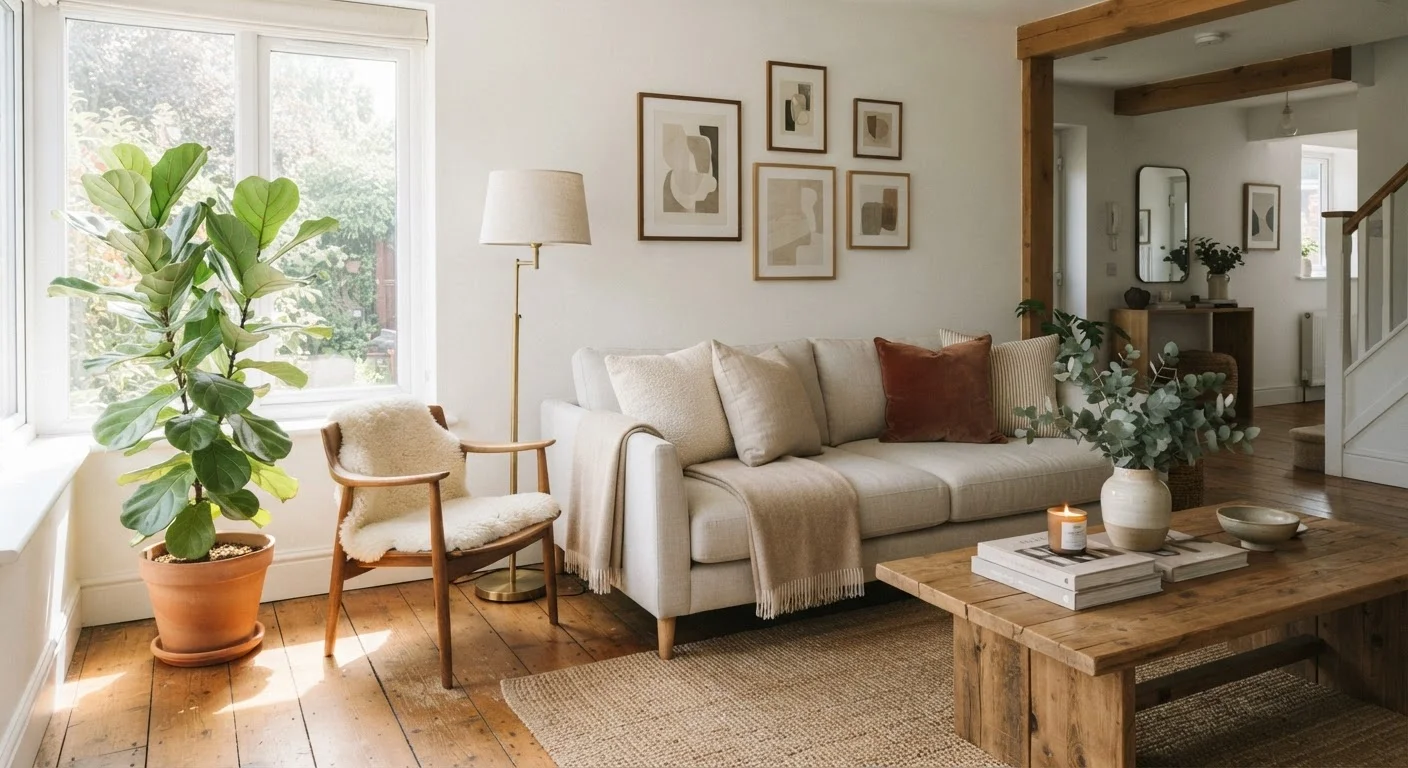
Before spending money on new décor, work through this checklist. Rearranging, editing, and lighting tweaks often do more than new purchases.
Key Takeaways
Most rooms feel stale because of layout, lighting, or clutter — not missing furniture.
Editing what you own is often more effective than adding new pieces.
Lighting adjustments are among the highest-impact, lowest-cost room changes available.
Rearranging furniture changes how a room feels spatially without spending a dollar.
Introducing mixed textures and styles makes a room look more intentional, not less.
Why a Checklist Before a Purchase?
The urge to buy something new when a room feels off is completely understandable — but it often misdiagnoses the problem. A sofa that feels boring in one corner can feel anchoring in another. A rug that looks mismatched under poor lighting can read beautifully in daylight. Before spending money, this checklist helps you audit what's actually happening in your space so any future purchase — if you still decide to make one — solves a real problem rather than adding noise.
Work through each item honestly. Take notes or photos as you go. You may be surprised how far a room can move without a single trip to a store. If you do decide something new is genuinely needed, check out what to look for in secondhand furniture before defaulting to retail.
Lighting
Check your bulb color temperature — swap warm white (2700K–3000K) into living and bedroom spaces and cool white (3500K–4000K) into task areas like kitchens or offices.Must
Count your light sources: a room with only one overhead fixture almost always feels flat — add a floor lamp or table lamp to create layers.Must
Inspect lampshades for yellowing, warping, or sizing that's out of proportion to the base — a new shade can transform an existing lamp for a fraction of the cost of replacement.Should
Assess whether window treatments are blocking natural light unnecessarily — pulling curtains closer to the wall (rather than over the glass) visually widens windows and brightens the room.Should
Furniture Arrangement
Pull furniture away from walls — floating pieces even a few inches into the room typically makes spaces feel more intentional and less cramped.Must
Check that your seating faces a focal point — fireplace, window, TV, or a piece of art — rather than pointing at blank walls or doorways.Must
Measure and confirm walkways are at least 30–36 inches wide; if they're not, identify which piece is blocking flow before assuming you need something smaller.Should
Try rotating your rug 90 degrees or centering it properly under furniture — an off-center rug is one of the most common reasons a seating area feels unresolved.Should
Editing and Decluttering
Remove everything from every surface in the room temporarily, then return only items you'd genuinely miss — this reveals what was decorating and what was just occupying space.Must
Identify any item you've stopped seeing — pieces that have become invisible through familiarity are candidates for relocation, donation, or storage.Must
Look for items that belong in a different room entirely; redistributing existing pieces between rooms costs nothing and often solves problems in two spaces at once.Should
Texture, Color, and Visual Balance
Scan the room for texture variety — if every surface is smooth (glass, lacquer, metal), add one woven, linen, or natural element before buying anything new.Should
Check color distribution: a single dominant color tends to look heavy — look for whether accent tones repeat at least three places in the room (pillow, art, small object).Should
Assess visual weight balance — heavy pieces clustered on one side of a room create an imbalanced feel that more furniture usually can't fix.Should
Evaluate whether any wall art is hung at the right height — the standard guideline is eye level at 57–60 inches to center, but groupings should be treated as a single unit.Nice to have
How to Use This Checklist Effectively
Move through the room methodically — don't try to mentally audit from the doorway. Sit in the seats people actually use. Stand where you stand when cooking, dressing, or working. The goal is to experience the space as it functions, not as it photographs.
Don't Rearrange Before You Edit
Moving furniture before decluttering surfaces and removing excess items means you're rearranging clutter, not solving it. Always complete the editing step first — it changes what you're working with and frequently eliminates rearrangement problems on its own.
Pay special attention to the lighting and furniture arrangement groups. These two categories account for the majority of rooms that feel dull or awkward despite containing perfectly good pieces. As a companion to this checklist, understanding why matchy décor stalls a room is worth reading — it often explains why a space feels flat even when everything is technically coordinated.
For bedroom-specific considerations, the bedroom décor guide covers layout and textile decisions in depth.
Required
Tape measure
Verify walkway clearances, rug positioning, and furniture spacing during your layout audit.
Required
Smartphone camera
Photograph the room from multiple angles to see it more objectively — the camera reveals imbalances the eye tends to overlook.
Optional
Painter's tape
Mark potential furniture positions on the floor before moving heavy pieces to test new arrangements.
Optional
A4 notepad or notes app
Record observations and decisions as you work through each checklist item so you don't lose insights mid-process.
Home & Garden Editorial Team is the collective byline for our editorial team and contributor network. Articles published under this byline or an editorial pen name are researched, written, and reviewed according to our editorial standards for clarity, consistency, and independence before publication.
The content provided on our blog site traverses numerous categories, offering readers valuable and practical information. Readers can use the editorial team’s research and data to gain more insights into their topics of interest. However, they are requested not to treat the articles as conclusive. The website team cannot be held responsible for differences in data or inaccuracies found across other platforms. Please also note that the site might also miss out on various schemes and offers available that the readers may find more beneficial than the ones we cover.