
Why Packing Method Actually Matters
Most travelers pick a packing style once and stick with it out of habit — but the method you use meaningfully affects how much fits in your bag, how your clothes arrive, and how long you spend sorting through them at the hotel. The three most widely used techniques — rolling, folding, and bundle wrapping — each have a distinct mechanical logic. Understanding that logic helps you apply the right tool to the right garment.
Wrinkles, for instance, form when fabric fibers are held in a compressed, bent position over time. Each method bends fibers differently, which is why one approach might leave your linen shirt looking pressed and another might leave it looking slept-in. Space efficiency is equally method-dependent: a rolled T-shirt fills gaps that a flat-folded one cannot reach.
If you're also navigating the choice between organizational tools, the packing cubes vs. compression bags comparison covers how containers interact with each of these folding techniques.
Rolling: Space Efficiency With Trade-Offs
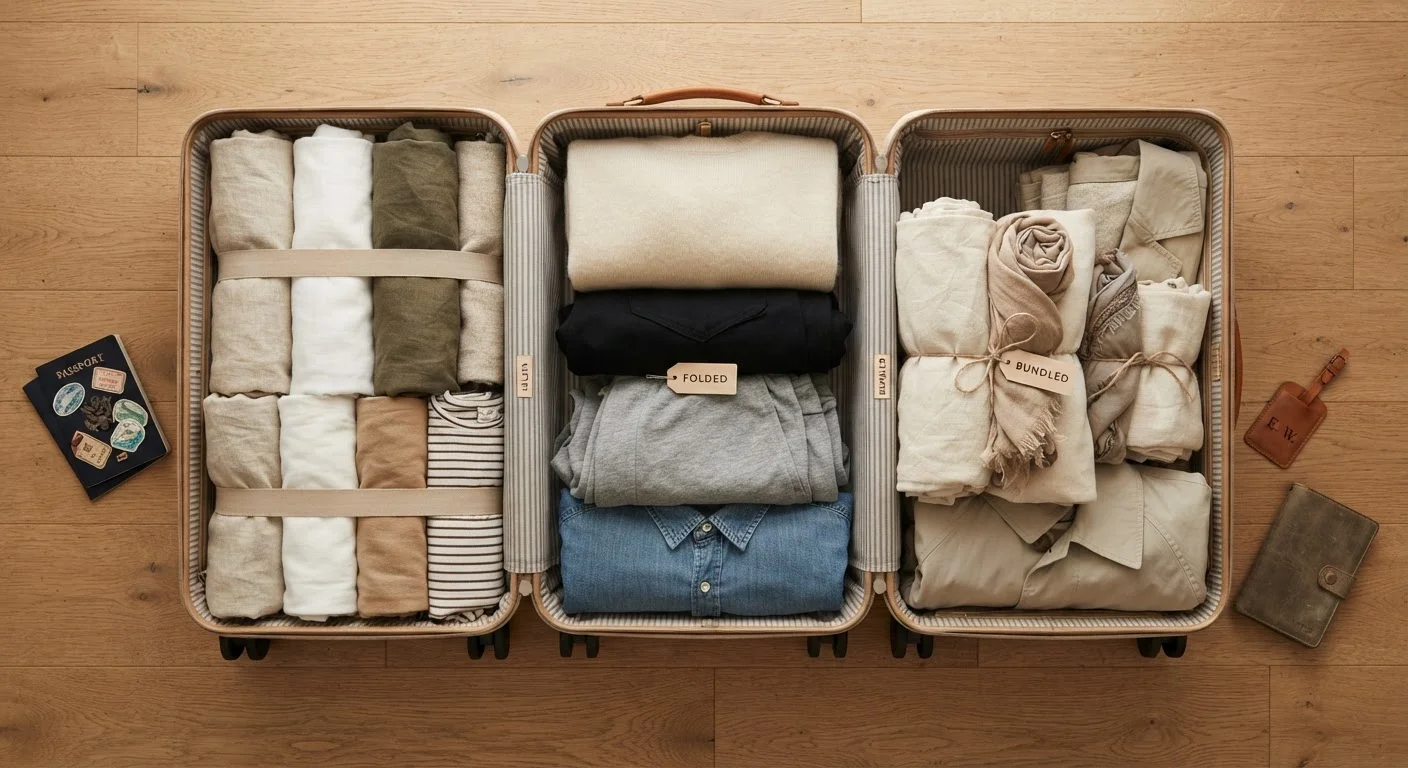
Rolling involves tightly coiling a garment from one end to the other, producing a compact cylinder. The primary advantage is space: cylinders fit into corners, gaps, and irregular spaces that flat stacks cannot reach. For backpacks and duffel bags — which have rounded or irregular interiors — rolling frequently yields noticeably more usable space than folding.
The wrinkle equation, however, is fabric-dependent. Knit fabrics, jersey, synthetic activewear, and casual cotton generally emerge from rolling with minimal creasing because their fibers are flexible. Woven fabrics — Oxford shirts, linen, structured trousers — are more rigid and can show rolling creases, particularly at the edges where the roll begins.
Rolling also makes individual items easy to identify without unpacking everything, which matters on longer trips where access frequency is high. The method works particularly well alongside packing cubes, which keep rolled items upright and visible. See our guide to clothing choices for carry-on travel for fabric recommendations that pair well with rolling.
Smooth Out Rolls Before Closing the Bag
When rolling knit or synthetic garments, lay the item completely flat and smooth out surface wrinkles before you begin the roll. Starting with a wrinkled surface locks those creases in rather than eliminating them. A few seconds of smoothing at the start saves ironing time at the destination.
Folding: The Case for Flat
Folding is the default for a reason: it mimics the way clothing is stored in drawers and on store shelves, and it's genuinely superior for structured garments. When a dress shirt is folded along its existing seams and crease lines, fabric stress is distributed predictably. The fold is deliberate rather than random, which means fewer surprise wrinkles.
Blazers, suit jackets, and dress trousers respond better to flat folding — ideally with tissue paper inserted at stress points — than to any other portable packing method. Folding also stacks efficiently in rectangular suitcases, where flat layers tile neatly against a hard shell.
The downside is that folding wastes the irregular space around and between stacked items, and nested stacks mean unpacking the top layer to reach something at the bottom. For travelers prone to overpacking, understanding the psychology behind overpacking is worth reading alongside practical techniques like these.
Bundle Wrapping: The Method Most Travelers Skip
Bundle wrapping — sometimes called the bundle method — is less intuitive but often the most effective approach for wrinkle prevention. The technique works by wrapping garments in concentric layers around a central core object (a toiletry bag or a pair of shoes work well). Each garment is laid flat, and successive items are wrapped around the core in alternating directions.
The result is that no garment has a sharp fold line. Instead, each piece curves gently around the bundle, keeping fabric fibers under even, low-stress tension rather than compressed at a crease point. Travelers who regularly pack dress outfits for events report that bundle wrapping produces noticeably fewer wrinkles than either rolling or folding alone.
The trade-off is access: the bundle must be unwrapped to reach any individual item, making it impractical for multi-stop trips where you're repacking daily. It also requires more deliberate assembly time. Bundle wrapping is best reserved for destination-focused trips where the suitcase stays closed for several days at a time. For cold-weather travel where bulky layers complicate any method, see our cold-weather packing strategies.
| Rolling | Folding | Bundle Wrapping | |
|---|---|---|---|
| Space efficiency | High — fills irregular gaps well | Moderate — best in flat rectangular bags | Moderate — compact but fixed shape |
| Wrinkle prevention | Good for knits and synthetics | Good for structured woven garments | Excellent across all fabric types |
| Access to individual items | Easy — items are visible and separate | Moderate — requires unstacking | Difficult — full unbundling required |
| Time to pack | Fast | Fast to moderate | Slow — requires planning |
| Best bag type | Backpacks, duffels, soft bags | Hard-shell rectangular suitcases | Any bag used for single destination |
| Best garment types | T-shirts, jeans, activewear | Blazers, dress shirts, trousers | Full outfits including formalwear |
Combining Methods for Real-World Bags
The most practical takeaway from comparing these methods is that none of them needs to be used exclusively. A well-packed rectangular suitcase might use flat folding for two dress shirts and a blazer, rolling for all casual tops, underwear, and workout gear, and bundle wrapping only for a single formal outfit being carried to a specific event.
Bag shape should guide your approach: hard-shell rectangular luggage favors folding along the frame, while soft duffels and backpacks reward rolling. Many experienced travelers also find that common packing myths — like the belief that one method works universally — are worth unlearning before departure.
Finally, your bag's construction matters too. Soft-sided vs. hard-shell luggage differ in how well they accommodate each method, and matching your packing technique to your bag type is the final piece of a genuinely efficient system.