

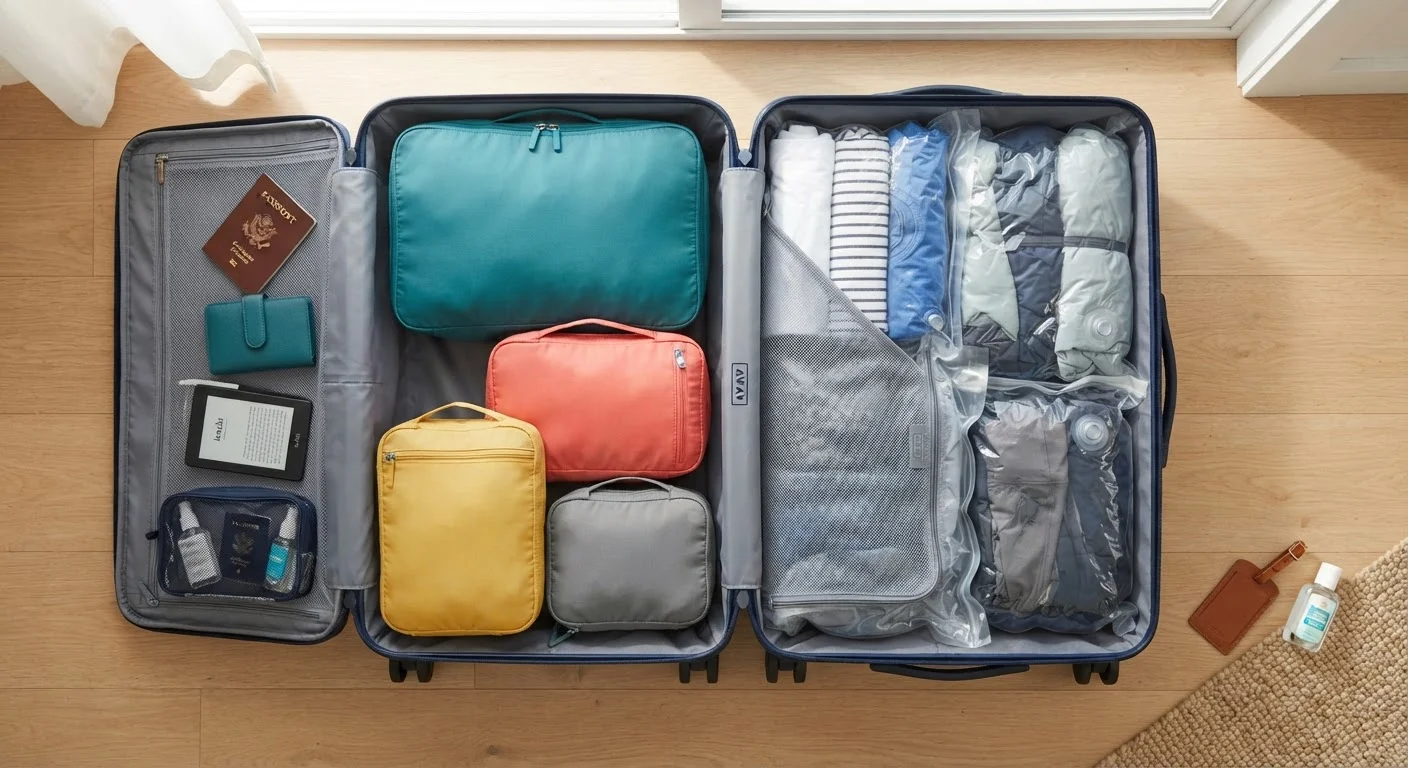
What Each Organizer Actually Does
Packing cubes are fabric containers — typically rectangular, zippered pouches — that segment your luggage into defined compartments. Think of them as drawers inside your bag. You assign categories (tops, bottoms, underwear, workout gear) to individual cubes, zip them closed, and stack them. The bag stays structured, and finding a specific item takes seconds rather than minutes of digging.
Compression bags work on a different principle entirely. They're sealed pouches — often with a one-way valve or roll-down closure — designed to squeeze air out of soft, compressible items. The result is a denser, smaller package. A bulky sweater that once took up a third of your suitcase might occupy half that space after compression.
The key distinction: packing cubes manage organization, while compression bags manage volume. Confusing the two leads to disappointment — someone who buys compression bags hoping for a tidy, accessible wardrobe will find the opposite. Someone who buys packing cubes expecting to fit an extra jacket will be equally frustrated.
Understanding this difference is the foundation of using either tool well. For a broader look at how your packing method interacts with bag choice, see the science behind rolling, folding, and bundle wrapping.
Where Packing Cubes Excel — and Where They Fall Short
Packing cubes shine on multi-day trips where you're living out of a bag. Because each cube holds a category, you can pull out just the top layer without disturbing the rest. At hotel check-in, you transfer cubes to drawers in under two minutes. Repacking is equally fast — cubes go back in the same configuration every time.
They also protect clothing shape. Structured garments, delicate fabrics, and anything prone to wrinkling fare better in cubes than compressed into an airtight bag. If you're curious about how packing method affects wrinkles specifically, rolling vs. folding vs. bundle wrapping explores that in detail.
The limitation: packing cubes don't save space in any meaningful way. They organize existing space. If your bag is already at capacity, adding cubes won't help — and in some cases, the cube fabric itself adds marginal bulk. Cubes also require consistent repacking discipline to stay useful; if you start mixing categories mid-trip, the system breaks down.
| Criterion | Packing Cubes | Compression Bags |
|---|---|---|
| Primary benefit | Organization and access | Volume reduction |
| Space savings | Minimal — organizes existing space | Meaningful for bulky soft items |
| Best clothing types | All types, including structured garments | Fleece, down, thick knitwear only |
| Wrinkle risk | Low with proper folding | High — compression forces creases |
| Mid-trip access | Easy — open, grab, rezip | Disruptive — requires repacking effort |
| Repack ease | Consistent and quick | Harder to achieve same compression twice |
| Best trip type | Multi-day trips, varied outfits | Cold-weather travel, checked bags |
Where Compression Bags Excel — and Where They Fall Short
Compression bags deliver genuine, measurable space savings for the right items: fleece pullovers, down jackets, thick hoodies, spare blankets, and bulky base layers. These fabrics compress readily because they're mostly air and loft. A compression bag can realistically reduce that volume by 30–50%, making them a practical tool for cold-weather travel or anyone checking luggage packed with winter gear.
The trade-offs are real, though. Compressing clothing creates significant wrinkles — the pressure forces fabric into folds that are difficult to shake out. Structured blazers, dress shirts, and woven fabrics don't compress well and may emerge unusable without a steamer. Additionally, after you've opened a compression bag at your destination, you can't easily reseal it to the same density without the original rolling pressure. That means repacking for the return trip often takes more time than it saved initially.
There's also a risk with over-reliance: compression bags can encourage overpacking by making a larger clothing load feel manageable. If you find yourself reaching for a compression bag to fit items you wouldn't otherwise bring, understanding why overpacking happens is worth reading before your next trip.
Using Both Together — and Knowing When to Skip One
The most practical answer for many travelers isn't a choice between the two — it's a deliberate combination. Use compression bags for the two or three bulky soft items that would otherwise dominate your bag (a down jacket, a thick hoodie), then use packing cubes for the rest of your clothing. This hybrid approach captures the space savings where they're meaningful while preserving the organization and access advantages of cubes for everyday items.
That said, some trips don't need both. A warm-weather carry-on trip with lightweight clothing has no use for compression bags — cubes alone are sufficient. A weekend trip where you're living out of your bag in the car might not need cubes either; a single compression bag for the sweater and loose packing for the rest may be perfectly adequate.
The right organizer depends heavily on your bag type, too. If you're still deciding between carry-on and checked luggage, the carry-on vs. checked luggage trade-offs can help clarify which bag constraints you're actually working within. And if you suspect your packing list itself is the problem rather than the containers, common packing myths that waste space addresses the beliefs that consistently lead travelers to overload their bags in the first place.
Neither tool is a substitute for thoughtful decisions about what actually belongs in your bag. They organize and compress what you choose to bring — the choosing still happens before anything gets packed.