
It's Not Really About the Clothes
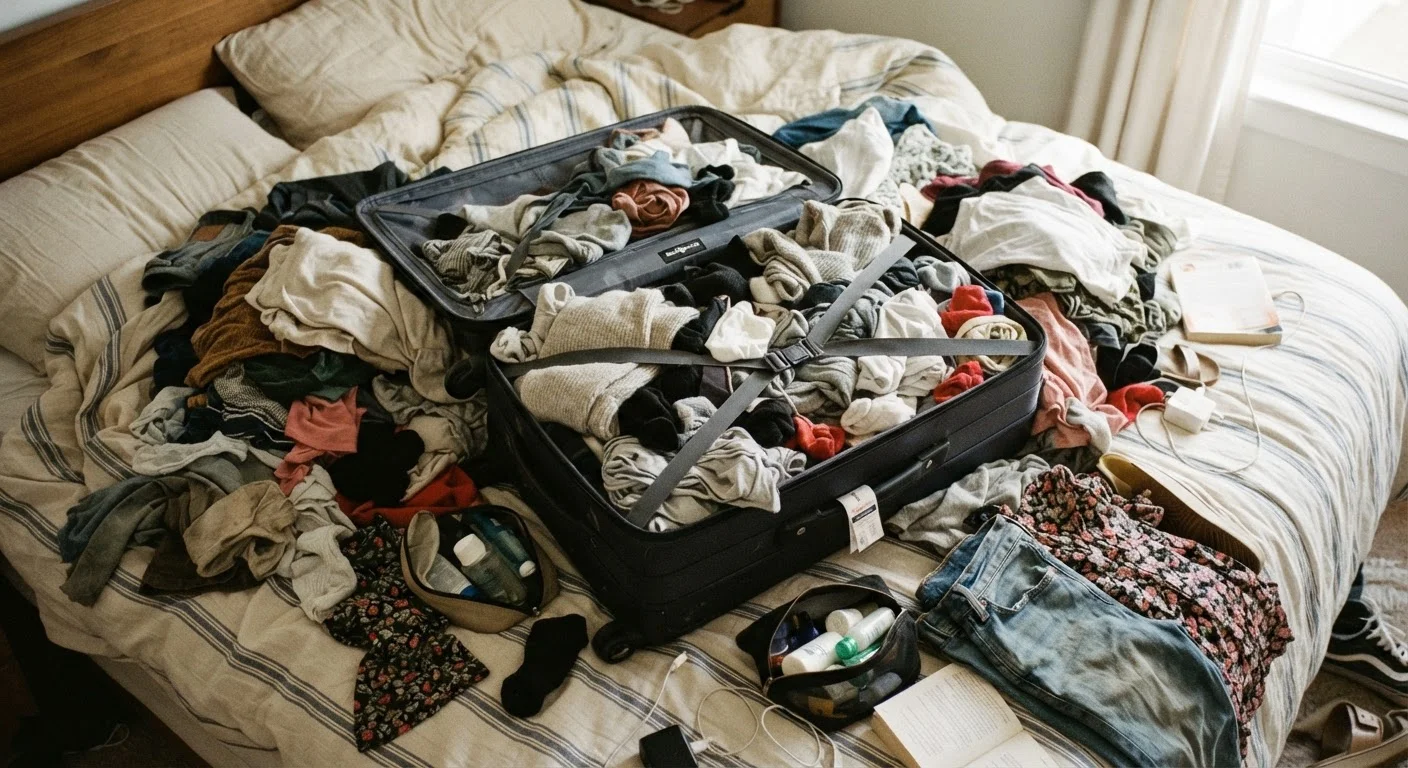
Ask someone why they packed four pairs of shoes for a five-day trip and they'll usually say something like, "just in case." That phrase is the fingerprint of overpacking. The suitcase isn't the problem — the thinking that filled it is.
Overpacking is a behavioral pattern rooted in anticipatory anxiety. Travelers mentally rehearse worst-case scenarios — a spill, a formal dinner invitation, unexpectedly cold weather — and pack a solution for each one. The result is a bag stuffed with contingency items that statistically never get used. Research on travel behavior consistently shows that most travelers use only a portion of what they bring; the rest rides along as expensive, heavy insurance against unlikely events.
Understanding why overpacking happens is the first step toward stopping it. It's rarely carelessness — it's actually an overcorrection toward preparedness. Once you recognize that impulse, you can redirect it.
The Most Common Overpacking Mistakes
These patterns show up across all kinds of travelers, from first-timers to frequent fliers. Recognizing them in your own packing routine is where the mental shift begins.
Packing for hypothetical scenarios instead of the actual itinerary.
Why it happens: Travelers focus on what could go wrong rather than what's scheduled, leading to redundant backup clothing and gear for situations that rarely arise.
Treating the suitcase as a security blanket rather than a practical tool.
Why it happens: A full bag feels emotionally reassuring — it signals readiness. This psychological comfort leads travelers to fill space even when there's no functional reason to.
Duplicating items already available at the destination.
Why it happens: Travelers underestimate how accessible everyday items are abroad or in other U.S. cities, defaulting to bringing everything from home as a precaution.
Packing an entire wardrobe instead of building a travel capsule.
Why it happens: Without a deliberate system, travelers pack standalone outfits for each day rather than versatile pieces that mix and match across multiple combinations.
Adding items late in the packing process under time pressure.
Why it happens: Last-minute packing triggers anxiety, and anxiety triggers the "just in case" impulse. Items added in the final hour rarely make the cut on a calm review.
For trips where bulky items are unavoidable, practical strategies exist — see our guidance on cold-weather packing without the weight for a concrete approach to managing volume.
The Mental Shift: From 'What If' to 'What Will'
The single most effective reframe in packing is swapping one question for another. Instead of asking "What if I need this?" ask "What will I actually use?" It sounds minor, but the change in verb tense forces concrete thinking over abstract worry.
"What if" opens the door to infinite hypotheticals. "What will" requires you to picture yourself on the trip — your real itinerary, your real habits, the actual climate — and select accordingly. Travelers who adopt this frame consistently pack lighter without feeling underprepared.
~60–70%
Clothing actually worn on a typical trip
Travel behavior surveys consistently indicate most travelers return home with a meaningful portion of their wardrobe untouched, confirming that packing habits routinely outpace real needs.
50 lbs
Standard checked baggage weight limit (most U.S. carriers)
Exceeding this threshold triggers fees that can range from $100 to $200 or more per bag on many domestic and international routes — a direct financial cost of overpacking.
A second useful shift is thinking about your bag on the move, not just at the destination. A carry-on that feels manageable in your bedroom becomes a liability hauling it up subway stairs or through cobblestone streets. Imagining the physical reality of your bag in transit — not just its contents at rest — makes marginal items easier to leave behind.
Pair this mindset with practical organization methods. Our guide to rolling, folding, and bundle wrapping explains how your packing method itself affects how much you can fit without the bag becoming unmanageable. And before you invest in organizers, it's worth reading about packing cubes vs. compression bags — they solve different problems, and choosing the right one matters.
If you're also wondering which items are actually worth adding — rather than cutting — situational items most travelers overlook provides a grounded counterpoint to the minimalism-at-all-costs mindset. And for a broader look at beliefs that quietly inflate your bag, see common packing myths that waste space.