

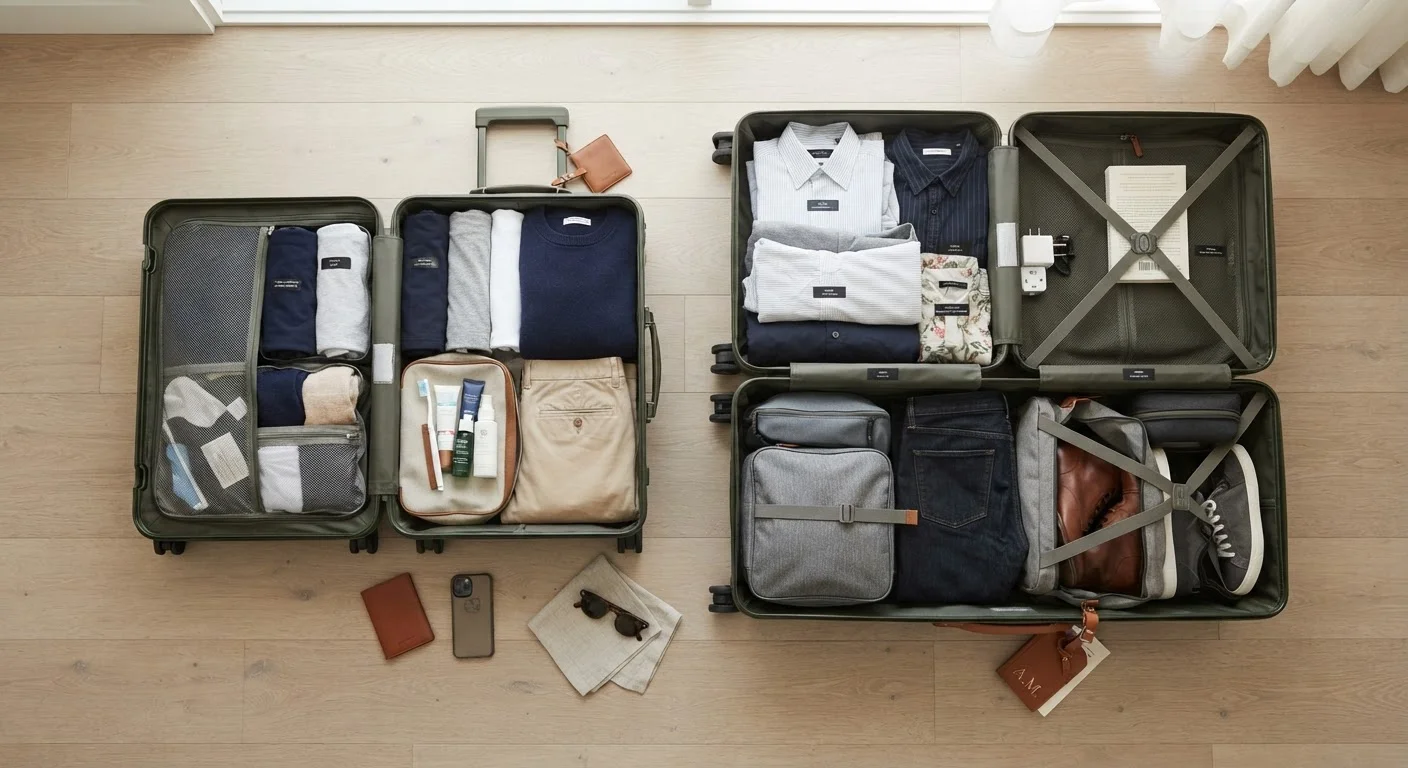
What You're Actually Trading Off
Choosing between a carry-on and checked luggage isn't really about the bag — it's about how you want your travel experience to feel from curb to destination. Both approaches involve real compromises, and neither is universally superior.
With carry-on only, you gain speed and control. You skip the check-in counter, avoid baggage fees on most major domestic carriers, and walk straight off the plane to ground transportation. The trade-off is a hard ceiling on what you can bring: volume, weight, and liquid restrictions all apply. Discipline in packing becomes non-negotiable.
Checked luggage lifts that ceiling significantly. You can pack for two weeks, bring full-size toiletries, check in specialty gear, and dress for a formal event without sacrificing comfort items. But you pay for that freedom — in fees, in time waiting at baggage claim, and in the small but real possibility your bag arrives later than you do.
For a deeper look at how your overall trip mode shapes these decisions, see our comparison of road trips versus flying — the luggage question connects directly to how you're getting there.
| Criterion | Carry-On Only | Checked Luggage |
|---|---|---|
| Bag fees (typical domestic) | Usually none | $30–$70+ per bag, per way |
| Packing capacity | Limited by airline size rules | Generous, up to ~50 lbs |
| Airport wait time | Skip baggage claim entirely | 15–45 min at baggage claim |
| Risk of loss or delay | Stays with you in cabin | Small but real misrouting risk |
| Liquids and TSA rules | 3-1-1 rule applies strictly | Full-size liquids permitted |
| Best trip length | 1–7 days typically | 7+ days or gear-heavy trips |
| Overhead bin guarantee | Not guaranteed on full flights | Not applicable |
When Carry-On Only Makes Practical Sense
For trips lasting roughly five days or fewer, most travelers can pack everything they need into a standard carry-on (typically 22 x 14 x 9 inches, though airlines vary) plus a personal item like a backpack or tote. The key is intentional clothing selection rather than radical minimalism.
Fabrics that resist wrinkles, dry quickly, and layer well make the difference between feeling cramped and feeling prepared. Our guide on clothing choices that make carry-on travel realistic walks through this in practical terms.
Carry-on travel also shines when your itinerary involves multiple cities, tight connections, or frequent transportation changes. Every time you move between locations, not wrestling with a large checked bag saves meaningful time and energy. For travelers with medical equipment or prescription medications, keeping everything in the cabin also provides peace of mind — though that comes with its own considerations covered in our guide to medications and airport security.
One honest caveat: overhead bin space is not guaranteed. Full flights often result in gate-checked carry-ons, which somewhat narrows the advantage — your bag may still end up in the hold, just without a fee.
When Checked Luggage Is the Smarter Call
Certain trips simply outgrow carry-on constraints, and pushing past them creates more stress than it saves. Cold-weather destinations are a clear example: bulky coats, waterproof boots, and thermal layers consume space rapidly. Our cold-weather packing guide offers strategies for keeping this manageable, but some trips genuinely call for the extra room a checked bag provides.
Trips longer than a week, formal travel with event-specific clothing, or any journey requiring specialty gear — sports equipment, photography kits, instruments — also favor checked luggage. Trying to compress these needs into carry-on dimensions often means leaving essential items behind or arriving underprepared.
The cost factor deserves clear-eyed attention. On most major U.S. carriers, a first checked bag on a domestic round trip runs between $30 and $70 each way, though this varies by airline and ticket class. Elite status or co-branded credit cards sometimes waive fees — worth checking before booking. For the full picture on how bag fees affect total trip cost, our article on the real cost of checked bags breaks it down.
Bag mishandling does occur, though industry data suggests the rate has improved over time. For irreplaceable or high-value items, checked luggage carries inherent risk that carry-on travel avoids entirely.
Making Your Decision: A Practical Framework
Rather than defaulting to one approach out of habit, run through a few concrete questions before your next trip:
- How many days? Under five to seven days, carry-on is usually achievable with planning.
- What's the climate? Cold or unpredictable weather expands your pack significantly.
- How many connections? Multiple layovers raise the risk profile for checked bags.
- What's the airline's fee structure? Some low-cost carriers charge more for overhead bin bags than for checked ones — always verify before assuming.
- Are you carrying anything fragile, regulated, or oversized? These items often need to be checked regardless of preference.
Inside your bag, organization tools can stretch the usable space of either option. Our comparison of packing cubes and compression bags explains what each method actually does — and which problems they solve — so you can choose accordingly.
For travelers interested in the luggage itself, the construction of your bag matters too. Our soft-sided vs. hard-shell luggage breakdown covers durability, weight, and flexibility differences that affect both carry-on and checked use.
The most practical outcome for many travelers is a flexible mindset: carry-on for shorter, simpler trips and checked luggage when the destination or duration genuinely warrants it — not as a default, but as a deliberate choice.