

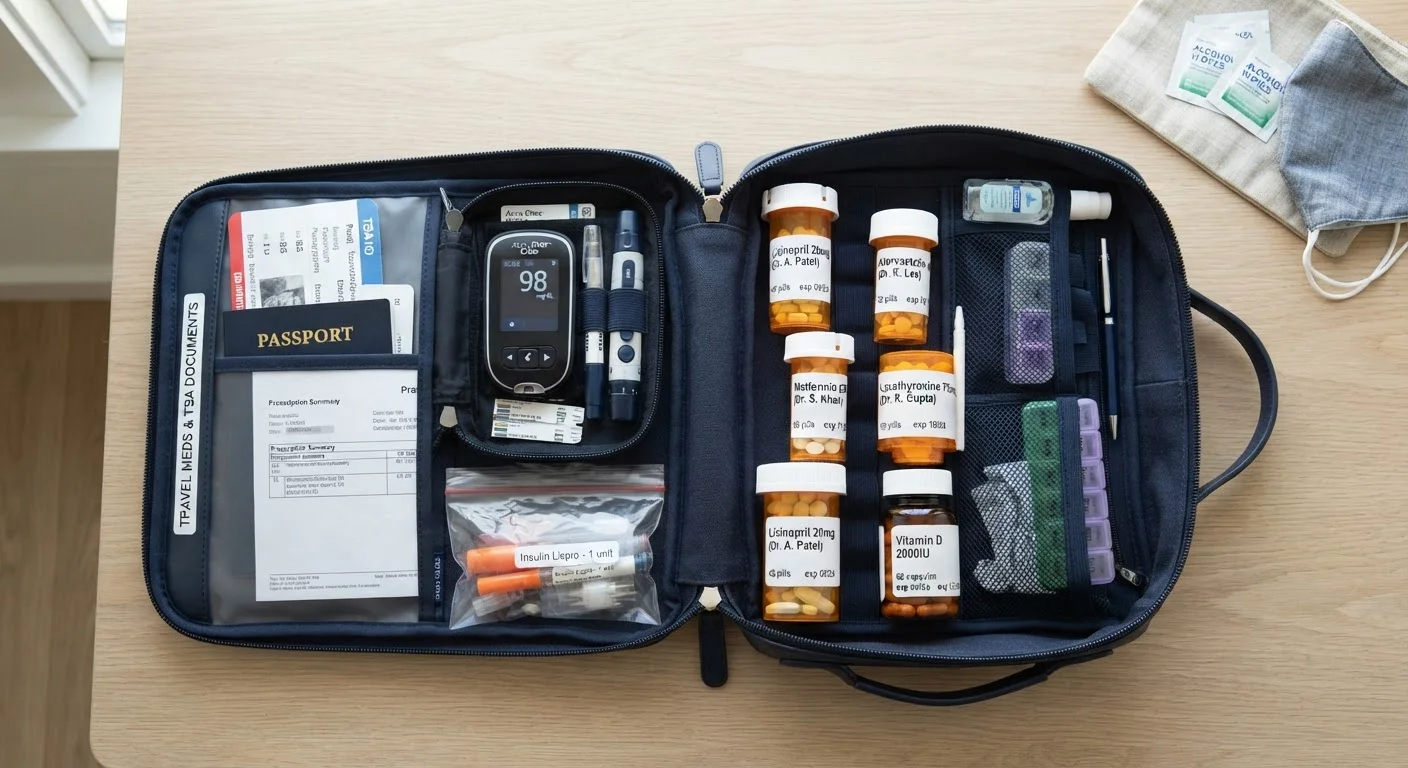
Why Medical Travelers Need a Different Packing Strategy
For most passengers, airport security is a routine inconvenience. For travelers carrying prescription medications, injectable drugs, or medical devices like insulin pumps or CPAP machines, a little extra planning can be the difference between a smooth checkpoint and a stressful delay.
The TSA (Transportation Security Administration) does accommodate medical needs — but the rules aren't always intuitive, and they differ from standard carry-on guidelines. Combine that with varying international regulations, and travelers managing health conditions need a deliberate pre-trip strategy rather than a last-minute scramble.
This guide walks through what to prepare before you leave home, how to move through security confidently, and what documentation to keep accessible. For a broader pre-departure framework, see our pre-trip planning checklist for domestic travel.
What you will need
Step-by-Step: Preparing and Packing Your Medical Supplies
Following a clear sequence before departure removes uncertainty at the checkpoint and protects you if questions arise mid-trip.
Contact your prescribing physician at least two weeks before departure
Ask your doctor for a signed letter on official letterhead that includes your name, a list of your medications and dosages, the medical necessity of any devices or injectable supplies, and their contact information. This letter is not legally required by TSA for domestic flights, but it significantly reduces screening friction and is often required at international borders.
Keep medications in original, pharmacy-labeled containers
Prescription bottles with your name, medication name, prescribing doctor, and pharmacy information are the clearest signal to security officers that your medications are legitimate. Pill organizers are convenient but can prompt additional screening. If you prefer to use an organizer, carry the original bottles alongside it.
Separate medical items before reaching the security bin
Place all medications, syringes, auto-injectors, lancets, and medical devices in an easily accessible section of your bag. When you reach the screening lane, inform the TSA officer before placing items on the belt. You have the right to request a visual inspection of your insulin or other temperature-sensitive medications instead of X-ray screening — simply state this clearly before the officer processes your bag.
Pack medical devices according to TSA and airline guidelines
Devices such as CPAP and BiPAP machines, nebulizers, glucose monitors, insulin pumps, and portable oxygen concentrators are all permitted in the cabin. CPAP machines do not count against your carry-on allowance on most U.S. airlines, but confirm this with your carrier before travel. Portable oxygen concentrators (POCs) are subject to FAA approval — verify your device model is FAA-accepted and notify your airline at least 48 hours in advance.
Store all critical medications in your carry-on, not checked baggage
Checked bags can be delayed, lost, or exposed to extreme temperatures in cargo holds — conditions that can degrade medications or leave you without essential drugs at your destination. This applies especially to insulin, biologics requiring refrigeration, and any medication without which you cannot safely manage your health condition during the trip.
Notify the Airline in Advance for Devices
Airlines can better accommodate medical travelers when notified ahead of time. If you use a portable oxygen concentrator, require accessible seating near the aisle, or need to carry a sharps disposal container, call the airline's accessibility or special services line well before your departure date. Most airlines have dedicated staff for these requests and can document your needs in the reservation.
Documentation, International Travel, and What to Verify
Domestic flights within the U.S. operate under TSA rules, but international routes introduce an additional layer of complexity. Controlled substances — including certain pain medications, stimulants, and sedatives — are subject to customs laws that vary significantly by country. Some medications legal in the U.S. are restricted or prohibited elsewhere.
Before any international trip, contact the embassy or consulate of your destination country to confirm what documentation is required for your specific medications. Many countries require advance import permits for controlled substances, and some require a certified translation of your prescription. The U.S. State Department's country information pages and the destination country's official health ministry are reliable starting points — not travel forums.
International Rules Can Differ Significantly
Medications that are fully legal in the United States — including certain opioids, ADHD medications, and benzodiazepines — may be controlled, restricted, or outright banned in other countries. Carrying these substances across borders without proper documentation can result in confiscation, fines, or detention regardless of your medical need. Always contact the destination country's embassy and your own healthcare provider before traveling internationally with any controlled substance.
Organizing your medical paperwork alongside your other travel documents is also smart practice. Our guide on travel document organization covers how to structure and back up critical papers before departure. If you're deciding between carry-on and checked luggage, our breakdown of carry-on versus checked luggage trade-offs is also worth reviewing — medications should almost always travel with you in the cabin.
Liquid medications follow a separate TSA rule from standard toiletries. Unlike the standard 3.4 oz limit, medically necessary liquids in larger quantities are permitted — but must be declared to the officer before screening begins. For context on how the standard liquids rule works, see what TSA's 3-1-1 rule actually means.
This article provides general travel information only. Rules and regulations change; always verify current requirements directly with the TSA, your airline, and relevant government authorities before travel. Consult your healthcare provider regarding the management of your specific medical needs while traveling.