
What Actually Counts as a Liquid
This is where most travelers run into trouble. The TSA defines "liquids" far more broadly than the word implies. Under the 3-1-1 rule, the following categories are all treated as liquids:
- Liquids: water, juice, contact lens solution, mouthwash
- Gels: hair gel, aloe vera gel, hand sanitizer
- Aerosols: dry shampoo, spray sunscreen, deodorant sprays
- Creams and lotions: moisturizer, sunscreen, face wash
- Pastes: toothpaste, peanut butter (yes, really)
If a product can spread, pour, spray, or squeeze out of a container, assume it's a liquid until you verify otherwise. When in doubt, the TSA's official website has a searchable "What Can I Bring?" tool that gives a clear answer for specific items.
Solids Are Not Subject to 3-1-1
Bar soap, solid shampoo bars, powder deodorant, and powder-format sunscreen don't qualify as liquids and don't need to go in your quart bag. Switching even a couple of products to solid form is one of the simplest ways to stretch your liquid allowance. These alternatives are increasingly widely available in standard retail stores.
Solid alternatives — bar soap, shampoo bars, powder sunscreen, solid deodorant sticks — are not subject to the 3-1-1 rule at all. Switching even one or two items to solid form can meaningfully free up space in your quart bag. If you're packing for a longer trip, see our carry-on vs. checked luggage guide for a fuller picture of how liquids factor into your overall packing strategy.
The Three Numbers — and Why Each One Matters
The rule is called 3-1-1 because it has three distinct requirements, and all three must be met simultaneously. Missing any one of them means a problem at the checkpoint.
3.4 oz per container
The size limit applies to the container's printed capacity, not the actual volume inside it. A 5 oz bottle of conditioner that's nearly empty is still a 5 oz bottle. Transfer products into smaller travel bottles or buy travel-sized versions to comply. Containers are measured in ounces on US packaging; the 100 ml metric equivalent is the same threshold used internationally.
1 quart-sized clear bag
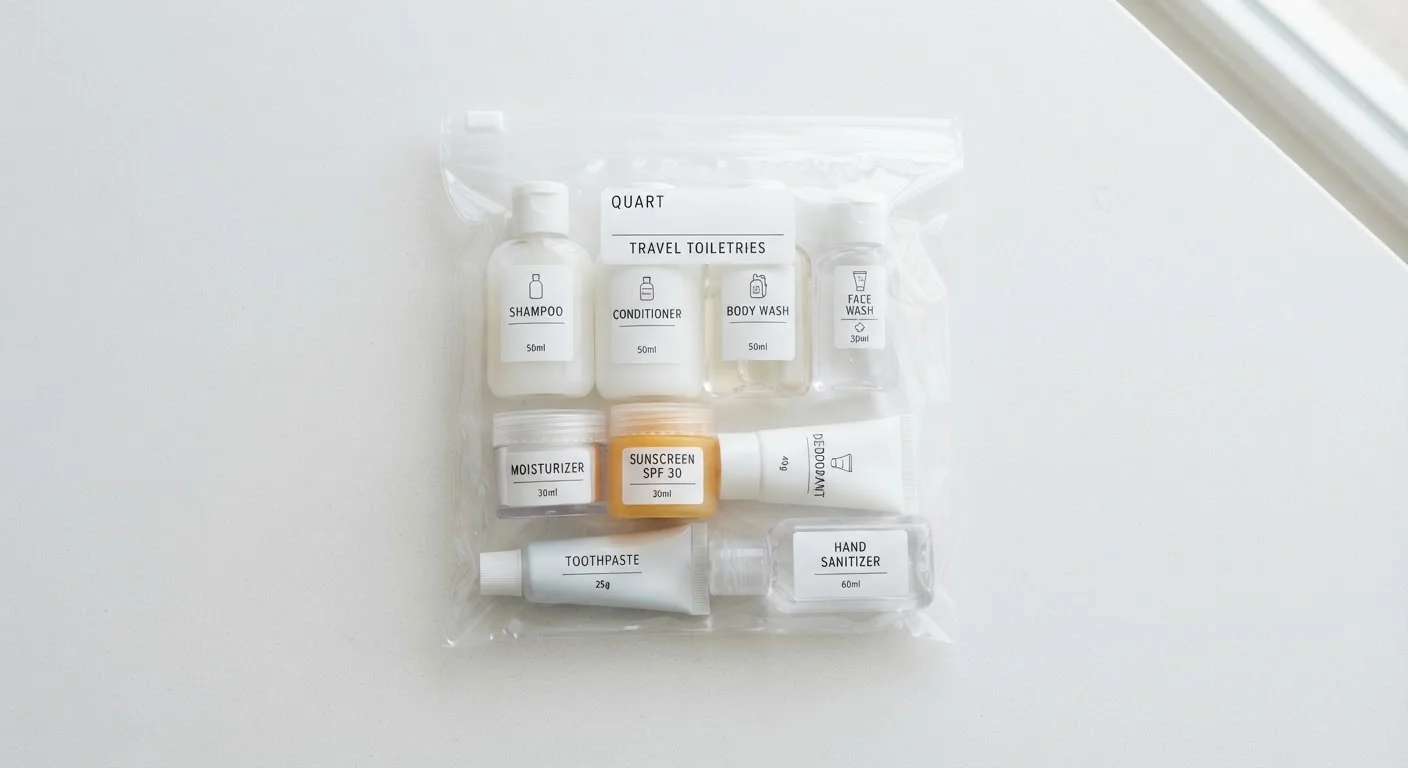
Your bag must be clear, zip-top, and roughly quart-sized — approximately 7 x 8 inches. Oversized pouches don't qualify. You don't need to purchase a specific product; a standard kitchen zip bag works fine. The bag must close fully — bulging or half-sealed bags may be flagged.
1 bag per traveler
Each passenger gets one quart bag. If you're traveling with a companion, each of you can carry your own bag, which effectively doubles your household's liquid allowance without breaking any rule. This is worth coordinating before you leave home — splitting shared items like sunscreen between two bags is perfectly allowed.
3.4 oz
Maximum liquid container size allowed in carry-on
This equals 100 milliliters — the international standard used by most countries' aviation security agencies.
1 quart bag
Number of liquid bags permitted per traveler
TSA allows exactly one clear, quart-sized, zip-top bag of liquids per passenger through the security checkpoint.
~4–6 items
Typical liquid slots in a quart bag
Most travelers can fit between four and six standard 3 oz travel bottles in a single quart bag, depending on container shape.
Exceptions and Edge Cases You Should Know
The 3-1-1 rule has a few legitimate exceptions, but they come with conditions:
Medications and medical liquids
Prescription medications, over-the-counter liquid medicines, and medically necessary liquids (such as eye drops or insulin) are permitted in quantities exceeding 3.4 oz. They must be declared to the TSA officer at the checkpoint and may be subject to additional screening. Carrying your prescription label or a doctor's note is a reasonable precaution. For a fuller breakdown of how medications interact with security procedures, see our guide on medications and airport security.
Infant and toddler items
Formula, breast milk, and juice for infants or toddlers are also exempt from the standard limit. Inform TSA officers when you approach screening, as these may require separate inspection.
Post-security purchases
Liquids bought after clearing the checkpoint — at airport shops or duty-free — are not subject to 3-1-1. However, if your itinerary includes a connecting international flight, customs rules at that country's airport may apply. Verify before assuming your duty-free purchase travels freely through every leg of your journey.
TSA rules are set by the federal government and are subject to change. Always verify current requirements at tsa.gov before your travel date, especially for international itineraries where both TSA and destination-country rules may apply.
How to Pack Your Quart Bag Efficiently
Getting the most out of your single quart bag is a practical exercise in realistic planning. Here's an approach that works for most travelers on trips up to a week long:
- Audit what you actually use daily — not what you bring out of habit. Many travelers carry 8–10 liquid products when they realistically use 4–5.
- Switch to solids where possible — shampoo bars, solid moisturizers, and powder-format products don't count against your bag space.
- Use hotel or accommodation supplies for items like shampoo, conditioner, and body wash, which are nearly universally provided. Reserve your bag space for products you can't substitute.
- Check container sizes before you leave — not at the checkpoint. Weigh or measure anything you're unsure about at home.
- Pack the quart bag last, on top of everything else, so it's easy to remove for the security bin without rummaging.
If you're building a full packing strategy around carry-on travel, clothing choices for single carry-on travel pairs well with getting your liquids under control. And if this is your first international trip, our international traveler prep primer walks through every preparatory step in sequence.