

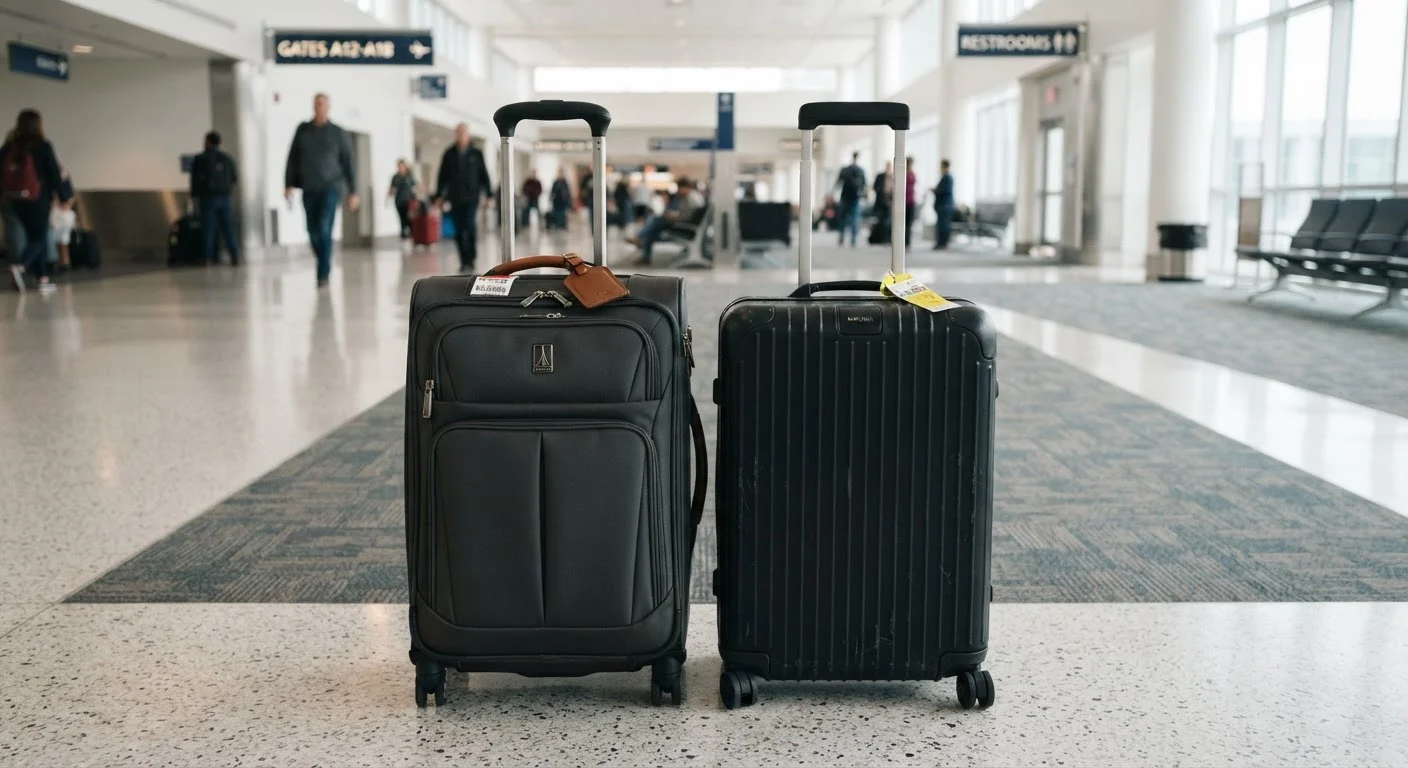
Why the Luggage Shell Type Actually Matters
Most travelers pick luggage based on price or looks, but the structural design — soft fabric exterior versus rigid shell — has real, practical consequences for how your bag performs across different trip types. Understanding what each construction does and doesn't do well is more useful than any blanket recommendation.
The decision intersects with how you travel: do you check bags or carry on? Are you hopping between flights or taking a single long-haul trip? Do you pack precisely or squeeze in a little extra? Your answers shape which type is genuinely the better fit.
If you're still working out how your overall luggage strategy fits together, the comparison in carry-on only vs. checked luggage is worth reading alongside this guide.
The Case for Soft-Sided Luggage
Soft-sided bags — made from materials like ballistic nylon, polyester, or canvas — have remained popular precisely because they offer practical advantages that rigid cases cannot replicate.
Lighter empty weight preserves airline allowance
Soft-sided bags typically weigh less than comparable hard-shell cases, which can mean an extra pound or two of usable weight allowance before airline fees kick in.
Flexible exterior compresses into tight spaces
Soft bags can flex slightly when overfull, making them easier to fit into crowded overhead bins or car trunks where a rigid case would simply not close.
External pockets for quick-access storage
Most soft-sided designs include exterior pockets — useful for passports, boarding passes, chargers, or snacks that you need without opening the main compartment.
Generally easier to repair if damaged
A torn zipper or small fabric tear on a soft bag can often be repaired by a luggage shop or cobbler, whereas a cracked hard-shell panel typically means replacement.
Often more versatile in casual or outdoor settings
Soft bags tend to feel less conspicuous in non-hotel travel settings and can be easier to carry on uneven terrain where wheels don't roll smoothly.
The flexibility of a soft-sided bag pays off most visibly at the airport gate. A bag that's even slightly overpacked can compress enough to fit into an overhead bin where a hard-shell case cannot. External pockets also give you quick access to documents, chargers, and snacks without digging through your main compartment — a small convenience that adds up on long travel days.
Because soft bags tend to weigh less on their own, you preserve more of your airline's weight allowance for actual belongings. If you're trying to travel light, pairing a soft suitcase with smart organization tools like those covered in packing cubes vs. compression bags can make a real difference in how efficiently you use the space.
The Case for Hard-Shell Luggage
Hard-shell cases — most commonly made from polycarbonate, ABS plastic, or aluminum — offer a different set of trade-offs that suit specific travel styles and cargo types very well.
Less protection for fragile or rigid contents
Soft fabric offers little resistance to crushing or sharp impacts, making it a poor choice for transporting cameras, glass, or anything that can't absorb compression.
Harder to keep organized without interior structure
Without fixed dividers or a rigid frame, soft bags can become chaotic inside unless you use packing cubes or other organizers to impose order.
More vulnerable to slashing and tampering
Soft fabric can be cut more easily than a hard shell, which is a consideration in higher-risk travel environments or when a bag will be left unattended.
Limited interior volume — no expansion on rigid cases
Hard-shell cases with a fixed interior do not compress or expand; if you overpack, the bag simply will not close, leaving no flexibility for last-minute additions.
Heavier empty weight on many models
Hard-shell cases — particularly those made from aluminum or thick polycarbonate — can weigh significantly more than soft bags of the same size, eating into your usable weight allowance.
Scratches and scuffs are highly visible
Hard-shell cases show cosmetic wear quickly, especially in darker colors or glossy finishes, which bothers some travelers even when the structural integrity is unaffected.
The structural rigidity that defines a hard-shell bag works in its favor when bags are being stacked, thrown onto conveyor belts, or exposed to rain on a tarmac. For travelers carrying cameras, glass items, or anything that would be damaged by a sharp impact, a hard-shell case provides a meaningful level of passive protection that fabric simply cannot match.
One underappreciated benefit is theft resistance: a hard-shell case with a quality zipper or locking mechanism is harder to slash open quickly than a soft bag. This doesn't make it theft-proof, but it raises the difficulty level noticeably in higher-risk environments.
Spinner Wheels and Shell Type Are Separate Decisions
Both soft-sided and hard-shell luggage now commonly come with four-wheel spinner configurations. The number and quality of wheels is an independent factor from shell construction — a hard-shell bag can have poor wheels, and a soft bag can roll exceptionally smoothly. When evaluating any bag, check the wheel housing and axle quality separately from the material of the shell itself.
The downside of a fixed interior is that packing strategy becomes more important. Techniques like those described in rolling, folding, or bundle wrapping help you maximize a rigid case's interior without wasted space.
What to Weigh When Making Your Choice
Rather than defaulting to one type, match the construction to your trip profile:
- Checking bags frequently? A hard-shell case holds up better to baggage handling over time.
- Carry-on only traveler? A soft bag's flexibility gives you more margin when bins fill up.
- Traveling with fragile or valuable items? Hard-shell provides passive protection that soft bags don't.
- Packing strategically for a week in a single bag? Soft-sided bags work well alongside clothing choices for one carry-on approaches.
- Concerned about weight limits? Check the bag's listed empty weight — soft bags typically have an edge here.
Also consider where the bag is made and what warranty the manufacturer offers. A well-constructed soft-sided bag will outlast a poorly made hard-shell, and vice versa. Shell type is one variable; quality of materials and construction is another, and often the more decisive one.
If packing myths are driving your luggage choices — like the idea that a bigger bag always gives you more flexibility — it's worth revisiting those assumptions in light of common packing myths.
~30%
Weight difference between shell types
Consumer testing has generally found soft-sided bags run roughly 20–30% lighter than hard-shell cases of comparable size, though this varies significantly by brand and materials.
4-wheel spinners
Now standard across both luggage types
Four-wheel spinner systems have become the dominant wheel format for both soft and hard-shell luggage in the mid-to-premium segment of the market.