
What a Smart Home Device Actually Does
At its core, a smart home device is any household item — a lamp, an outlet, a thermostat, a doorbell — that can connect to your home network and be controlled through a smartphone app, a voice assistant, or an automated schedule. Instead of walking across the room to flip a switch, you can tap a button from your couch, set a timer so lights turn off automatically, or have your porch light switch on at sunset every evening without touching anything.
The "smart" part comes from the device's ability to send and receive instructions over the internet, usually through a manufacturer's cloud service. This means the device isn't just responding to you in the room — it can respond to rules, schedules, location triggers, or commands from anywhere in the world.
Smart plug
An adapter that fits into a standard wall outlet and gives you remote or scheduled control over whatever appliance is plugged into it.
Hub
A central device that connects and coordinates multiple smart home devices, especially those from different brands or that use different wireless protocols.
Voice assistant
Software that responds to spoken commands — like Amazon Alexa or Google Assistant — and can be used to control compatible smart devices hands-free.
2.4 GHz band
One of the two main Wi-Fi frequencies. It travels farther and penetrates walls better than 5 GHz, which is why most smart home devices use it.
Firmware
The built-in software that runs on a smart device. Manufacturers release firmware updates to fix bugs and patch security vulnerabilities.
Automation / Routine
A pre-set rule that tells a smart device to do something automatically — for example, turning lights on at sunset or off at a set bedtime — without any manual input.
Where to Start: Choosing Your First Device
For most people, the two lowest-friction starting points are a smart plug or a smart bulb. Here's why:
- Smart plugs slot into any standard outlet and make whatever is plugged into them controllable remotely. They don't require any rewiring or technical knowledge. You can use one to automate a lamp, a fan, or a coffee maker.
- Smart bulbs screw into existing light sockets and let you adjust brightness or color through an app. They're particularly useful for setting moods or building bedtime routines.
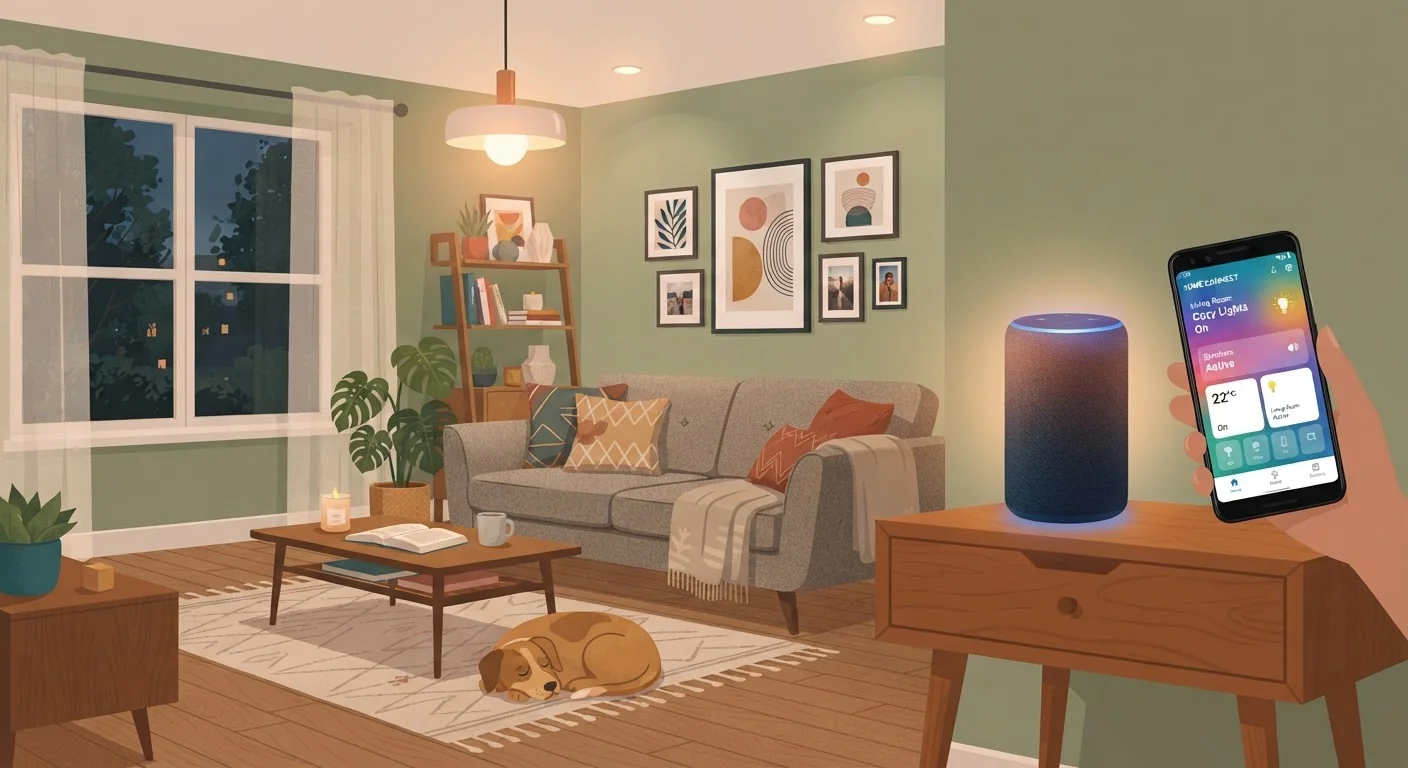
A smart speaker with a built-in voice assistant is also a common first purchase. It acts as a control hub you can talk to — useful once you have more devices, but less essential as your very first device if you're just exploring.
Avoid starting with a smart thermostat or smart lock as your entry point — both involve more complex installation and carry higher stakes if something goes wrong. If you're also tackling broader home improvements, the Home Improvement Primer for First-Time Homeowners covers how to think about projects like these in a wider context.
What You Need Before You Plug Anything In
Before buying any smart device, confirm you have the following in place:
- A reliable home Wi-Fi network. Nearly every consumer smart device depends on Wi-Fi. If your network is spotty or the signal doesn't reach certain rooms, devices in those spots will disconnect frequently. See our guide to setting up a home network from scratch for a thorough walkthrough.
- A 2.4 GHz network band available. Most smart devices use the 2.4 GHz band, not 5 GHz. If your router only broadcasts one combined network, it likely handles this automatically — but some routers keep the bands separate, and you'll need to connect to the right one during setup.
- A smartphone and the device's app. Setup is app-driven. Download the manufacturer's app before you open the box so you're not scrambling during installation.
- An account with the device's platform. Most devices require you to create a free account (e.g., with Amazon, Google, or the manufacturer). Have your login ready.
Check Compatibility Before You Buy
If you already own a voice assistant — like an Amazon Echo or Google Nest speaker — look for devices that explicitly state compatibility with that platform. Mixing incompatible ecosystems can mean juggling multiple apps and losing the ability to automate devices together. When in doubt, the device's packaging or the manufacturer's website will list supported platforms clearly.
Setting Up and What to Realistically Expect
Most basic smart devices follow the same setup pattern: plug in the device, open the app, create or sign into your account, and follow the pairing steps — which typically involve connecting the device to your Wi-Fi by temporarily joining a network the device broadcasts. The whole process usually takes 5–15 minutes.
What to expect realistically:
- It may take a few tries to pair. Wi-Fi interference, a weak signal, or being connected to the wrong band are the most common causes. Move closer to your router if the first attempt fails.
- Voice assistant integration is a second step. If you want to control your device by voice, you'll link it to your Alexa, Google Home, or Apple HomeKit account separately, after the device itself is set up.
- Automation takes a little learning. Schedules and routines are powerful but require a few minutes in the app to configure. Start simple — "turn off at 11 PM" — before building complex automations.
The payoff for that initial effort is genuine: lights that match your schedule, outlets you can switch off remotely, and a foundation you can expand at your own pace.
Privacy and Security Basics
Smart devices are always-on network nodes in your home, which means taking a few basic precautions is worthwhile from day one.
- Change default passwords immediately. Any device that ships with a generic login (like "admin/admin") should have its password updated before it's connected to your network.
- Keep firmware updated. Manufacturers regularly push security patches. Enable automatic updates in the app where possible, and check manually every few months.
- Use a strong, unique Wi-Fi password. Your smart devices are only as secure as the network they're on. A weak Wi-Fi password is an easy entry point.
- Consider a guest network. Some routers let you create a separate network for smart devices, isolating them from computers or phones that hold more sensitive data. This is a sensible step if your router supports it.
You don't need to be a security expert to use smart home devices safely — these four habits cover the large majority of common vulnerabilities for household users.
Home Network Setup Guide
A step-by-step walkthrough for setting up a reliable home Wi-Fi network — essential reading before adding any smart devices to your home.
Smart Home App (Manufacturer's Official App)
Each smart device comes with a companion app for setup, scheduling, and control. Download it from the App Store or Google Play before opening the device box.
Router Admin Panel
Accessible via your browser using your router's IP address, this panel lets you view connected devices, separate network bands, and set up a guest network for your smart home devices.