
Why Old Charging Advice Doesn't Apply Anymore
Much of the charging wisdom circulating online — drain it to zero, never plug it in overnight, always use the original charger — was written for nickel-cadmium (NiCd) and nickel-metal hydride (NiMH) batteries. Those chemistries had a real problem called memory effect, where partial charging would cause the battery to "forget" its full capacity over time.
Today's smartphones, laptops, and tablets almost universally use lithium-ion (Li-ion) or lithium-polymer (LiPo) batteries. These cells work on entirely different electrochemical principles, and the old rules don't just fail to help — in some cases, following them actively damages your battery.
Understanding what your lithium battery actually needs takes less than five minutes and can meaningfully extend how long your device performs well. For a broader look at what quietly reduces your battery's daily performance, see why your gadget's battery drains faster than it should.
Myth
You should drain your battery to 0% before recharging to maintain its capacity.
Fact
Fully depleting a lithium battery regularly causes measurable damage. Partial discharges are far healthier for Li-ion cells.
This rule applied to older NiCd batteries, which suffered from memory effect. Lithium-ion cells have no such issue. In fact, each time a Li-ion battery is fully discharged to zero, it undergoes a deep discharge cycle that stresses the cell chemistry and accelerates capacity loss. Battery researchers generally recommend keeping a lithium battery between 20% and 80% for day-to-day use to maximize the number of healthy charge cycles it completes over its lifetime.
Myth
Leaving your phone plugged in overnight will overcharge the battery and destroy it.
Fact
Modern devices have charge-management circuits that stop drawing current once the battery reaches 100%, preventing true overcharge.
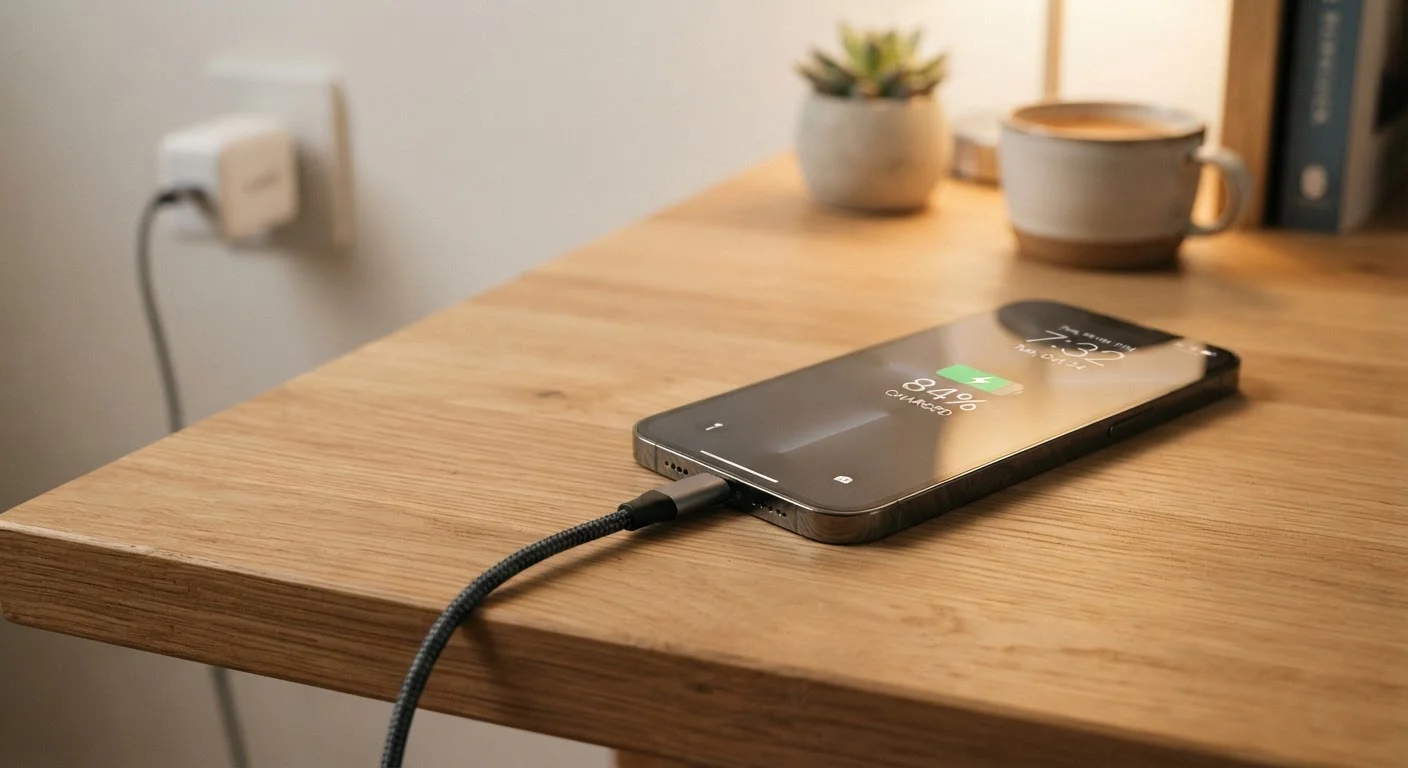
Every contemporary smartphone, laptop, and tablet contains a battery management system (BMS) — a small chip that monitors voltage, temperature, and charge state. Once the battery hits full charge, the BMS switches the device to run directly off wall power and stops charging the battery. The concern about overnight charging is not overcharging per se, but the fact that most chargers then top the battery back up to 100% each time it dips slightly, keeping it in a high state of charge for many hours. This is why some manufacturers offer scheduled or adaptive charging that learns your routine and delays the final charge until shortly before you typically wake up.
Myth
Using a fast charger damages your battery faster than a standard charger.
Fact
Fast charging supported by the manufacturer is engineered to be safe. Occasional use has a negligible impact on long-term battery health.
Fast charging does generate more heat than slow charging, and heat is a genuine stressor for lithium batteries. However, modern fast-charging systems — such as those built into flagship smartphones — include thermal management protocols that slow the charge rate when temperatures rise. The overall degradation from manufacturer-supported fast charging used normally is small. Where users run into trouble is using third-party chargers that exceed the device's rated input, or fast charging a device that's already hot from gaming or outdoor use.
Myth
You must always use the original charger that came in the box.
Fact
Any charger that meets your device's voltage and current specifications and carries appropriate safety certification will work without harming the battery.
The charger that ships with a device is simply one that the manufacturer knows meets spec. What matters is the voltage output, current rating, and connector standard — not the brand logo on the brick. USB Power Delivery (USB-PD) is a widely adopted standard that allows many chargers to communicate with devices and negotiate the appropriate power level automatically. Look for chargers that carry relevant safety certifications (such as UL listing in the US) and match your device's rated input. Avoid uncertified no-name chargers, which may not regulate voltage reliably — but certified third-party chargers from established manufacturers are generally fine.
Myth
Wireless charging is harder on batteries than wired charging.
Fact
Wireless charging is slightly less efficient and generates a bit more heat, but used normally it does not meaningfully shorten battery lifespan.
Wireless (inductive) charging transfers power less efficiently than a direct wired connection, meaning some energy is lost as heat during the process. Heat, as noted, is not ideal for lithium cells. However, the temperature increase from standard wireless charging pads is modest and well within the safe operating range of modern batteries. Where wireless charging can become a problem is when the phone is inside a thick case that traps heat, or when the pad and phone are slightly misaligned and generating excess heat from inefficient coupling. Remove thick cases when wirelessly charging if you notice the device getting warm.
Practical Habits That Actually Protect Your Battery
Now that the myths are cleared up, here are the habits that battery researchers and device manufacturers broadly agree on:
- Aim for 20–80% charge most days. You don't have to be obsessive about it, but avoiding consistent full charges and complete drains adds charge cycles to your battery's life. Many devices now include a setting to cap charging at 80% for this exact reason.
- Avoid heat exposure during charging. Don't charge your phone under a pillow, in direct sunlight, or inside a car on a hot day. Heat is the single biggest accelerant of lithium battery degradation. Check your device's temperature settings — many modern phones will temporarily slow or pause charging when they detect excessive heat.
- Use fast charging selectively. Fast charging is convenient and generally safe when used as the manufacturer intended. If you're not in a hurry, a slower charge is marginally gentler on cells, but the difference in daily use is small.
- Keep the battery out of extended 100% or 0% states. If you're storing a device for weeks, charge it to around 50% first. Storing at full charge or fully depleted accelerates chemical aging.
These habits slot naturally into the bigger picture of keeping your devices running longer. The practical habits that keep devices running longer covers storage temperature, update cycles, and other often-overlooked factors beyond just charging.
It's also worth visiting your device's settings menu. Many phones and laptops now include dedicated battery health or charging optimization features that automate some of these practices for you. The overlooked settings that change how your device actually behaves explains where to find them and what they actually do.
Car Batteries Follow Different Rules
Everything in this article applies to lithium-ion batteries in consumer electronics — not lead-acid car batteries. Car batteries operate on entirely different chemistry and have their own maintenance requirements. If you're curious about vehicle battery care, the car battery basics guide covers lifespan, warning signs, and safe maintenance separately.