
The Basic Mechanic: Fighting Sound With Sound
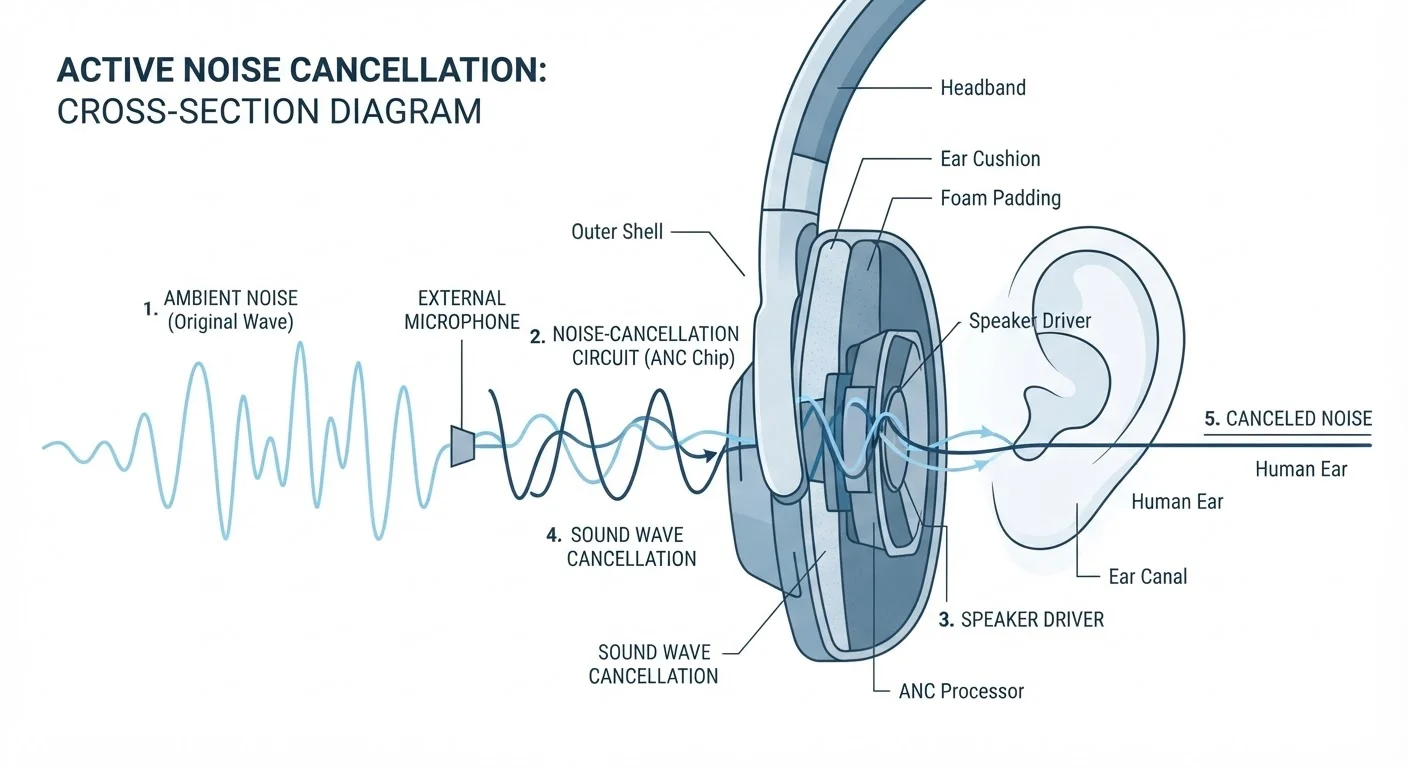
Sound travels as waves — alternating compressions and expansions of air. ANC technology exploits a simple physics principle: when two identical waves meet perfectly out of phase with each other, they cancel out. This is called destructive interference.
Here's how it happens in practice inside a pair of headphones:
- Microphones listen. Tiny microphones on the outside of the ear cup continuously sample the incoming noise in your environment.
- A processor analyzes the wave. A dedicated chip reads the sound's frequency and amplitude in milliseconds and calculates its inverse — a mirror image shifted 180 degrees.
- The speaker plays the anti-signal. The headphone driver plays this inverted wave simultaneously with your audio. The two signals combine in your ear canal and largely neutralize each other.
The entire loop — sample, compute, respond — must complete in under a millisecond to be effective, which is why the processor inside an ANC device matters as much as any other component.
“Active noise cancellation doesn't remove sound — it adds sound. The net effect at your eardrum is silence, but the mechanism is entirely additive. You're always hearing two signals; you just don't notice one of them.”
— Audio engineering researcher (paraphrased from published acoustics literature), Acoustics and signal processing researcher
Where ANC Excels — and Where It Struggles
ANC is not a universal mute button. Its effectiveness depends heavily on the type of noise you're dealing with.
Where it performs well
- Low-frequency drones — airplane cabin hum, bus engines, HVAC systems. These are steady, predictable, and slow-moving enough for the processor to track accurately.
- Consistent background rumble — train vibration, road noise in a car, fans and generators.
Where it falls short
- Human speech — voices are complex, varied, and change too rapidly for most ANC systems to invert cleanly.
- High-frequency sounds — clicks, clatter, sharp alarms. The wavelengths are short enough that even minor timing errors cause the anti-signal to miss.
- Sudden or unpredictable sounds — a door slamming, a dog barking. The processor can't predict them fast enough to generate an effective counter-wave.
20–30 dB
Typical low-frequency noise reduction from ANC
Audio engineering reviews generally find that well-implemented ANC systems reduce consistent low-frequency noise by roughly 20 to 30 decibels in real-world conditions.
~1 ms
Processing loop time required for effective ANC
For destructive interference to work accurately, the entire sample-compute-respond cycle must complete in approximately one millisecond or less.
85 Hz–1 kHz
Frequency range where ANC works best
Most ANC systems are most effective below 1 kHz; performance drops significantly at higher frequencies where wavelengths become too short to cancel reliably.
This is why ANC headphones in a loud coffee shop often feel less effective than on a long flight — the acoustic environment is far less predictable.
Passive Isolation: The Unsung Partner
Most people don't realize that the physical fit of their headphones does a significant share of the noise-reduction work. Passive noise isolation — the seal created by ear cushions pressing against your head — blocks mid- and high-frequency sound mechanically, the same way earmuffs at a shooting range work.
ANC and passive isolation operate on different parts of the frequency spectrum, which is why they complement each other. ANC handles the low rumble that physical padding struggles to block; the ear cup's seal handles the higher frequencies that ANC can't efficiently cancel.
This means the fit of your headphones — how firmly and evenly the ear cups seal around your ears — directly affects how well ANC performs. A loose or poorly fitting ear cup undercuts both systems at once.
If you're curious how other audio devices process and respond to ambient sound, the same principles apply to how smart speakers handle voice commands in noisy environments.
Feedforward vs. Feedback vs. Hybrid ANC
Not all ANC systems are designed the same way. The position of the microphone changes how the system hears and responds to noise.
- Feedforward ANC
- The microphone sits on the outside of the ear cup, sampling noise before it enters. This gives the processor a head start, but it can't account for sound that leaks through the ear cup itself.
- Feedback ANC
- The microphone sits inside the ear cup, closer to your ear. It hears what you actually hear — including any leakage — and corrects accordingly. The tradeoff is slightly less processing lead time.
- Hybrid ANC
- Uses microphones in both positions simultaneously, combining the advantages of each approach. This is the most effective configuration and is common in higher-quality devices.
Understanding which type a device uses gives you a clearer picture of what you're actually paying for beyond brand marketing.