
What Happens the Moment You Speak
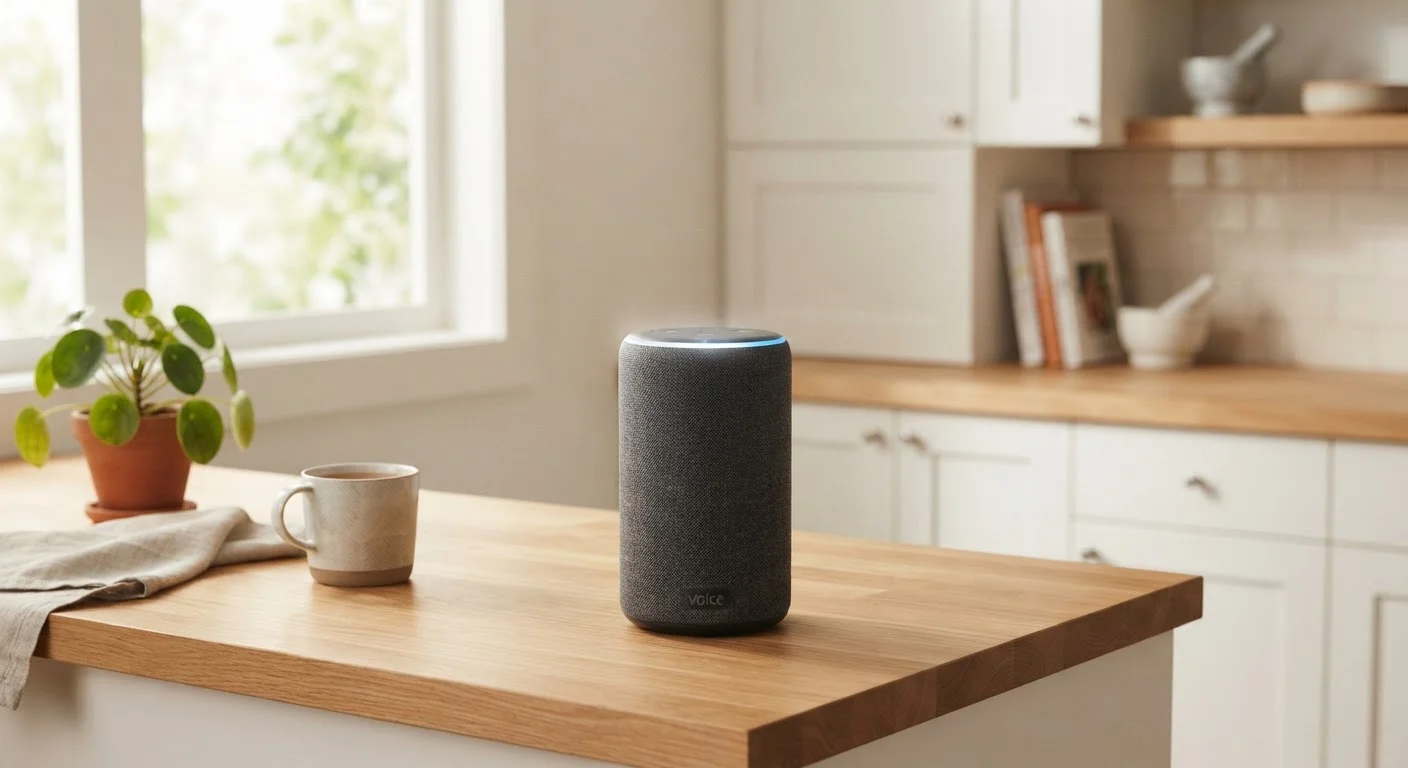
When you say a wake word, two distinct things happen in quick succession. First, a small, low-power chip inside the speaker — running continuously — recognizes the specific sound pattern it was trained to detect. This step happens entirely on the device, offline, with no data sent anywhere. Second, once that trigger fires, the speaker begins recording your actual request and streams that audio to cloud servers operated by the assistant provider.
Those servers apply natural language processing — a branch of artificial intelligence that interprets spoken words and intent — and send a response back to your speaker within a second or two. The spoken answer you hear, the song that starts playing, or the light that switches on: all of that is orchestrated remotely. The speaker itself is primarily a microphone array, a speaker driver, and a Wi-Fi radio. The 'brain' is elsewhere.
Understanding this split matters for a practical reason: if your internet goes down, the device essentially stops working. It's not a standalone computer. It's a well-designed terminal for a cloud service. For a deeper look at the wireless connection your speaker relies on, see how Wi-Fi, Bluetooth, and NFC each work.
Beyond Music: What Smart Speakers Actually Do
Music playback is the feature most people use first, but it represents a small fraction of what these devices handle. Here are the functional categories worth knowing:
- Information queries: Weather forecasts, unit conversions, sports scores, general knowledge — the assistant queries the web and reads back a summary.
- Smart home control: Compatible lights, thermostats, plugs, and locks can be turned on, adjusted, or scheduled by voice. Compatibility depends on the device supporting the assistant's ecosystem or a shared standard like Matter.
- Reminders, timers, and calendar: Voice-set reminders sync to your linked account and can appear across other devices, not just the speaker.
- Communication: Many speakers can place calls or send messages to contacts, using your linked phone account or a platform-specific calling feature.
- Routines: Multiple actions can be chained together and triggered by a single phrase — for example, saying 'good morning' could turn on lights, read the weather, and start a playlist simultaneously.
If you're thinking about expanding beyond a single speaker into a broader setup, starting a smart home is a natural next step.
~35%
U.S. adults who own a smart speaker
According to Pew Research Center survey data, roughly a third of American adults report owning a smart speaker as of recent years.
3–7
Microphones in a typical smart speaker array
Multiple microphones enable beamforming, which allows the device to isolate a speaker's voice and reduce background noise across a room.
~1–2 sec
Typical cloud round-trip response time
From wake word to spoken response, most smart speakers complete the full cloud processing cycle in roughly one to two seconds on a stable broadband connection.
The Privacy Trade-Off You Should Understand
The always-on microphone is the feature that generates the most legitimate concern, and it deserves a straight explanation rather than a dismissal. The wake-word detection chip runs locally and is not transmitting audio to any server — that part is genuinely offline. But false activations do occur, and when they do, audio gets sent to the cloud unintentionally. Providers have publicly acknowledged this.
Most services give users meaningful controls: you can review stored voice history, delete individual clips or entire histories, and opt out of having clips reviewed by human quality-assurance teams. Physical mute switches, present on most models, cut microphone power entirely — not just a software mute, but an actual hardware interrupt that prevents any audio capture.
The data that does get collected — voice clips and usage patterns — is generally used to improve assistant accuracy and, depending on the provider's privacy policy, may inform advertising profiles. Reading the provider's data policy before setup is a reasonable habit, not paranoia.
Voice History Is Reviewable — and Deletable
Most smart speaker platforms provide a companion app or web dashboard where you can listen to stored voice clips, delete individual entries, or clear your entire history. Setting a reminder to review this periodically — monthly, for example — is a manageable privacy habit that takes only a few minutes.
Smart Home Compatibility Isn't Universal
A smart speaker doesn't automatically work with every smart home gadget. Compatibility depends on the assistant platform and which communication standards or ecosystems the gadget supports. The Matter standard, introduced to improve cross-platform compatibility, is increasingly common but not yet universal across all devices.
What the Hardware Inside Actually Does
Smart speakers vary in audio quality and microphone sensitivity, but the internal architecture follows a consistent pattern. A microphone array — typically three to seven microphones arranged in a ring or line — uses a technique called beamforming to isolate your voice direction and filter out background noise. This is why these devices can hear you across a noisy room.
A small processor handles the wake-word detection and manages network communication. Audio playback goes through an amplifier and one or more speaker drivers tuned for the enclosure size. Larger models tend to have more powerful amplifiers and dedicated tweeters for high-frequency reproduction. The speaker quality is real hardware — those differences are audible — but they have nothing to do with how 'smart' the device is. Intelligence is in the cloud service, not the enclosure.
Curious about how the processors in your other devices compare? what a processor actually does breaks down what chips handle and why it affects everyday performance.