
Steady vs. Flashing: The First Thing to Notice
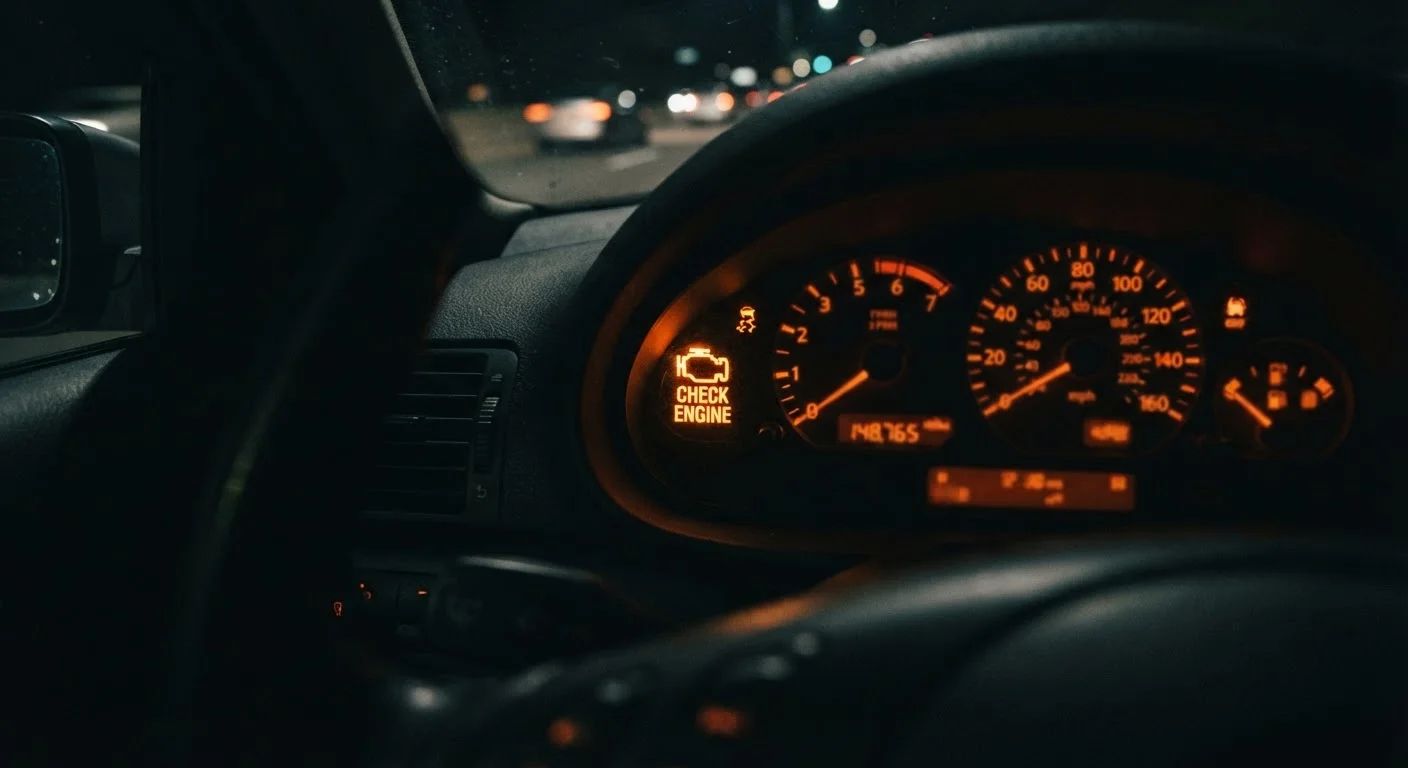
The very first thing to do when your check engine light comes on is to look at how it's behaving. This single detail tells you a lot about urgency.
Steady light: The car's computer has logged a fault, but it's not detecting an active catastrophic event. You have time to drive to a shop or auto parts store for a scan — ideally within a day or two, not weeks.
Flashing light: This is more serious. A flashing check engine light almost always indicates an engine misfire — meaning fuel is burning incompletely. Unburned fuel passing into the exhaust system can quickly destroy a catalytic converter, an expensive component. If your light is flashing, ease off the throttle and get the vehicle checked as soon as safely possible.
Also pay attention to how the car feels. If the engine is running roughly, stalling, or you've lost significant power, treat the situation as urgent regardless of whether the light is steady or flashing. For other warning signs beyond the check engine light, see our guide on noises your car makes and what each one suggests.
Check Your Gas Cap First
Before heading to a shop, pull over safely, remove your gas cap, and reinstall it firmly until it clicks. A loose cap is one of the most frequent check engine light triggers and costs nothing to fix. Drive normally for a day or two — if the cap was the culprit, the light will typically go off on its own.
What Actually Triggers the Light
The check engine light is connected to your car's OBD-II system, which monitors dozens of sensors across the engine, transmission, and emissions systems. When any reading falls outside acceptable parameters, the computer logs a code and lights the lamp.
Common causes include:
- Loose or faulty gas cap — Allows fuel vapors to escape the sealed fuel system.
- Faulty oxygen sensor — Oxygen sensors measure exhaust gases to help the engine burn fuel efficiently. A bad sensor can reduce fuel economy and, over time, damage the catalytic converter.
- Catalytic converter failure — This emissions component breaks down harmful gases. When it fails, performance and fuel economy drop.
- Mass airflow sensor fault — Measures the air entering the engine. A faulty reading causes poor fuel metering.
- Spark plug or ignition coil issues — Worn plugs or coils cause misfires, which often produce a flashing light.
- Evaporative emissions (EVAP) leak — A small leak anywhere in the fuel vapor system can trigger a code.
It's worth noting that the stored code identifies the system with the fault, not necessarily the exact broken part. A code for an oxygen sensor circuit, for example, could mean a bad sensor, a wiring problem, or an exhaust leak upstream. Professional diagnosis is needed to pinpoint the cause.
~10%
U.S. cars with a check engine light on at any given time
Industry estimates from automotive diagnostic data suggest roughly 1 in 10 vehicles on U.S. roads is carrying an active check engine fault at any moment.
$800–$1,500+
Typical catalytic converter replacement cost
Repair cost estimates from automotive service data reflect U.S. averages; actual costs vary by vehicle make, model, and region.
How to Get the Code — and What to Do Next
Your car's computer stores a fault code every time the check engine light triggers. Retrieving that code is step one. Here's how it typically works:
- Visit an auto parts store. Many chains offer free OBD-II code reading. They plug a scan tool into the diagnostic port (usually located under the dashboard near the steering column) and print or display the stored codes.
- Understand the code format. Codes follow a pattern like
P0420. The letter indicates the system (P = powertrain, B = body, C = chassis, U = network). The numbers narrow it down further. - Research or consult a mechanic. The code is a starting point, not a final answer. A shop can perform a deeper inspection to confirm the actual fault before parts are replaced.
It's also a good habit to check your vehicle's fluid levels whenever a warning light appears — low oil or coolant can sometimes trigger related codes. Our guide to car fluids every driver should know how to check walks through the basics. And if you're seeing brake-related symptoms alongside the check engine light, our article on brake warning signs that shouldn't be ignored covers what to watch for.
Why Ignoring It Costs You More
It can be tempting to put a piece of black tape over the light and move on. But the longer a fault goes unaddressed, the more likely it is to cascade into larger problems.
A failing oxygen sensor, left unchecked, can damage the catalytic converter — a part that commonly runs $800–$1,500 or more to replace. A misfiring engine can damage cylinder walls and pistons over time. In short, a $100 diagnostic fee and a modest repair today is often far less costly than the repair you'll face in six months.
Your owner's manual is also worth consulting when any warning light appears — it contains the maintenance schedule your manufacturer designed specifically for your vehicle. See our overview of reading your owner's manual for guidance on making the most of it.
The check engine light is not an emergency siren, but it's not background noise either. Think of it as your car asking for a conversation — one worth having sooner rather than later.
This article is for general informational purposes only and is not a substitute for professional mechanical advice. If you are uncertain about your vehicle's condition, consult a qualified mechanic.