

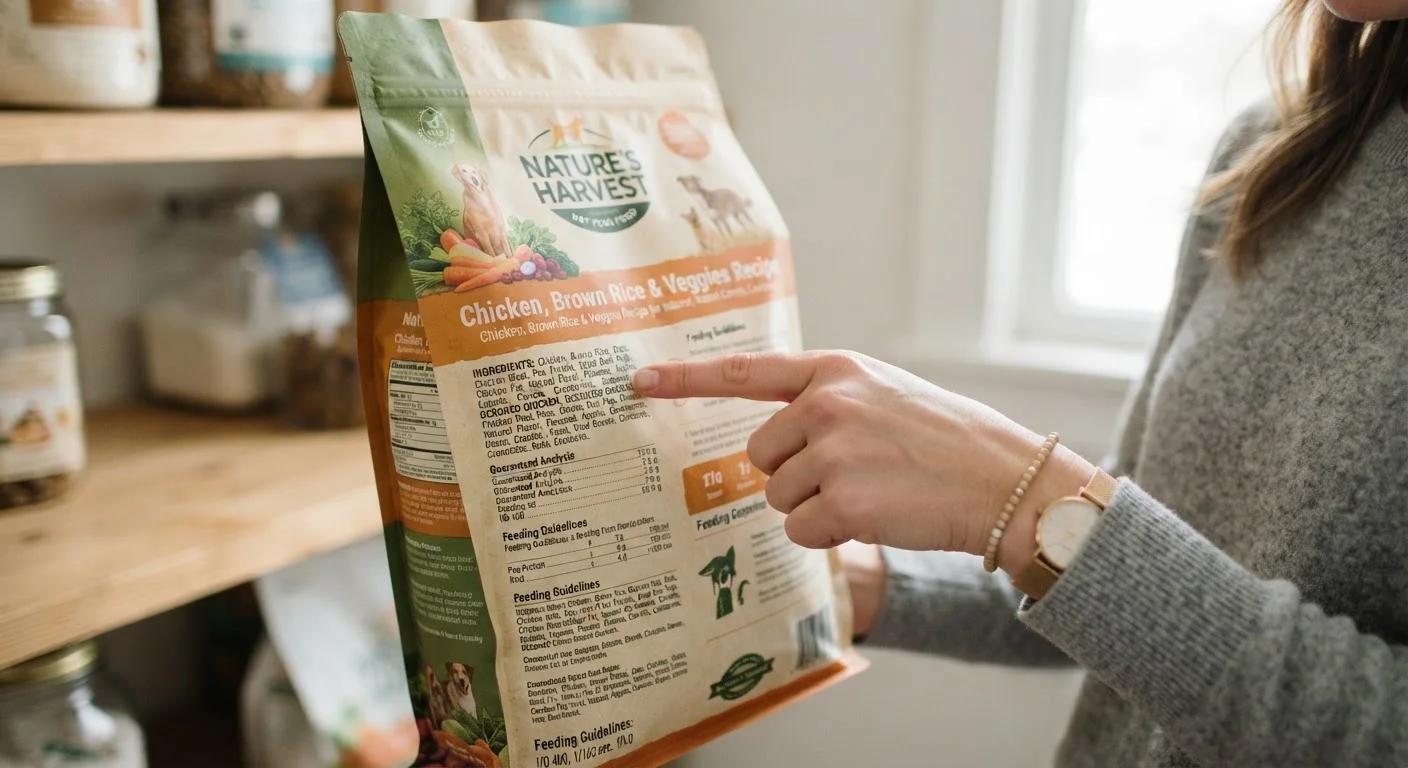
Why Ingredient Labels Feel So Confusing
Pick up any bag of dog food and flip it over. The ingredient list often runs three or four dense lines, packed with terms like "chicken meal," "dried beet pulp," and "mixed tocopherols." It's easy to feel like you need a chemistry degree just to decide what to feed your dog.
The good news is that U.S. dog food labels follow rules set by the Association of American Feed Control Officials (AAFCO) and enforced at the state level. Once you understand the structure those rules create, the label becomes a lot more readable. This guide walks you through that structure step by step.
If you're also weighing kibble against canned options, our guide to wet food vs. dry food explains how format affects nutrition and convenience.
What You'll Need Before You Start
Reading a label doesn't require any special tools, but having a few things on hand makes the process smoother.
What you will need
How to Read the Label, Step by Step
Follow these steps with a dog food bag in front of you for the best results. The process takes only a few minutes once you know what to look for.
Locate the ingredient list
On dry kibble bags, the ingredient list is usually on the back or side panel. On canned food, check the back label or the bottom of the can. Ingredients are required by AAFCO rules to be listed in descending order by weight before processing — meaning the heaviest ingredient (by raw weight) comes first.
Check what's at the top of the list
The first few ingredients make up the bulk of the food. Ideally, you want to see a named protein source — such as beef, chicken, turkey, or salmon — within the first two or three ingredients. A named protein tells you the species and is easier to evaluate than a vague term like "meat."
Keep in mind that whole proteins like "chicken" are weighed before cooking, when they still contain a lot of moisture. After processing, their contribution may be smaller than it appears. This is why chicken meal appearing third or fourth on a list isn't necessarily worse than whole chicken appearing first.
Scan for carbohydrate and fiber sources
Carbohydrates provide energy and often appear as grains (rice, oats, barley) or legumes (peas, lentils, chickpeas). Neither is automatically better or worse — dogs can digest a range of carbohydrate sources. Fiber ingredients like dried beet pulp or chicory root support digestive health and are added intentionally, not as cheap filler.
Review the vitamin and mineral additions
Near the bottom of the list, you'll find a cluster of vitamins and minerals — things like zinc sulfate, vitamin E supplement, and niacin. This section looks intimidating but is essentially the food's nutritional insurance policy. These additions ensure the food meets established nutrient levels. Their presence is expected and appropriate, not a red flag.
Find and read the AAFCO nutritional adequacy statement
Separate from the ingredient list, look for a statement confirming the food meets AAFCO nutritional profiles for a specific life stage. This statement also indicates whether validation came from feeding trials (which involve actual animals) or from formulation against a nutrient profile. Both are accepted methods, but feeding trials provide an additional layer of real-world evidence.
Common Terms That Trip People Up
A few phrases on ingredient lists are widely misunderstood, and clearing them up can prevent unnecessary worry — or misplaced confidence.
- "Meal" (e.g., chicken meal, salmon meal)
- This refers to a rendered product — meaning moisture has been removed, leaving a concentrated protein powder. Because it's measured after rendering, chicken meal can actually deliver more protein by weight than whole chicken listed higher on the label. It's not a lower-quality ingredient by definition.
- "By-products"
- By-products are animal parts other than muscle meat — organs, for example. Organ meats are nutrient-dense, and by-products are not inherently poor quality. Unnamed by-products ("meat by-products" with no species listed) are harder to evaluate, which is why a named source is preferable.
- "Natural flavors" or "artificial flavors"
- These are palatability enhancers added in very small quantities. Their presence near the bottom of the list generally means they aren't a meaningful nutritional contributor — they're there so your dog actually wants to eat the food.
- "Mixed tocopherols"
- This is simply a form of vitamin E used as a natural preservative. It's not a cause for concern.
Shorter Lists Aren't Always Better
Some owners assume a shorter ingredient list signals a cleaner, healthier food. In reality, a longer list often reflects the addition of vitamins, minerals, and functional ingredients that support complete nutrition. Focus on what the ingredients are, not how many there are.
It's also worth keeping perspective on ingredient splitting — a practice where a single ingredient (like peas) appears in multiple forms (pea flour, pea protein, pea starch) spread across the list. This can make that ingredient's total contribution appear smaller than it really is. If you notice several variations of one ingredient, consider their combined weight when evaluating the food. Our article on common dog health myths addresses several related misconceptions that can affect how owners interpret pet food marketing.
The One Statement That Matters Most
After scanning the ingredient list, find the AAFCO nutritional adequacy statement. This is usually a short sentence near the feeding guidelines, and it tells you something no ingredient list can: whether the food has been validated as complete and balanced for your dog's life stage.
Look for language like "formulated to meet the nutritional levels established by the AAFCO Dog Food Nutrient Profiles for adult maintenance" or "all life stages." A food that passed feeding trials will say so explicitly. If a food lacks this statement entirely, it may not be suitable as a primary diet.
Life stage matters too — a food formulated only for adult maintenance isn't appropriate for puppies or pregnant dogs, regardless of how strong the ingredient list looks. When you pair label literacy with a consistent feeding routine, you're setting your dog up well. Our piece on common feeding schedule mistakes covers the habits that can undermine even the best food choices.
This article provides general educational information about dog food labels and is not a substitute for personalized veterinary nutrition advice. If your dog has a health condition or specific dietary needs, consult your veterinarian before making changes to their diet.