
Why This Decision Is More Complex Than It Looks
Most cat owners eventually face this question, and the answer rarely fits neatly on a bumper sticker. Where your cat spends their time affects their lifespan, physical health, stress levels, and even your relationship with neighbors. Veterinary and animal welfare organizations generally recommend indoor living for safety reasons, but the picture has genuine nuance on both sides.
The right choice depends on factors specific to your cat — their age, temperament, and prior experience — as well as your local environment. A cat raised outdoors in a rural area faces a very different risk profile than one considering a first venture outside in a dense suburb near a highway. Understanding the real trade-offs helps you make a confident, informed decision rather than a guilt-driven one.
The Case for Keeping Cats Indoors
The safety argument for indoor living is well-supported. Studies consistently show that cats kept indoors live substantially longer on average, largely because they avoid traffic, predators, contagious disease, and human-caused harm. The American Veterinary Medical Association and most veterinary professionals acknowledge these risks as meaningful and not overstated.
Significantly longer average lifespan
Indoor cats are shielded from traffic, predators, disease transmission from other animals, and accidental poisoning. Veterinary data consistently reflects this in measurable lifespan differences.
Reduced exposure to parasites and infectious disease
Diseases like FIV (feline immunodeficiency virus) and FeLV (feline leukemia virus) are transmitted through contact with infected cats — a risk dramatically lower when a cat stays inside.
Easier to monitor health and behavior
When a cat stays home, changes in appetite, litter box habits, or energy levels are much easier to catch early, allowing faster veterinary intervention.
No neighbor or wildlife conflicts
Indoor cats don't wander into neighboring yards, chase protected wildlife, or create disputes over territory — a practical benefit in many communities.
Indoor life does require active effort from owners to meet a cat's mental and physical needs. A bored or under-stimulated indoor cat can develop anxiety, overgrooming, or destructive behavior. The good news is that these risks are manageable with intentional enrichment. See our guide to keeping indoor cats stimulated and active for practical strategies, and consider how a structured daily routine can meaningfully support your cat's wellbeing.
The Case for Outdoor or Hybrid Access
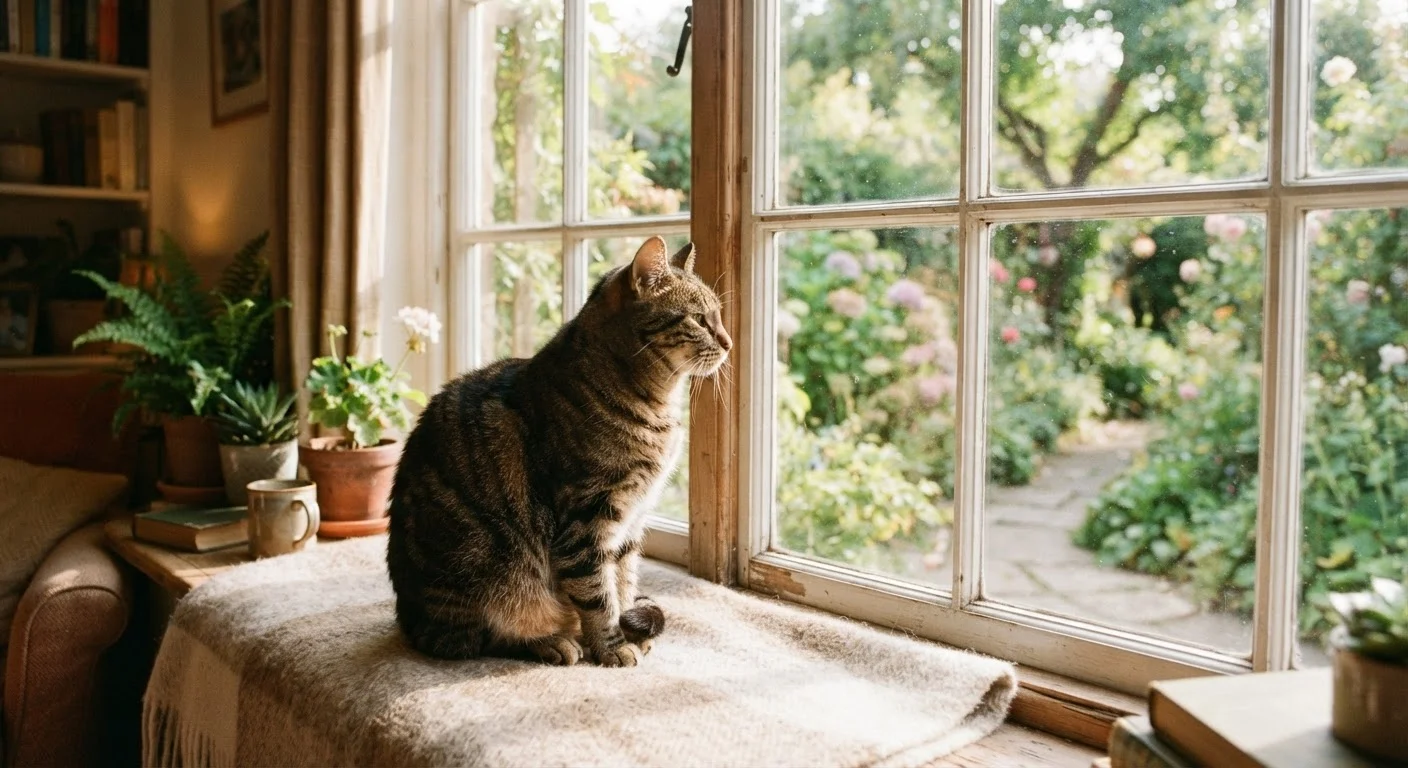
Outdoor access offers cats something genuinely difficult to replicate indoors: unscripted sensory experience. The sights, smells, textures, and sounds of the natural world engage a cat's instincts in ways that even excellent indoor enrichment cannot fully substitute. For cats with a strong outdoor drive — particularly those adopted as adults with outdoor history — confinement can cause visible distress.
Genuine enrichment requires consistent owner effort
Without outdoor stimulation, indoor cats depend entirely on their owners for mental and physical engagement. Neglecting this can lead to boredom-related behavioral issues.
May not suit cats with strong outdoor history
Adult cats accustomed to outdoor life can show chronic stress when confined, including restlessness, vocalization, and attempts to escape. Their prior experience matters significantly.
Outdoor access offers unmatched sensory richness
Natural environments engage feline instincts — hunting, climbing, scent-tracking — in ways that indoor toys and structures can only partially replicate.
Free-roaming outdoor cats face serious hazards
Traffic, predators, toxic plants, disease, and human cruelty are all real risks for cats that roam unsupervised, with the severity varying widely by location.
A hybrid approach, sometimes called a "catio" (an enclosed outdoor structure) or leash-and-harness walking, allows cats to experience the outdoors without free-roaming risks. This middle path has grown in popularity and works well for many households, though it requires setup time and a willingness to train your cat to a harness gradually.
10–15 yrs
Average indoor cat lifespan
According to the American Veterinary Medical Association, indoor cats typically live 10–15 years, compared to estimates of 2–5 years for free-roaming outdoor cats.
~63%
U.S. cats kept primarily indoors
The American Pet Products Association's National Pet Owners Survey has consistently found that a majority of owned cats in the U.S. are kept primarily or exclusively indoors.
What to Consider Before Deciding
Before settling on a lifestyle for your cat, work through a few honest questions:
- Your local environment: Are there busy roads, coyotes, or high rates of feline disease in your area? Urban and suburban settings typically carry higher free-roaming risk than rural ones.
- Your cat's history: A cat raised exclusively indoors may never show interest in going outside. An adult cat rehomed from an outdoor situation may struggle with confinement.
- Your capacity for enrichment: Indoor cats need more deliberate stimulation. If you travel frequently or work long hours, consider whether you can realistically meet that need — or whether a companion cat might help. Our multi-cat household prep checklist can help you plan that transition.
- Local wildlife and ecology: Free-roaming cats can impact local bird and small mammal populations, a consideration some owners weigh alongside their cat's individual welfare.
There is no shame in landing on any of these options. The goal is a choice that genuinely serves your cat's wellbeing and fits your real-life circumstances.