

What Makes These Two Types of Credit Different
Consumer debt broadly divides into two categories: revolving credit and installment loans. Understanding how each works is the first step to managing them strategically. For a broader overview of how these fit into the larger debt landscape, see The Full Picture of American Consumer Debt.
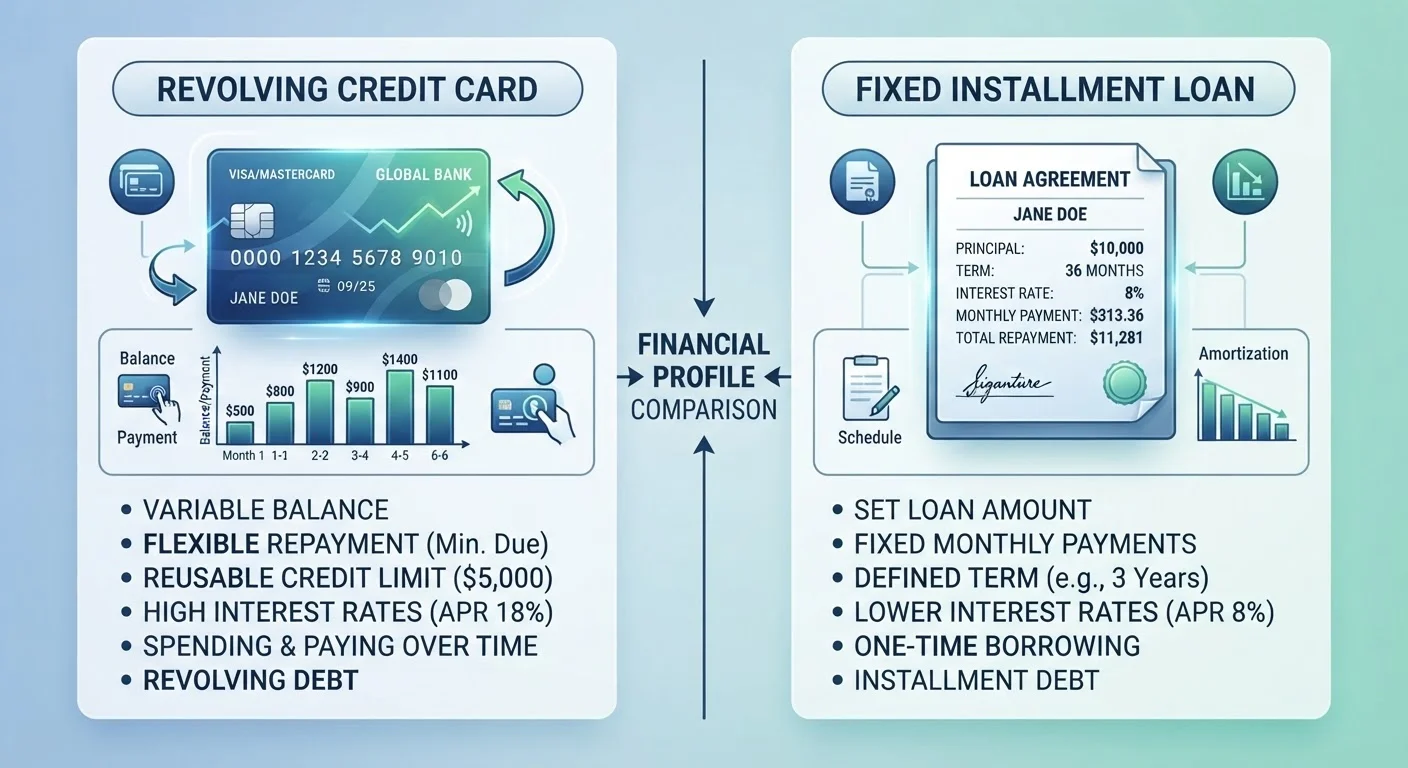
Revolving credit comes with a credit limit you can borrow against repeatedly. Credit cards are the most common example. You draw on the account, make payments, and your available credit replenishes. The balance can rise and fall month to month — there's no fixed endpoint.
Installment loans work differently. You borrow a lump sum upfront and repay it in equal, scheduled payments over a set term. Auto loans, mortgages, student loans, and personal loans all fall into this category. Once paid off, the account is closed.
That structural difference — open-ended versus fixed — is what drives how each account type behaves in your credit profile.
How Each Type Is Scored
Scoring models like FICO and VantageScore evaluate revolving and installment accounts using some shared factors and some account-specific ones.
Payment History (Applies to Both)
On-time payments are the single largest factor in most scoring models, accounting for roughly 35% of a FICO score. A missed payment on a credit card or a car loan does the same type of damage — though the severity depends on how late the payment is and how long it remains unpaid.
Credit Utilization (Revolving Only)
Utilization — the percentage of your revolving credit limit that's in use — only applies to revolving accounts. If you have a $10,000 total credit limit across your cards and carry a $3,000 balance, your utilization is 30%. Scoring models generally reward lower utilization. For a deeper look at why this ratio carries so much weight and what thresholds to be aware of, see Credit Utilization: The Ratio That Quietly Shapes Your Score.
Installment loan balances do affect your score, but not through the utilization calculation. What matters more is simply whether you're making payments on time.
Credit Mix
Scoring models reward having a variety of account types — typically around 10% of your FICO score. A profile with only credit cards or only installment loans signals a narrower borrowing history than one that includes both.
| Revolving Credit | Installment Loans | |
|---|---|---|
| Structure | Open-ended, reusable credit line | Fixed loan amount, set repayment term |
| Common examples | Credit cards, HELOCs | Mortgages, auto loans, student loans |
| Monthly payment | Variable — depends on balance | Fixed — same amount each period |
| Utilization impact | Yes — high balances raise utilization | No — not part of utilization calculation |
| Account stays open after payoff? | Yes — remains open with available credit | No — account closes upon final payment |
| Primary scoring risk | High utilization ratio | Missed or late payments |
| Contributes to credit mix? | Yes | Yes |
Common Mistakes That Hurt Your Profile
Both account types come with pitfalls worth knowing before you apply or close an account.
- Carrying high revolving balances: Even if you pay on time, a utilization ratio above 30% can drag down your score. Paying balances down — or making a mid-cycle payment — can help.
- Closing old credit card accounts: This reduces your total available credit, which pushes utilization up, and shortens your average account age — both potentially harmful moves.
- Taking on installment debt you don't need: The credit-mix benefit is real but modest. It's generally not worth paying interest on a loan you don't need just to diversify your profile.
- Missing payments: A single missed payment, on either account type, can remain on your credit report for up to seven years. Automatic payments can help prevent this.
If you're applying for new credit, be aware that each application typically generates a hard inquiry. Hard Inquiries vs. Soft Inquiries on Your Credit Report and how much each actually moves your score.
Building and Balancing Your Credit Profile Over Time
If you're newer to credit, starting with one well-managed revolving account — such as a secured card — is a common first step. Over time, an installment loan added for a genuine purpose, such as financing a vehicle or consolidating debt, can round out your profile. Building Credit From Zero walks through the general paths available when you're starting without a history.
For those already managing multiple debts, the priority is usually the same regardless of account type: pay on time, keep revolving balances low relative to your limits, and avoid unnecessary applications. If you're weighing how to pay down existing debt, Debt Avalanche vs. Debt Snowball to see which approach suits your situation.
Your credit profile is a long-term record, not a single number to chase. Both revolving credit and installment loans contribute to that record — what matters most is the behavior attached to them.
This article provides general financial education and is not personalized financial or credit advice. Consult a qualified financial professional for guidance specific to your situation.