

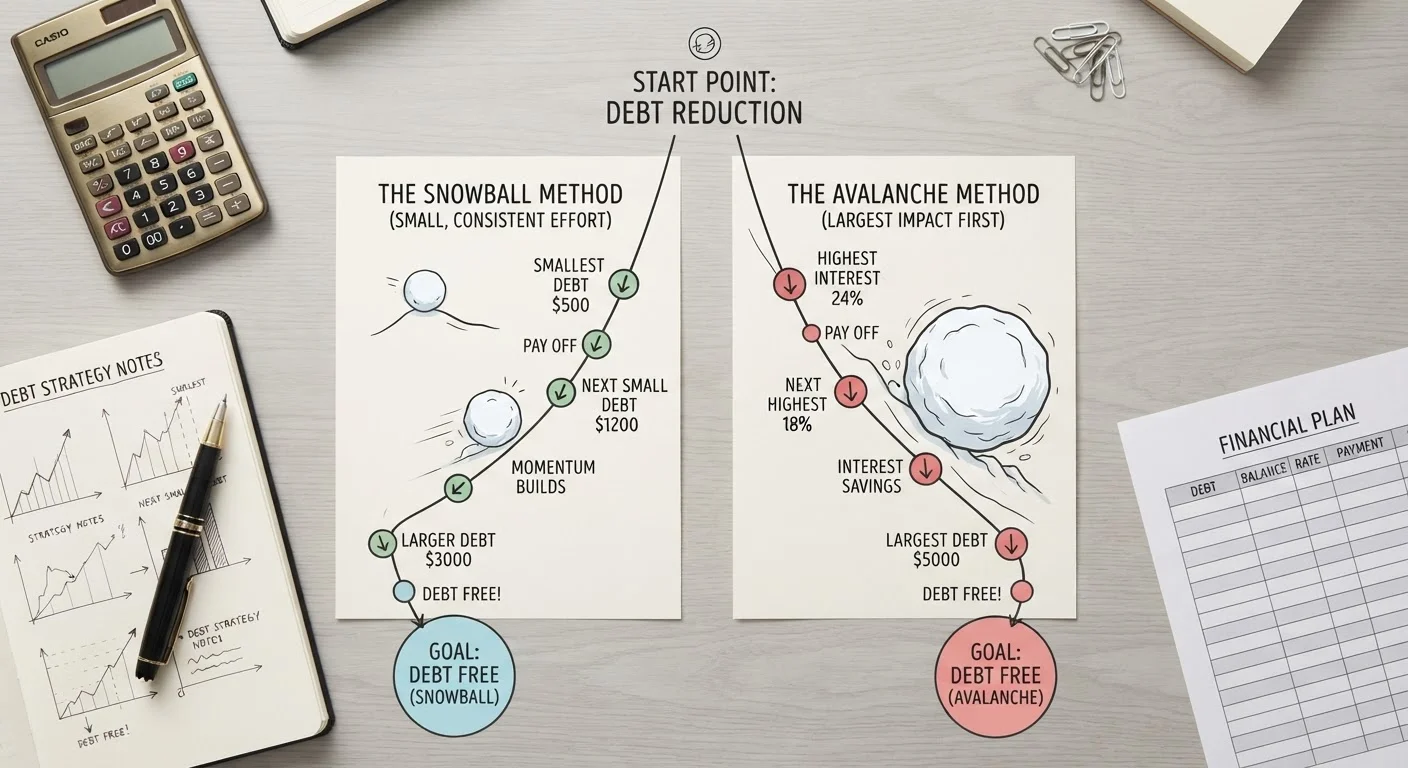
How Each Method Actually Works
Both strategies share the same foundational mechanic: you make minimum payments on every debt, then direct any additional money — even a modest amount — toward one target debt at a time. Once that balance hits zero, you roll what you were paying on it into the next target. The methods differ only in how you choose the target.
Debt Avalanche: Sort your debts by annual percentage rate (APR), highest to lowest. Your extra payment always goes toward the highest-rate balance. Once it's paid off, that freed-up payment rolls to the next highest rate, and so on. Because high-interest debt compounds fastest, eliminating it first stops the most expensive interest accumulation. To understand how that compounding works against you, see our plain-language guide to compound interest.
Debt Snowball: Sort your debts by balance, smallest to largest, regardless of interest rate. Extra payments go to the smallest balance. When it's gone, you combine what you were paying on it with your next minimum payment and attack the next smallest. The idea is that eliminating whole accounts quickly generates a sense of momentum.
| Criterion | Debt Avalanche | Debt Snowball |
|---|---|---|
| Payoff order | Highest APR first | Smallest balance first |
| Total interest paid | Generally less | Generally more |
| Time to first payoff | Potentially longer | Faster (small balances clear quickly) |
| Psychological reward | Delayed; requires patience | Early and frequent |
| Complexity | Low; just sort by rate | Low; just sort by balance |
| Best when rates vary widely | Strong advantage | Advantage less relevant |
| Motivation risk | Higher if progress feels slow | Lower; wins come quickly |
The Math Gap — and Why It Might Not Be the Deciding Factor
In a pure numbers comparison, the avalanche almost always comes out ahead. By reducing high-rate balances sooner, you shrink the principal on which interest is calculated each month. Over a multi-year payoff period, that difference can add up to hundreds or even thousands of dollars saved.
The snowball, by contrast, may cost more in total interest because low-rate balances can sit accruing while you clear tiny debts. However, research in behavioral economics — including work published in the Journal of Marketing Research — has found that people are more likely to remain committed to a debt repayment plan when they experience early, tangible progress. A strategy that's theoretically cheaper but gets abandoned isn't cheaper in practice.
For many households, especially those with multiple debts across different types, the real cost comparison is modest rather than dramatic. The gap narrows when balances and rates are spread out rather than concentrated. Context on the broader landscape of American consumer debt is available in our overview of the types of debt consumers carry.
~$1,000
Typical interest savings with avalanche over snowball
Consumer finance simulations commonly show avalanche savers keeping roughly $1,000 more in their pocket versus snowball users, though the exact figure varies widely by balance size and rate mix.
3–5 debts
Average number of debts held by US borrowers
Federal Reserve consumer finance data consistently show that most American households with debt carry multiple obligations simultaneously, making a structured payoff order especially relevant.
Higher
Completion rates linked to early wins
Behavioral research published in the Journal of Marketing Research found that consumers who reduced the number of accounts they owed — not just the total balance — were more likely to eliminate debt entirely.
Choosing the Right Method for Your Situation
There's no universal answer — the right method depends on your financial picture and your personality. A few factors worth honestly assessing:
- Your highest-rate debt's balance: If it's enormous relative to your other debts, the avalanche's payoff could feel distant for a long time, which increases abandonment risk.
- How you respond to setbacks: If one bad month causes you to quit entirely, the snowball's quick wins may provide the buffer you need.
- Whether your debts are manageable in number: Juggling eight accounts is stressful regardless of method. If that resonates, it may be worth reading about debt consolidation trade-offs before committing to a payoff strategy.
- Your income stability: If your cash flow is unpredictable, the snowball's faster account closures give you more flexibility sooner.
Some people split the difference by starting with the snowball to build confidence, then switching to the avalanche once they've cleared a few small accounts and feel grounded. That hybrid isn't textbook, but personal finance rarely is. What matters is finding an approach that fits your life — not just your spreadsheet.
This article provides general financial education and is not personalized financial advice. Consider speaking with a qualified financial counselor or advisor about your specific situation before making significant changes to your debt repayment approach.