

What Is Consumer Debt?
Consumer debt refers to money borrowed by individuals for personal, family, or household purposes — as opposed to business borrowing. It covers everything from the mortgage on your home to the balance on a store credit card. According to the Federal Reserve, total U.S. household debt has grown steadily over recent decades and now runs into the tens of trillions of dollars collectively.
Not all debt is created equal. The interest rate you pay, whether your property can be seized if you stop paying, and how the loan is repaid all depend on the type of debt you have. Before you can manage, reduce, or strategize around debt, you need a clear picture of what you actually owe and why it behaves the way it does. If you encounter unfamiliar terms along the way, the borrower's glossary is a useful reference.
This article is for general informational purposes only and does not constitute personalized financial, legal, or tax advice. Consult a qualified financial professional for guidance specific to your situation.
Secured vs. Unsecured Debt: The Core Distinction
The single most important distinction in consumer debt is whether it is secured or unsecured.
Secured debt is backed by an asset — called collateral. If you stop making payments, the lender has a legal right to seize that asset. A home mortgage is secured by the house itself; an auto loan is secured by the vehicle. Because the lender carries less risk, secured loans typically carry lower interest rates.
Unsecured debt carries no collateral. The lender relies solely on your creditworthiness and your legal obligation to repay. Credit cards, personal loans, and medical debt are common examples. Because the lender bears more risk, interest rates on unsecured debt are generally higher — sometimes significantly so.
Default Consequences Differ by Debt Type
With a secured loan, a lender can repossess a car or initiate foreclosure on a home if you stop paying. With unsecured debt, a lender must typically pursue legal action to collect — which is slower, but can still result in wage garnishment or a court judgment against you. Knowing what's at stake with each debt type helps you prioritize when money is tight.
This distinction matters in a default scenario. With a secured loan, a lender can repossess a car or initiate foreclosure on a home. With unsecured debt, a lender must typically pursue legal action to collect — which is slower, but can still result in wage garnishment or a court judgment against you.
The Major Categories of Consumer Debt
Within the secured and unsecured framework, consumer debt clusters into a handful of major categories:
- Mortgage debt — The largest debt most Americans carry. Secured by real estate, typically repaid over 15 or 30 years. Interest rates are generally among the lowest available to consumers because the collateral is substantial.
- Auto loans — Secured by the vehicle. Loan terms generally run two to seven years. Because cars depreciate quickly, borrowers can end up owing more than the car is worth — a situation called being underwater on the loan. For more context on auto financing decisions, see the car buying guide.
- Student loans — Used to fund higher education. Federal student loans carry fixed rates set by Congress and come with income-driven repayment options; private student loans behave more like personal loans. Student loans are generally unsecured.
- Credit card debt — Unsecured, revolving (explained below), and often carrying some of the highest interest rates in consumer finance. The Federal Reserve has reported average credit card interest rates above 20% APR in recent periods.
- Personal loans — Unsecured fixed-term loans used for a wide range of purposes, from home improvements to medical expenses. Rates vary widely based on creditworthiness.
- Medical debt — A significant and often unexpected source of unsecured debt for many Americans. It may not accrue interest the same way other debts do, but unpaid balances can still be sent to collections.
$17T+
Total U.S. household debt
According to the Federal Reserve Bank of New York's Household Debt and Credit Report, total household debt surpassed $17 trillion in recent years.
20%+
Average credit card APR
The Federal Reserve has reported average assessed interest rates on credit card accounts exceeding 20% APR in recent reporting periods.
~70%
Homeowners with a mortgage
U.S. Census Bureau data consistently shows that roughly seven in ten homeowners with a mortgage are carrying housing debt.
Revolving vs. Installment Debt
Beyond secured and unsecured, debt is also categorized by its repayment structure.
Installment debt means you borrow a fixed amount, receive it in a lump sum, and repay it in equal, scheduled payments over a set term. Mortgages, auto loans, student loans, and personal loans are all installment debt. You know exactly how many payments you owe and when the debt will be paid off.
Revolving debt works differently. You're given a credit limit, and you can borrow, repay, and borrow again — repeatedly — up to that limit. Credit cards and home equity lines of credit (HELOCs) are revolving. There's no fixed payoff date; your required minimum payment typically fluctuates with your balance. If you only pay the minimum, interest compounds on the remaining balance, which is why revolving high-interest debt can be difficult to eliminate.
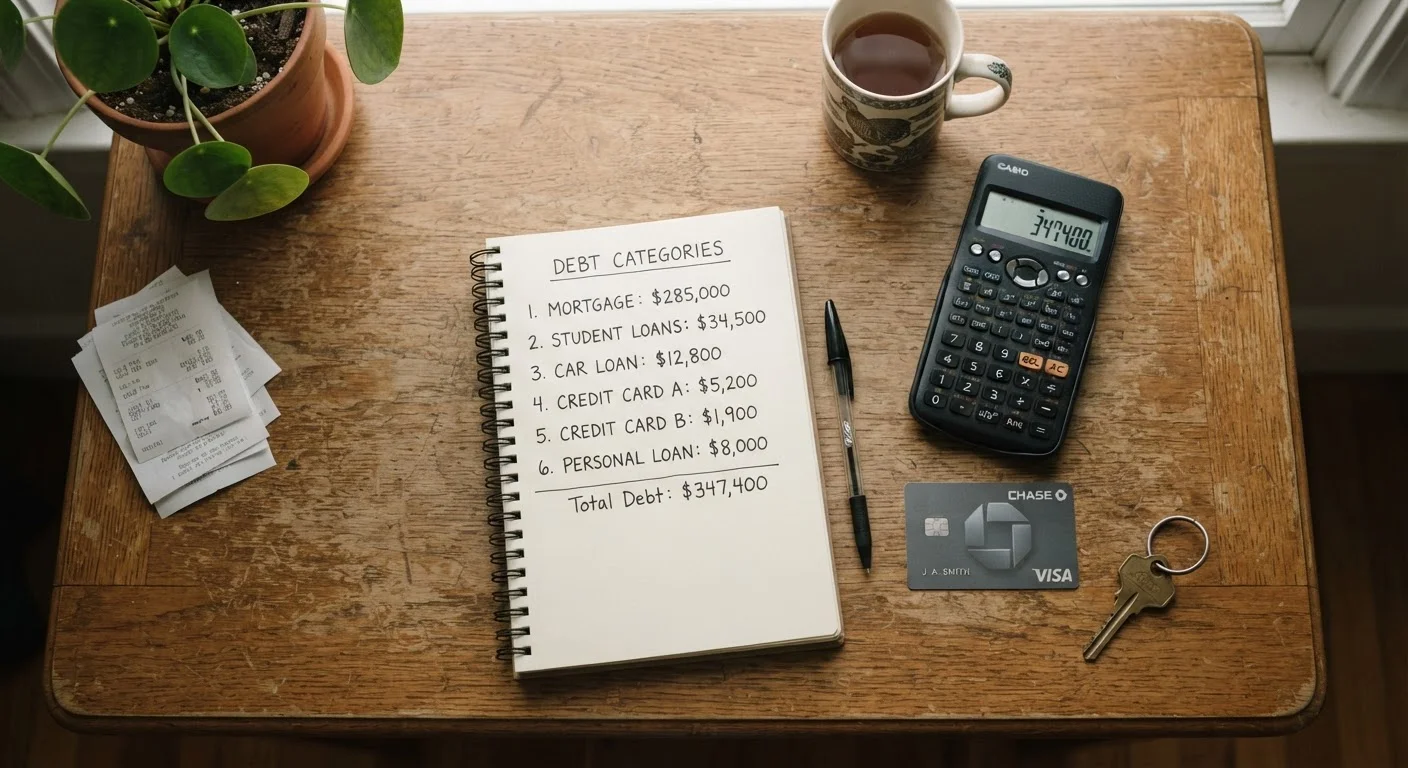
List every debt you owe with its type, balance, interest rate, and whether it's secured or unsecured before you develop any payoff strategy. Without this inventory, any plan you make is working from incomplete information.
Many consumers underestimate their total debt load or misremember interest rates. A written inventory removes guesswork and clarifies which debts are most urgent to address.
Pay close attention to whether a personal loan is truly unsecured before signing. Some lenders attach a lien to household goods or require a co-signer, which changes the risk profile significantly.
The terms 'unsecured' and 'personal loan' are sometimes used loosely in advertising. Reading the loan agreement carefully — or asking the lender directly — ensures you understand your actual obligations.
How Debt Affects Your Financial Health
Carrying debt is not inherently harmful. A mortgage builds equity over time; a student loan may increase earning potential; an auto loan makes transportation possible when savings aren't sufficient. The key variables are the cost of the debt (interest rate and fees), the purpose it serves, and whether repayment is sustainable relative to your income.
High-cost unsecured debt — particularly revolving credit card balances — tends to be the most financially damaging over time. Interest compounds quickly, and minimum payments are structured in a way that can extend repayment for years. Thinking about when debt makes financial sense can help you evaluate your own situation more clearly.
Your debt mix also affects your credit score. Credit scoring models consider your total amounts owed, your credit utilization rate (the share of revolving credit you're using), and the types of credit accounts you hold. Managing a mix of debt types responsibly tends to support a stronger credit profile over time.
Taking the Next Step
Once you have a clear view of the types of debt you carry, you're better positioned to act on them. Two widely used strategies for paying down multiple debts are the debt avalanche (targeting the highest-interest debt first) and the debt snowball (starting with the smallest balance for psychological momentum). You can explore how they compare in debt avalanche vs. debt snowball.
If juggling multiple accounts feels unmanageable, some people consider consolidating balances into a single loan. That approach has real trade-offs worth examining — see debt consolidation trade-offs before making any decisions.
Whatever path you choose, grounding it in an accurate understanding of what you owe — and why each debt behaves the way it does — is the essential starting point. A licensed financial counselor or certified financial planner can help you build a plan tailored to your specific circumstances.