
Your Shady Yard Is an Opportunity, Not an Obstacle
Many homeowners treat a shady yard as a gardening problem to solve — grass struggles, sun-loving annuals fizzle out, and the space feels neglected. But shade is simply a different growing condition, not a worse one. Woodland gardens, green foliage tapestries, and cool-season color are all within reach once you understand how to work with reduced light rather than against it.
The first step is honest assessment. Shade isn't uniform. Deep shade gets fewer than two hours of direct sun daily (think the north side of a house or under a dense evergreen). Partial shade gets two to four hours, often with morning sun. Dappled shade — filtered light through a deciduous canopy — shifts throughout the day and supports the widest plant palette. Knowing which type you have determines which strategies and plants will actually work in your yard.
For a broader look at all-season yard planning, the complete yard and garden care resource covers soil, planting, and upkeep from the ground up.
Diagnose your shade type before choosing any plants
Spend a full day observing how light moves across your shaded area — morning, midday, and late afternoon. Note whether the shade comes from structures (walls, fences) or from trees, since tree roots also compete for water and nutrients. A north-facing bed against a brick wall is fundamentally different from a spot beneath an oak canopy, even if both receive similar light hours. Getting this diagnosis right prevents the most common shade-gardening mistake: buying plants for the wrong conditions.
Watching light move across your yard for a full day is the most valuable planning step you can take.
Amend soil and mulch generously — shade roots demand it
Shaded areas under trees present a specific challenge: surface roots from mature trees compete aggressively for moisture and nutrients. Before planting, work 2–3 inches of compost into the top layer of soil without damaging established roots. Follow up with 2–3 inches of organic mulch (shredded bark or leaf mold work well) to retain moisture and moderate soil temperature. Mulch is especially important in shade because the canopy intercepts rainfall, leaving the soil beneath drier than it appears. The principles behind effective mulching cover depth and material selection in detail.
Tree canopies intercept rainfall, making careful mulching essential for any shade planting beneath them.
Build in layers — groundcovers, mid-height plants, and shrubs
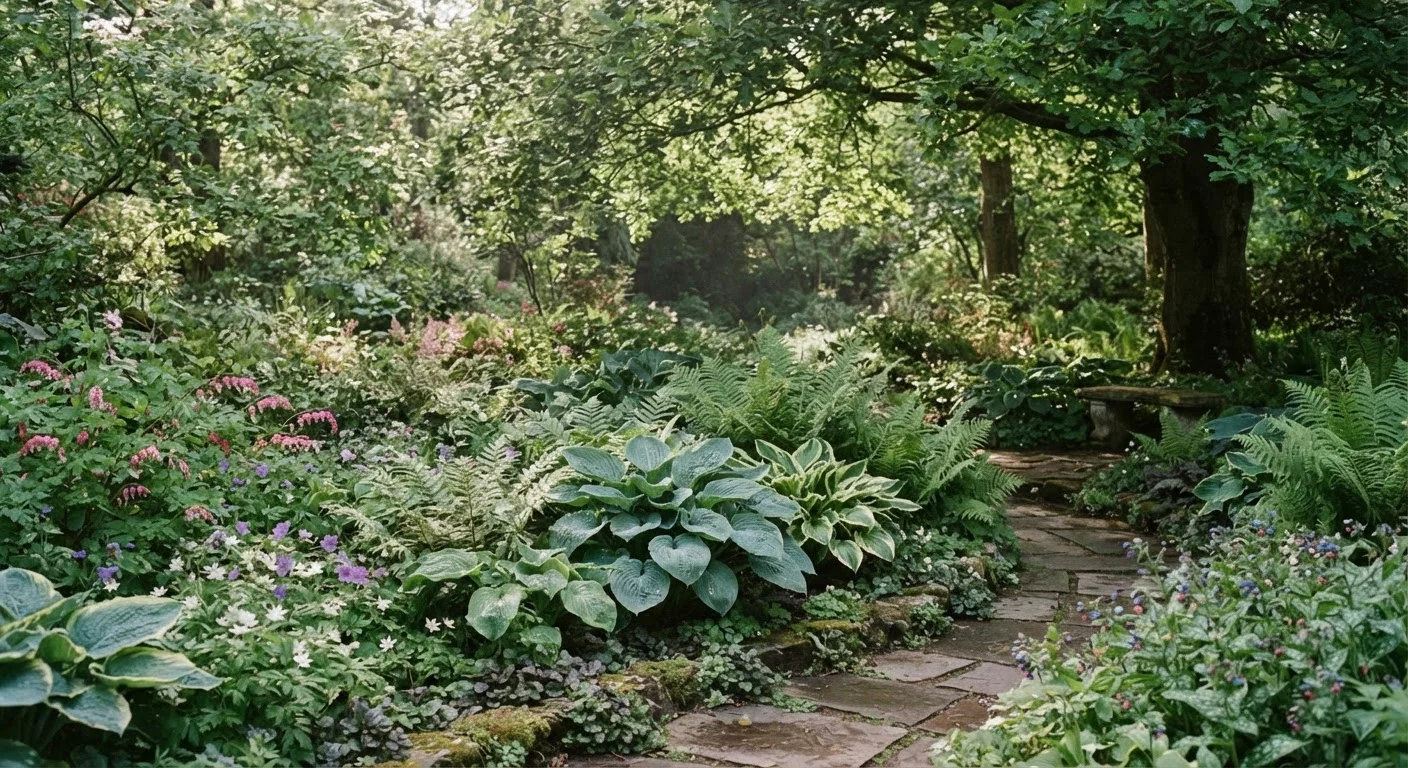
Successful shade gardens mimic natural woodland structure. At the lowest layer, use groundcovers like sweet woodruff, ajuga, or native wild ginger to suppress weeds and cover bare soil. The middle layer — roughly knee- to waist-high — is where most flowering shade perennials live: astilbe, bleeding heart, and Solomon's seal are reliable performers. Taller shrubs like oakleaf hydrangea or native viburnums form the upper canopy layer and anchor the design. This layered approach reduces maintenance because plants at each level suppress weeds and retain soil moisture for their neighbors.
Layering groundcovers, mid-height perennials, and shrubs reduces weeding and creates a self-sustaining garden structure.
Lean on foliage — flowers are a bonus, not the goal
In shade gardens, foliage carries the design through the whole season while flowers are often brief. Hostas are the classic example — dozens of forms offer variations in leaf size, color, and texture. Pair large-leafed, blue-green hostas with fine-textured ferns (Japanese painted fern is particularly striking) and broad-leafed heucheras in burgundy or amber tones. Light-colored or variegated foliage — creamy whites, chartreuse, silvery patterns — reflects what little light is available and visually opens up dark corners far more effectively than dark foliage alone.
Variegated and light-colored foliage does more to brighten a dark corner than any flower selection.
Choose shade-tolerant natives where possible
Native woodland plants are adapted to the natural shade conditions of your region, meaning they're generally lower-maintenance, more drought-tolerant once established, and supportive of local pollinators and wildlife. Eastern US gardeners have excellent options including trillium, wild columbine, Virginia bluebells, and Jack-in-the-pulpit. Pacific Northwest gardeners can work with sword fern and foamflower. Native plants also tend to handle the dry-shade conditions under tree canopies better than most garden cultivars, since they evolved alongside those same trees. Check with your local cooperative extension office for regionally appropriate species lists.
Native woodland plants often outperform garden cultivars in the dry, root-competitive conditions under mature trees.
Use containers to add flexibility and fill gaps
Containers are a practical tool in shade gardens, especially where soil is heavily compacted or root-dense. A large pot filled with a quality potting mix sidesteps root competition entirely and allows you to experiment with shade-tolerant combinations before committing to in-ground planting. Impatiens, caladiums, begonias, and trailing ivy all perform well in shaded container arrangements. Containers also give you the option to rotate in seasonal color and move plants if light conditions shift. For a comparison of container and in-ground approaches, see the guide to raised beds vs. in-ground planting.
Containers bypass root competition entirely and let you experiment with shade combinations at low risk.
Putting It All Together
A successful shade garden doesn't happen by accident — it's built on layering, soil preparation, and plant selection that respects your actual conditions. Start with one area, amend the soil well, and add plants in groups of three or five for visual cohesion. As your confidence grows, expand outward.
Give New Shade Plants Extra Water Their First Season
Even drought-tolerant shade plants need consistent moisture while their root systems establish. Check soil moisture an inch below the surface twice a week during the first growing season, especially in dry-shade conditions beneath tree canopies. Once established, most shade perennials need far less supplemental watering than sun-loving plants.
If you're mixing perennials and annuals in shaded spots, the guide to balancing perennials and annuals will help you plan for season-long color without starting over each spring. And if shade extends indoors, many of the same principles apply — see how to match houseplants to each room's light conditions for ideas that bring the garden inside.