
What the Monroney Label Is — and Why It Exists
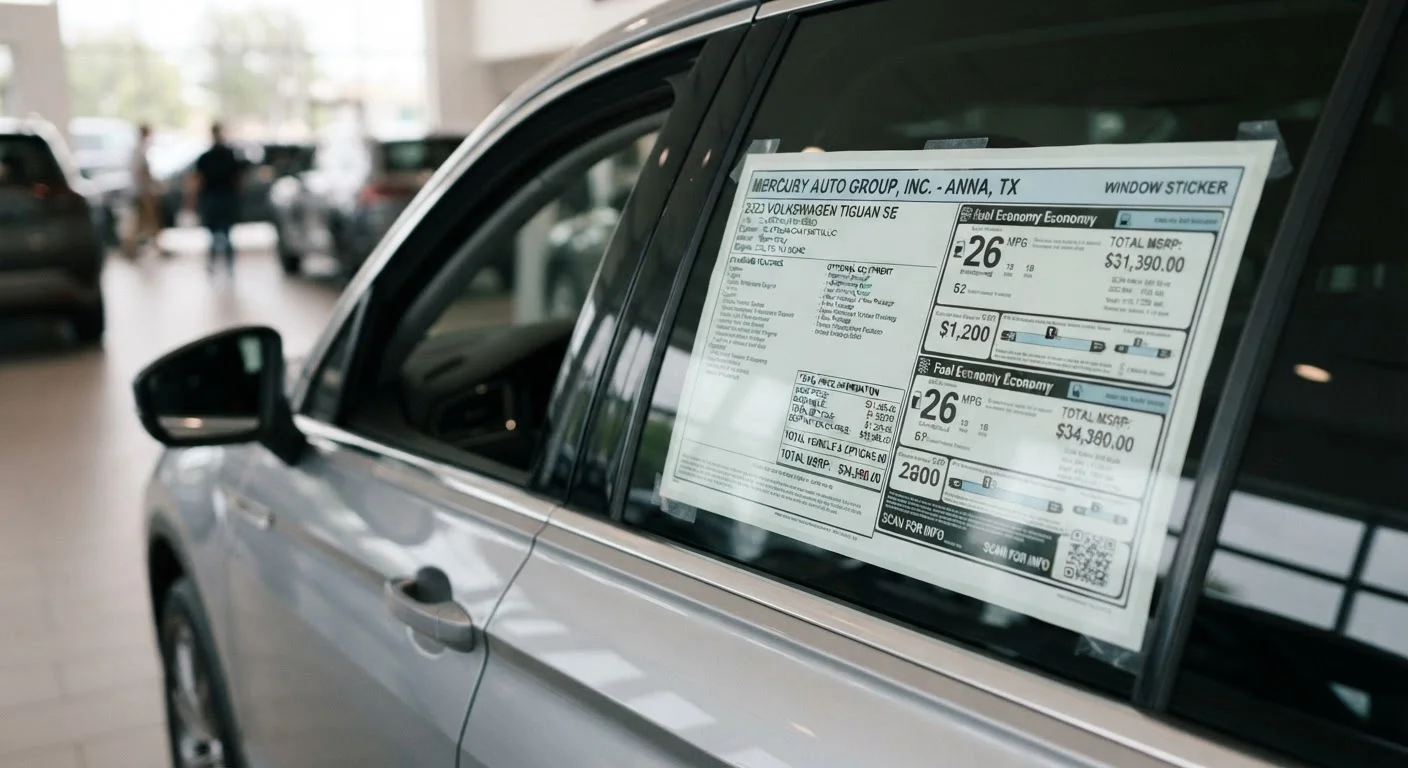
The sticker plastered to a new car's window isn't a dealer marketing tool — it's a federal document. The Monroney label, named after the Oklahoma senator who championed the 1958 Automobile Information Disclosure Act, is required by law on every new passenger vehicle sold in the United States. Dealers cannot legally remove it before the sale is complete.
Its purpose is straightforward: give buyers standardized, comparable information regardless of which dealership or manufacturer they're dealing with. Once you know how to read it, it becomes one of the most useful documents in the entire car-buying process. See our step-by-step car-buying walkthrough for how the Monroney fits into the broader purchase process.
Monroney Label
The federally mandated window sticker on all new vehicles, disclosing pricing, equipment, and fuel economy. Named after Senator Mike Monroney, who authored the 1958 Automobile Information Disclosure Act.
MSRP
Manufacturer's Suggested Retail Price — the total price the automaker recommends for a vehicle including options and destination charge. It is a starting point for negotiation, not a fixed sale price.
Destination Charge
A fixed fee on every new vehicle covering the cost of shipping from the factory to the dealership. This charge is non-negotiable and standardized for each model.
EPA Fuel Economy Estimate
Miles-per-gallon figures determined by standardized federal test procedures. Real-world fuel economy will vary based on driving habits, conditions, and vehicle load.
Market Adjustment
An additional markup a dealer adds above MSRP, typically on high-demand vehicles. This appears on the dealer's own sticker, not the federal Monroney label, and is subject to negotiation.
VIN
Vehicle Identification Number — a unique 17-character code assigned to every vehicle at the factory, encoding the manufacturer, model, engine, and production details.
Breaking Down Every Section of the Label
Monroney labels follow a regulated format, though the exact layout can vary slightly by manufacturer. Here's what each major section contains:
Vehicle Identification
The top of the label lists the make, model, trim level, and the 17-character VIN (Vehicle Identification Number). The VIN is your anchor for everything from history reports to warranty registration. For a deeper look at what those characters actually encode, see what a car's VIN tells you.
Standard Equipment
This section lists features included at the base trim level — things like the engine size, transmission type, safety systems, and standard interior features. These come with every vehicle of that configuration at no extra charge.
Optional Equipment and Packages
Here you'll find every add-on the dealer ordered for this specific vehicle, along with the manufacturer's suggested retail price (MSRP) for each item. Packages bundle multiple features together, often at a discount versus ordering items individually. This section tells you exactly what you're getting and what the factory says it's worth.
Fuel Economy
EPA-estimated city, highway, and combined fuel economy figures appear prominently. These numbers come from standardized federal tests and allow apples-to-apples comparisons between vehicles. The label also shows an estimated annual fuel cost and a comparison to similar vehicles — useful for understanding long-term running costs, not just the sticker price.
Manufacturer's Suggested Retail Price (MSRP)
The bottom of the label totals up the base price, optional equipment, and destination charge (the fixed cost of shipping the vehicle from the factory). This total is the MSRP — what the manufacturer suggests you pay. It is not a fixed price. Understanding what's on this line is essential before you sit down to negotiate.
Dealer-Added Stickers
Watch for a second sticker, usually placed adjacent to the Monroney. This one is dealer-generated and may list accessories the dealership added (window tint, floor mats, paint sealant) along with their own markup, sometimes called a market adjustment. Unlike the Monroney, this sticker is not federally regulated, and the items on it are often negotiable. Before agreeing to any of these, consider reading about add-ons at the finance desk — many of the same products appear there too.
| Law requiring the label | Automobile Information Disclosure Act (1958) |
| Who must display it | All new passenger vehicle dealers in the U.S. |
| When it can be removed | Only after the vehicle is sold to the buyer |
| Fuel economy figures source | U.S. Environmental Protection Agency (EPA) |
| Is MSRP a fixed price? | No — it is a suggested starting point |
| Is the dealer add-on sticker federally regulated? | No — it is dealer-generated and negotiable |