
Choosing the Right Bag for Two Weeks
The single most consequential packing decision you'll make is which bag to bring. Many experienced travelers are surprised to discover that a well-organized carry-on or medium-sized backpack (around 40–45 liters) can comfortably hold two weeks of clothing — and saves time, baggage fees, and the anxiety of lost luggage.
If you're visiting multiple cities or moving frequently, a bag with wheels can become a liability on cobblestone streets or staircase-heavy hostels. A structured travel backpack with a hip-belt and laptop sleeve often handles more terrain without straining your back. On the other hand, if your itinerary is mostly resort- or hotel-based with minimal transit, a roller suitcase in the 21–25 inch range offers more organization options.
Before you buy or commit, check the airline's carry-on size limits for every carrier on your itinerary — particularly budget international airlines, which often enforce stricter dimensions than U.S. carriers. For guidance on the broader logistics of international travel, see our first international trip prep guide.
Before finalizing your bag choice, do a full test pack at home a week before departure — then remove 20% of what's in it. Whatever you're most reluctant to take out is almost certainly something you can find or do without abroad.
Experienced travel researchers consistently find that first-time long-trip packers overestimate how much they'll wear and underestimate how much daily movement will make a heavy bag a burden.
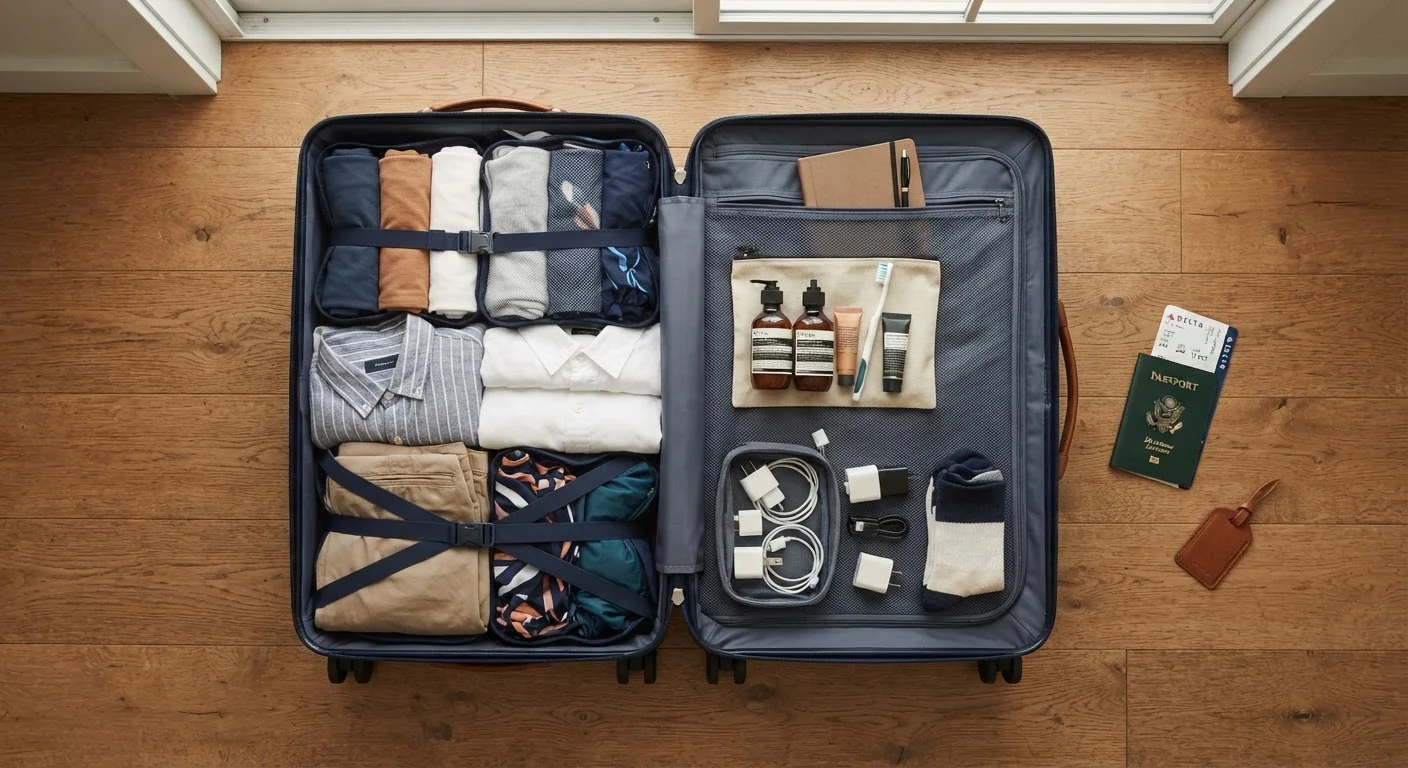
Pack your shoes sole-to-sole inside a shower cap or dedicated shoe bag, then place them along the spine of your bag — this distributes weight closest to your back and keeps the rest of your clothes clean.
Shoes are typically the heaviest and bulkiest items in any bag; placing them optimally improves both carrying comfort and available packing space.
Building Your Clothing Strategy
Two weeks sounds like a long time, but your wardrobe doesn't need to reflect that duration item-for-item. The principle that unlocks efficient packing is versatility over volume: choose neutral, mix-and-match pieces rather than full outfits designed for a single occasion.
A Practical Clothing Formula
- Tops: 5–6 lightweight tops that layer and coordinate across bottoms
- Bottoms: 3 pairs (one casual, one smart-casual, one activity-appropriate)
- Layering piece: 1 packable jacket or cardigan that works across contexts
- Underwear and socks: 7 pairs — plan on doing laundry once midway through
- Shoes: 2 pairs maximum — one walking shoe, one versatile dress or evening option
Merino wool and moisture-wicking synthetics are worth considering for tops and base layers; they resist odor longer than cotton, dry quickly when hand-washed, and pack compactly. Rolling clothes (rather than folding) reduces creasing and compresses volume. Packing cubes help keep categories separated and accessible without unpacking everything.
Plan around laundry. Most hotels offer laundry service; many cities have self-service laundromats. A small bottle of travel-safe detergent lets you hand-wash socks and underwear in any sink.
Toiletries, Medications, and Health Essentials
Toiletries are where bags quietly fill up fast. The discipline here: bring only what you'll realistically use, in travel-sized quantities for the first week, and plan to repurchase consumables locally if needed.
Toiletry Essentials
- Shampoo, conditioner, and body wash in 3.4 oz (100ml) or smaller containers for carry-on compliance
- Sunscreen appropriate to your destination's UV intensity
- Deodorant, toothbrush, toothpaste, and floss
- Any skincare products you use daily — decanted into small reusable bottles
Medications and Health Items
Carry all prescription medications in their original labeled containers. Bring enough supply for the full trip plus a few extra days' buffer. Include a copy of each prescription in case you need a replacement abroad — see our travel document organization guide for how to store these records safely.
A compact personal first-aid kit covering adhesive bandages, pain relievers, antidiarrheal medication, antihistamines, and blister treatment handles the majority of minor travel health needs. Confirm any destination-specific health precautions — such as recommended vaccinations or insect repellent needs — with official sources like the CDC's traveler health portal and your own physician well before departure.
Documents, Electronics, and Carry-On Must-Haves
Everything that would be catastrophic to lose should ride in your carry-on, on your person, or in a secure daypack — never in checked luggage.
Documents
- Passport (valid for at least six months beyond your return date — verify this requirement for your specific destinations)
- Printed and digital copies of your itinerary, hotel confirmations, and any visa approvals
- Travel insurance policy number and emergency contact line
- Emergency cash in local currency for the first day
Our document organization guide walks through exactly where to store each item and how to set up reliable digital backups.
Electronics
- Universal power adapter suited to your destination's outlet types
- Portable battery pack (check airline watt-hour limits before flying)
- Phone charging cable and any device-specific cables
- Noise-canceling earbuds or headphones for long flights
- Camera if applicable — but consider whether your phone meets your needs
Download offline maps, translation apps, and digital boarding passes before you leave the hotel each day. International roaming can be unreliable; a local SIM or an eSIM plan for your destination is often more economical than activating your home carrier's international plan.
What to Leave at Home
Overpacking is almost always the result of packing for anxiety rather than reality. These are the items most commonly packed and least commonly used on two-week international trips:
- Full-size toiletry bottles — heavy, take up unnecessary space, and available to purchase locally
- Multiple pairs of shoes — three or more pairs rarely all get worn; one versatile walking shoe and one smart option is typically sufficient
- "Just in case" formal wear — unless a specific formal event is confirmed, leave it behind
- Physical books — a single e-reader holds an entire library at a fraction of the weight
- Excessive electronics and cables — audit what you realistically use daily; most cables go unused
- Valuables and sentimental items — jewelry, heirlooms, and anything irreplaceable are best left at home to avoid loss or theft abroad
If you're weighing this trip against a shorter domestic trip's packing demands, our domestic pre-trip checklist offers a useful baseline comparison for what the two approaches have in common — and where they diverge.
Final Pre-Departure Checks
In the 48–72 hours before you leave, run through this checklist to avoid the most common last-minute problems:
- Weigh your bag. If checking luggage, confirm it's under the airline's weight limit. If carrying on, confirm dimensions match the strictest carrier on your route.
- Check entry requirements one final time. Visa rules, vaccination documentation requirements, and travel advisories can change. Verify with the U.S. Department of State's travel portal and the destination country's official embassy or consulate site.
- Notify your bank and credit card issuers. Flag your travel dates and destinations to avoid card freezes abroad.
- Enable two-factor authentication on your email and financial accounts — and make sure backup codes are accessible without your primary phone.
- Leave a copy of your itinerary with a trusted contact at home along with your passport's photo page.
- Confirm all bookings. Hotels, transportation, tours — a final confirmation email check prevents arrival surprises.
For a comprehensive walkthrough of the broader logistics — passports, visas, currency, and travel insurance — see our international trip prep guide. And if you're newer to international travel overall, the first-time traveler packing primer covers the foundational decisions end to end.
More trip planning strategies are available in our full planning hub.
This article provides general travel information for educational purposes. Entry requirements, health recommendations, and airline policies change frequently — always verify current requirements with official government and provider sources before you travel.