
Why Mental Exercise Matters as Much as Physical Activity
Most dog owners know their pets need regular walks and exercise — but physical activity alone doesn't cover all of a dog's needs. Dogs are intelligent, curious animals built for problem-solving, exploration, and social interaction. When those drives go unmet indoors, boredom sets in, and boredom rarely looks quiet. It tends to show up as destructive chewing, excessive barking, restlessness, or attention-seeking behavior that can frustrate even the most devoted owners.
The good news is that mental stimulation doesn't require a backyard or perfect weather. A dog that spends an afternoon working through a food puzzle, learning a new command, or following a scent trail around your apartment can be genuinely tired — and genuinely satisfied — by dinnertime. Research in canine cognition consistently supports the idea that cognitive engagement reduces stress and improves behavioral outcomes in domestic dogs.
If your dog's outdoor time is limited by weather, health, your schedule, or your living situation, the activities below can make a real difference. And if you're also managing physical exercise, see our guide to exercising dogs at different energy levels for complementary ideas.
Food Puzzle Toys and Slow Feeders
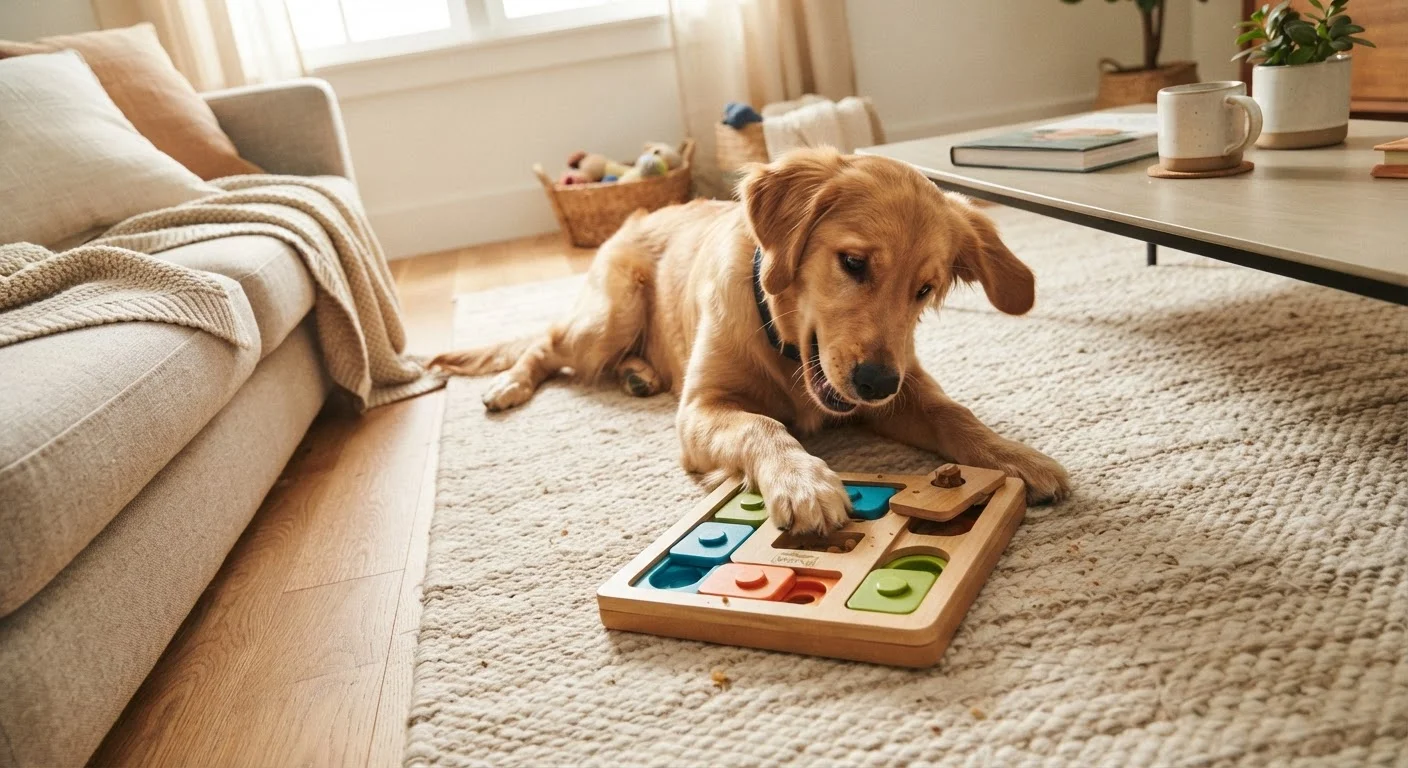
Swapping a standard food bowl for a puzzle feeder or Kong-style toy turns mealtime into a problem-solving exercise. Dogs must use their noses and paws to access food, which engages the same cognitive circuits that hunting and foraging would in the wild. Even a few minutes of this kind of effort can leave a dog noticeably calmer and more satisfied. Start with simpler puzzles and increase difficulty gradually so your dog stays challenged without becoming frustrated.
Turning mealtime into a puzzle engages your dog's brain as much as a game of fetch.
Nose Work and Scent Games
A dog's sense of smell is estimated to be tens of thousands of times more sensitive than a human's — and using it is deeply satisfying for them. Scent games can be as simple as hiding kibble or treats around a room and letting your dog find them. You can also introduce a specific scent (like a drop of essential oil on a cotton ball — avoid toxic oils) and teach your dog to alert when they locate it. This kind of activity, sometimes called nose work or scent detection, is used in formal dog sports and can be adapted easily for home use.
Scent work taps into a dog's most powerful sense, providing rich mental engagement with minimal equipment.
Short, Focused Training Sessions
Learning new commands or refining existing ones is one of the most reliable ways to tire a dog out mentally. Sessions as short as five to ten minutes are ideal — dogs tend to learn better in brief, focused intervals than in long drawn-out drills. Focus on positive reinforcement: reward the behavior you want, and keep the energy upbeat. Teaching a sequence of behaviors, working on impulse control exercises like "leave it" or "stay," or introducing tricks like "spin" or "touch" all count as enrichment. The mental effort of concentrating and responding to cues is genuinely fatiguing in the best way.
A five-minute training session can be as tiring for your dog's brain as a twenty-minute walk.
Interactive Play With Humans
Structured games with you — not just tossing a ball — are a strong form of mental engagement. Hide-and-seek (where you hide and call your dog to find you) combines problem-solving with social reward. Tug played with clear rules teaches impulse control alongside physical play. Even simple back-and-forth games where your dog has to respond to cues mid-play keep their mind active. The interaction with a trusted person is itself enriching; dogs are highly social and genuinely benefit from time that feels collaborative rather than solo.
Games that involve you aren't just fun — they deepen your dog's bond with you while working their brain.
Environmental Enrichment and Novel Experiences
Small changes to your dog's environment can provide meaningful novelty. Rotate toys so familiar ones feel new again. Let your dog explore a new room with interesting textures or smells. Play audio of nature sounds, or allow supervised sniffing time near an open window. You can also create simple obstacle courses from household items — cushions, boxes, low steps — for your dog to navigate. Novel sensory input keeps dogs curious and alert without requiring you to go anywhere. Consistency matters here too: a few new experiences each week is more sustainable than sporadic big events.
Novelty in the environment keeps dogs alert and curious — small changes can have a big impact.
Chew Opportunities and Calming Outlets
Chewing is a natural, self-soothing behavior for dogs — it releases endorphins and helps regulate stress. Providing appropriate chew items (size-matched to your dog and vet-approved for safety) gives dogs a productive outlet, especially during downtime. Long-lasting chews also occupy dogs during periods when you're busy or unavailable. This isn't about distraction — it's about honoring a genuine behavioral need. Dogs that have consistent chewing opportunities tend to be less likely to redirect that drive onto furniture or shoes.
Chewing is a stress-relief mechanism for dogs — providing safe outlets protects both your dog and your furniture.
Building Enrichment Into Your Dog's Everyday Life
You don't need to overhaul your schedule or invest in expensive equipment to keep your dog mentally engaged. The most effective approach is consistency — weaving small enrichment moments throughout the day rather than relying on one long session. A few minutes of training before meals, a sniff walk around the block when weather permits, and a puzzle toy during your work calls can add up to a genuinely stimulating day for your dog.
Start Small and Watch Your Dog's Cues
If your dog is new to enrichment activities, introduce one or two at a time rather than overhauling everything at once. Watch for signs of frustration (pawing, barking at a puzzle, walking away) and scale back the difficulty if needed. The goal is a dog that's happily engaged, not stressed. Even ten minutes of genuine mental engagement each day is a meaningful start.
Keep in mind that enrichment needs shift as your dog ages. Puppies often have intense curiosity but short attention spans, while senior dogs may need gentler, lower-effort activities. Our article on caring for a dog through every life stage covers how to adapt your approach over time. Whatever combination of activities you choose, the goal is a dog that feels engaged, understood, and genuinely at home — even on the days you never make it out the door.