

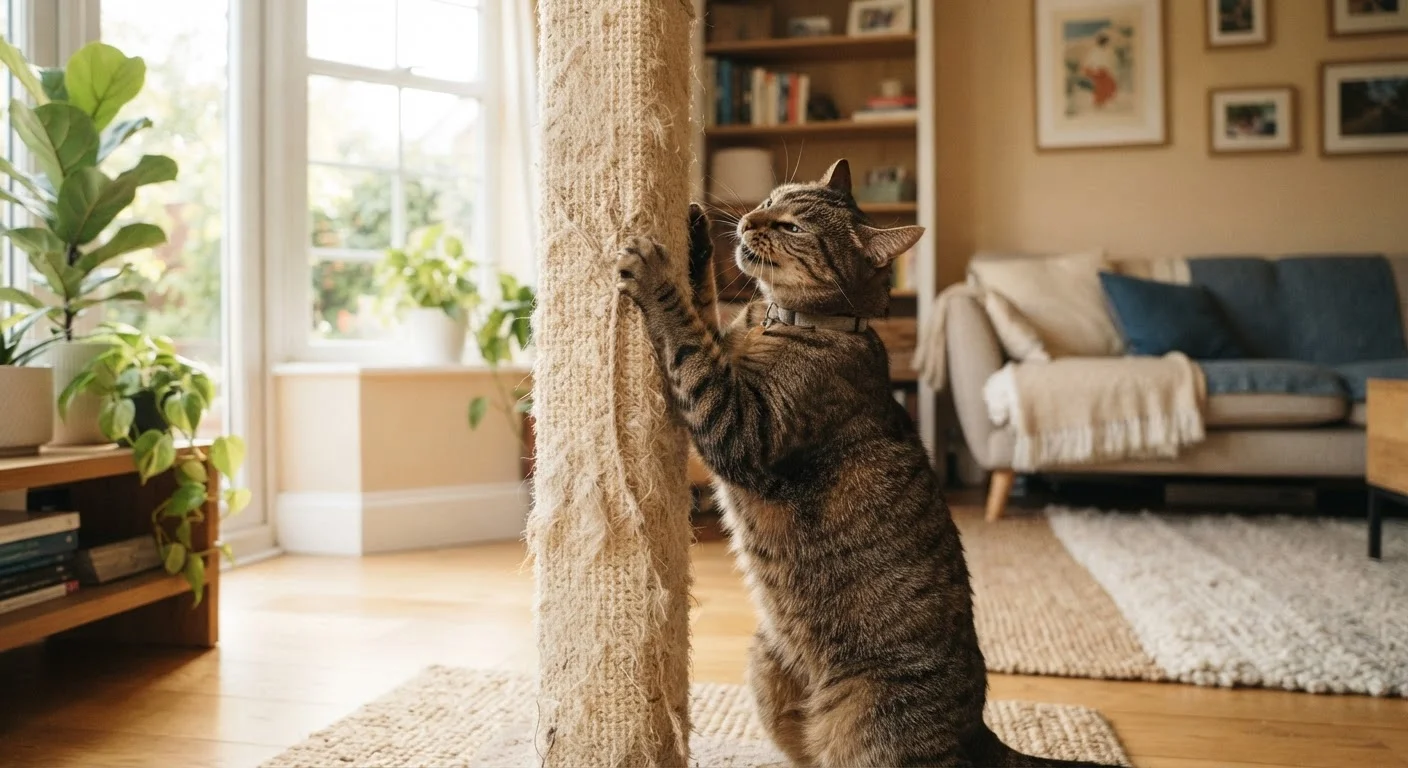
Why Cats Scratch: The Biology Behind the Behavior
If your cat has turned the corner of your sofa into a personal shredding station, you are not alone — and your cat is not being difficult. Scratching is one of the most fundamental behaviors in a cat's repertoire, wired in long before domestication and present in every cat regardless of how pampered their life might be.
There are three core reasons cats scratch:
- Claw maintenance: Cats' claws grow in layers. Scratching strips away the dull outer sheath to expose the sharper layer beneath. It is the feline equivalent of filing your nails.
- Physical conditioning: The full-body stretch a cat performs while scratching works the muscles of the back, shoulders, and forelimbs. Watch your cat carefully next time — it is essentially a yoga pose.
- Communication: Scratching leaves two types of messages. The visual marks signal "I was here" to other cats. The scent deposited from paw-pad glands delivers a longer-lasting chemical message about territory and identity.
Understanding that scratching fulfills genuine biological needs changes everything about how you respond to it. Rather than something to eliminate, it becomes something to redirect. As animal behavior science shows, cats are not acting out of spite — they are simply being cats.
Why Your Furniture Is So Appealing
Cats are not targeting your couch to annoy you. They are drawn to specific qualities that many pieces of furniture happen to have: height, stability, and texture. A tall, firm sofa arm offers the perfect resistance for a full-body stretch. The woven or looped fabric of upholstery catches claws in a satisfying way. And if your scent is on the furniture, scratching there also blends the cat's own scent into a communal territory marker — which, from their perspective, is a bonding behavior.
Match the Post to the Spot
The single most common reason scratching posts go unused is poor placement. Put the post directly beside the furniture your cat already scratches — not across the room. Cats scratch in socially significant locations, and a post tucked in a corner offers none of the territorial satisfaction they are looking for.
High-traffic areas also attract scratching. Cats tend to scratch in places where their messages will be "seen" — near entry points, sleeping spots, and areas where humans spend time. This is worth keeping in mind when you choose where to place scratching alternatives.
Scratching behavior can also intensify during times of stress, change, or excitement. A new pet, a change in schedule, or even outdoor cats visible through a window can all prompt more frequent scratching. If you have noticed a sudden uptick, it is worth considering what else may have shifted in your cat's environment. A predictable daily routine can help reduce anxiety-driven scratching over time.
Practical Redirection: What Actually Works
The goal is never to stop your cat from scratching — it is to give them a place to do it that is not your furniture. Here is what tends to be most effective:
- Choose the right post. Taller is almost always better. Cats need to fully extend their body to get the stretch that makes scratching worthwhile. A wobbly or short post will be ignored. Sisal rope and corrugated cardboard are popular textures, but observe your own cat's current scratching habits to learn their preference.
- Place it strategically. Put the scratching post next to the furniture your cat currently uses. Moving it to a back room defeats the purpose — cats scratch where their marks will be noticed. Once the habit transfers, you can gradually shift the post to a more convenient location.
- Make the furniture less appealing. Temporarily covering targeted surfaces with double-sided tape or a crinkly material can interrupt the habit while your cat builds a new one. Cat-safe deterrent sprays can also help.
- Reinforce the right behavior. When your cat uses the post, offer calm praise or a small treat. Positive reinforcement is far more effective than any form of punishment, which can increase stress and make scratching worse.
- Keep nails trimmed. Regular nail trims do not stop scratching, but they significantly reduce the damage. Soft nail caps are another option, applied by a vet or groomer, that allow scratching while protecting surfaces.
Consistency matters more than perfection. If you notice your cat is scratching more than usual or seems uncomfortable doing so, it is worth a check-in with your vet — occasionally, claw or paw issues can change scratching patterns. You can also read more about subtle signs your cat may be in pain to know when something physical might be driving a behavioral change.