

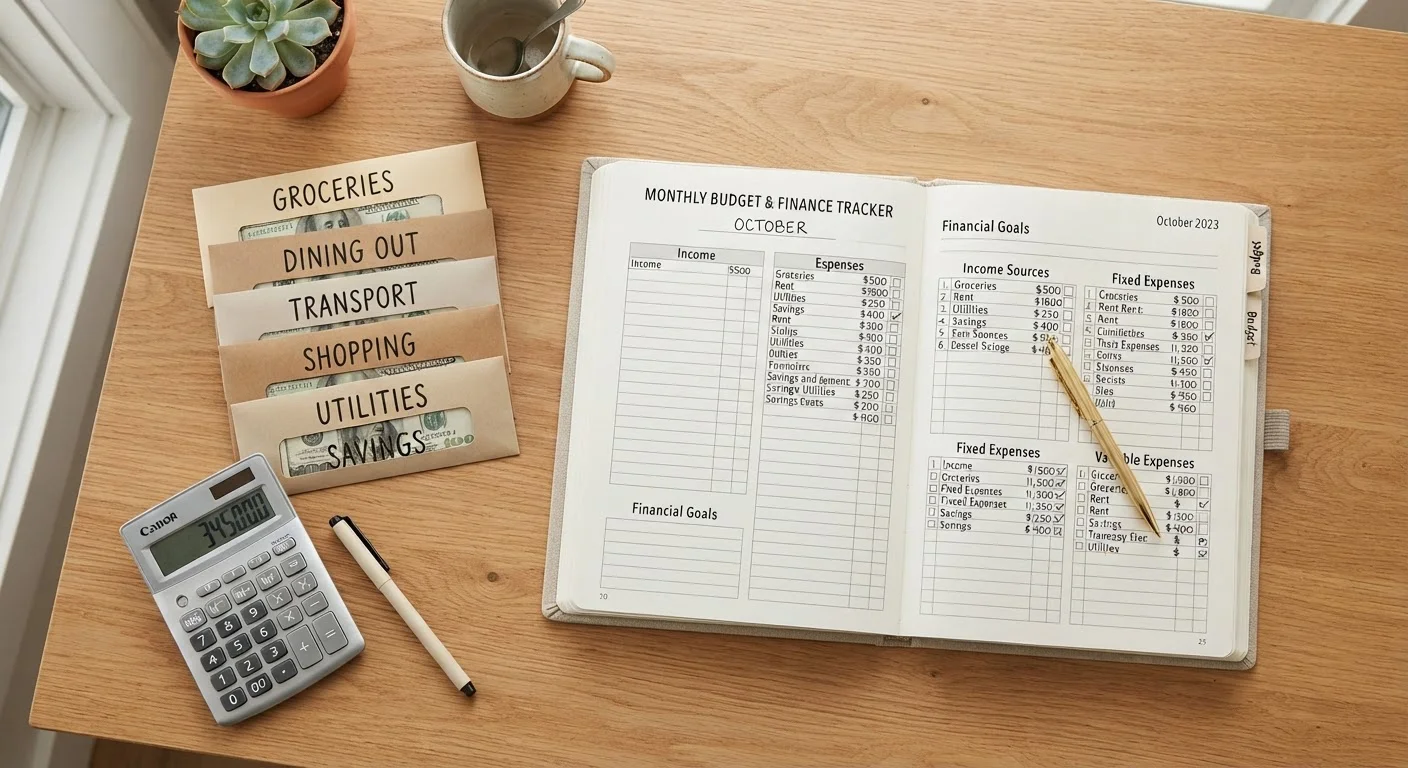
How Each System Actually Works
Before comparing the two methods, it helps to understand the mechanics behind each one. If you're brand new to budgeting in general, our guide to household budgeting from the ground up covers the foundational concepts worth knowing first.
Zero-Based Budgeting
With zero-based budgeting, you start with your total monthly income and assign every dollar to a category — housing, groceries, utilities, savings, debt payments, entertainment, and so on — until the math reaches zero. Zero doesn't mean you've spent everything; it means every dollar has a named job. A dollar sitting in your checking account with no category assigned is a dollar without a plan.
At the start of each new month, you build the budget again from scratch. This is deliberate: it forces a fresh look at priorities rather than letting old habits roll forward automatically.
The Envelope Method
The envelope method divides your spending money into physical envelopes, each labeled for a specific category — say, $400 for groceries, $150 for gas, $200 for dining out. You fund each envelope with cash at the start of the month. When an envelope is empty, spending in that category stops until the next funding cycle.
Digital versions of the envelope method exist through certain budgeting apps, where virtual envelopes replace physical ones. The core logic is the same: a fixed pool of money per category creates a hard ceiling.
| Criterion | Zero-Based Budgeting | The Envelope Method |
|---|---|---|
| Core mechanic | Assign every dollar a category until balance = $0 | Pre-load cash into labeled spending envelopes |
| Works with cards/digital | Yes — fully digital-friendly | Primarily cash; digital adaptations exist |
| Mid-month flexibility | Easy to reallocate between categories | Possible, but requires conscious effort |
| Spending tracking | Requires active logging of transactions | Cash balance in envelope tracks itself |
| Best behavioral effect | Comprehensive financial awareness | Hard stop on impulse overspending |
| Learning curve | Moderate — requires setup and discipline | Low — intuitive and visual |
| Suits irregular income | Yes — rebuilt fresh each month | Less naturally — works best with stable income |
Where They Differ in Practice
The two methods share the same goal — intentional spending — but they feel very different to use day to day.
Flexibility: Zero-based budgeting allows mid-month adjustments. If you underspend on dining, you can move that surplus to savings or another category with a quick update to your plan. The envelope method is more rigid: moving money between envelopes is possible but requires a conscious decision that feels deliberate, which is part of what makes it effective as a behavioral check.
Tracking effort: Zero-based budgeting requires consistent transaction logging — either in an app or a spreadsheet. The envelope method does the tracking for you physically; the remaining cash is the ledger. Understanding how your expenses break down by type can sharpen either approach — see our piece on fixed vs. variable expenses for a closer look at that distinction.
Cash dependency: The traditional envelope method requires withdrawing cash regularly, which doesn't suit everyone's lifestyle or safety preferences. Zero-based budgeting works entirely with digital accounts and card transactions, making it more compatible with how most Americans spend today.
Behavioral friction: The envelope method creates a physical pause before overspending — you literally have to look inside an envelope. Zero-based budgeting relies more on self-discipline and regular check-ins with your numbers. For people whose overspending is impulsive rather than planned, the envelope method's friction can be a genuine asset.
These aren't the only budgeting frameworks available. Our budgeting methods side-by-side comparison covers several other approaches, including pay-yourself-first and the 50/30/20 rule, if you want a wider view before committing.
Digital Envelope Apps: A Middle Ground
Several budgeting apps have built envelope-style functionality that works with bank accounts and debit cards rather than physical cash. This gives users the category-cap discipline of the envelope method without the need to withdraw and carry cash. If the cash-handling aspect of the traditional envelope method feels impractical, a digital envelope tool may be worth exploring as a compromise between the two systems.
Choosing the One That Will Actually Stick
The best budgeting method is the one you'll use consistently. Both zero-based budgeting and the envelope method have helped millions of Americans get a grip on their spending — but neither works if it sits abandoned after the first week.
Ask yourself a few honest questions: Do you tend to overspend in specific, predictable categories? The envelope method's hard stop may be exactly what you need. Do you prefer seeing your whole financial picture in one place? Zero-based budgeting's category-by-category structure makes that possible.
If you're worried that either system will feel too restrictive, it may help to read our piece on common budgeting myths — many people abandon a budget over misunderstandings that are easy to clear up. And if you're deciding between manual tracking and an app to support whichever method you choose, our comparison of manual tracking vs. budgeting apps walks through the real trade-offs.
Some people find that combining elements of both works well — using zero-based budgeting for the overall monthly plan while applying the envelope method to the two or three categories where they tend to slip. There's no rule against it.
~33%
Americans with a detailed household budget
Gallup polling has consistently found that roughly one in three U.S. adults report preparing a detailed monthly household budget.
74%
People who feel financially stressed without a plan
Consumer financial wellness surveys regularly find that the majority of adults without a spending plan report higher financial anxiety than those who budget.
This article is for general informational and educational purposes only and does not constitute personalised financial advice. For guidance specific to your situation, consult a qualified financial professional.