

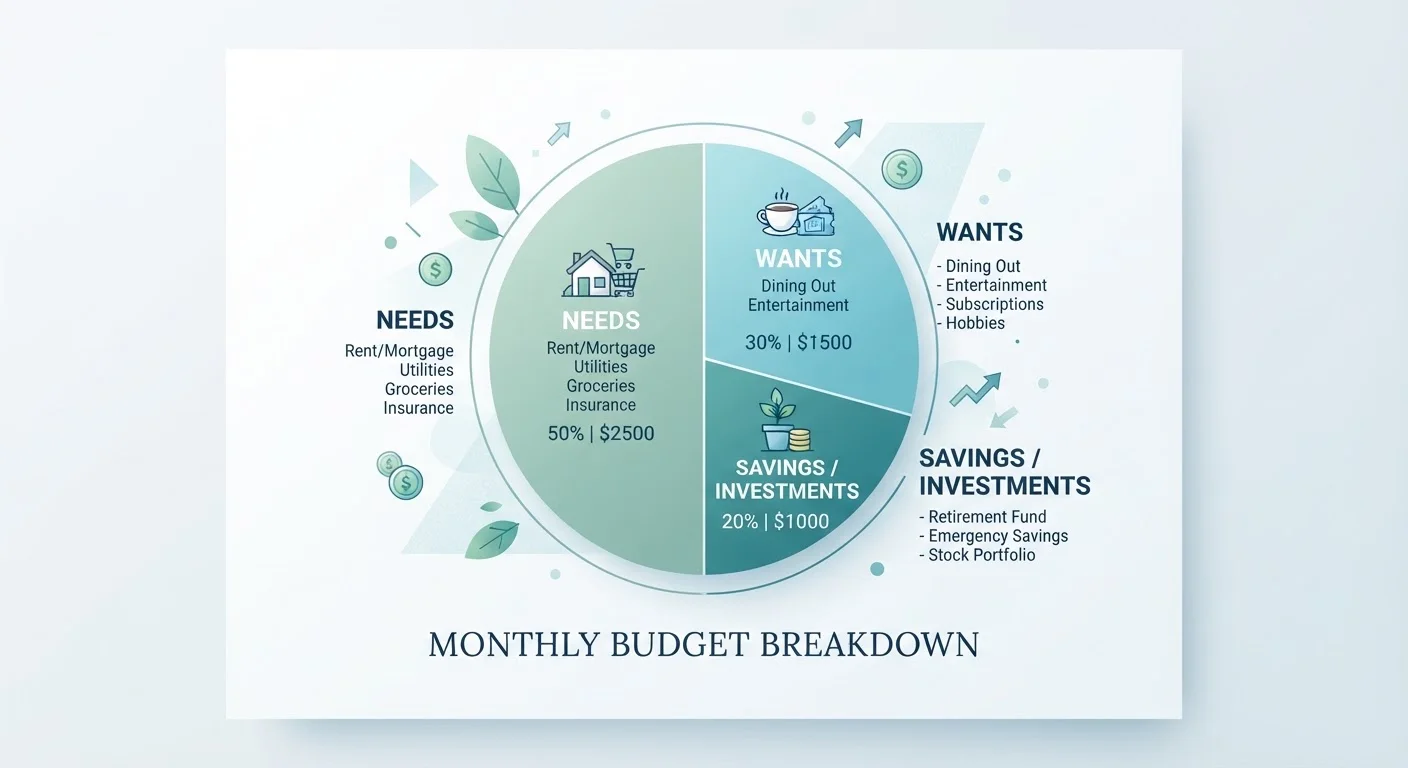
How the Three Categories Work
The 50/30/20 rule organizes your spending into three buckets. Understanding what goes in each one is the foundation of making the framework actually useful.
50% — Needs
Needs are the non-negotiables: housing costs, utilities, groceries, basic clothing, minimum loan payments, and health insurance premiums. These are expenses where skipping payment has serious consequences. If your needs regularly exceed 50% of your take-home pay, that's a signal worth paying attention to — either income needs to grow, housing costs need to come down, or both.
30% — Wants
Wants are the spending choices that improve your quality of life but aren't strictly necessary. Streaming services, dining out, gym memberships, travel, and clothing beyond the basics all land here. This category is not the enemy — enjoying some of your money is part of a sustainable financial life. But it's also where most overspending hides.
20% — Savings and Debt Repayment
This slice covers building an emergency fund, contributing to retirement accounts, and paying down debt beyond the minimum. The order in which you prioritize matters. Most financial educators suggest having at least a small liquid emergency fund before aggressively attacking debt, and tackling high-interest debt before building long-term savings. For ideas on growing what you set aside, explore the Saving & Growing Money hub.
Adjust the Percentages to Fit Your Life
The 50/30/20 split is a starting point, not a requirement. If you're aggressively paying off high-interest debt, temporarily reducing the wants category to 20% and pushing the savings-and-debt slice to 30% is a perfectly reasonable adjustment. What matters is that you're consciously allocating your income, not that you hit the exact numbers every month.
When the 50/30/20 Rule Works — and When It Doesn't
The rule's biggest strength is its simplicity. You don't need a spreadsheet with 40 categories. Three numbers are easy to remember and easy to check. For someone just starting to pay attention to their money, it's a much gentler entry point than more detailed systems.
That said, it has real limitations. In high-cost cities — New York, San Francisco, Boston — rent alone can eat 40% or more of a moderate income before a single grocery run. For people in that situation, hitting the 50% needs target is structurally difficult without significant income increases or relocation.
Low-income households face a harder version of the same problem. When essentials take 70 or 80 cents of every dollar, the math on 30% for wants and 20% for savings simply does not work. The rule was designed with a middle-income household in mind, and it shows.
The rule also doesn't distinguish between types of savings goals. Retirement contributions, a house down-payment fund, and a three-month emergency buffer are all very different in urgency and time horizon — but they're lumped into the same 20%. You'll need to think separately about how to split that slice.
If you want to compare the 50/30/20 approach against other methods before committing, a side-by-side look at major budgeting approaches can help you weigh the trade-offs.
77%
Americans living paycheck to paycheck at some point
According to a 2023 LendingClub report, roughly three in four Americans have reported experiencing financial stress from limited monthly cash flow.
~30%
Of income spent on housing by average US household
U.S. Bureau of Labor Statistics Consumer Expenditure data consistently shows housing as the single largest spending category for American families.
Putting It Into Practice
Start with your actual after-tax monthly income. If your income varies — freelance work, hourly shifts — use a conservative monthly estimate based on your lower-earning months.
Next, pull two to three months of bank and credit card statements and sort each transaction into one of the three buckets. Don't guess — look at the real numbers. Many people are surprised to discover their "wants" spending is significantly higher than they assumed.
Once you know your baseline, compare it to the 50/30/20 targets. It's rare for someone to line up perfectly on the first try. Treat the gaps as information, not failure. Then decide which adjustments are realistic: Can a subscription be cut? Can one fewer restaurant meal per week shift $80 toward savings?
A monthly check-in keeps things from drifting. Small overages compound quickly. If you want a structured process for that review, a monthly budget review checklist gives you a repeatable routine to catch overspending before it compounds. And if you find you need to challenge some of your own assumptions about what budgeting requires, common budgeting myths worth examining is a useful read.
This article is for general informational and educational purposes only. It is not personalized financial, tax, or investment advice. For guidance specific to your situation, consult a qualified financial professional.