

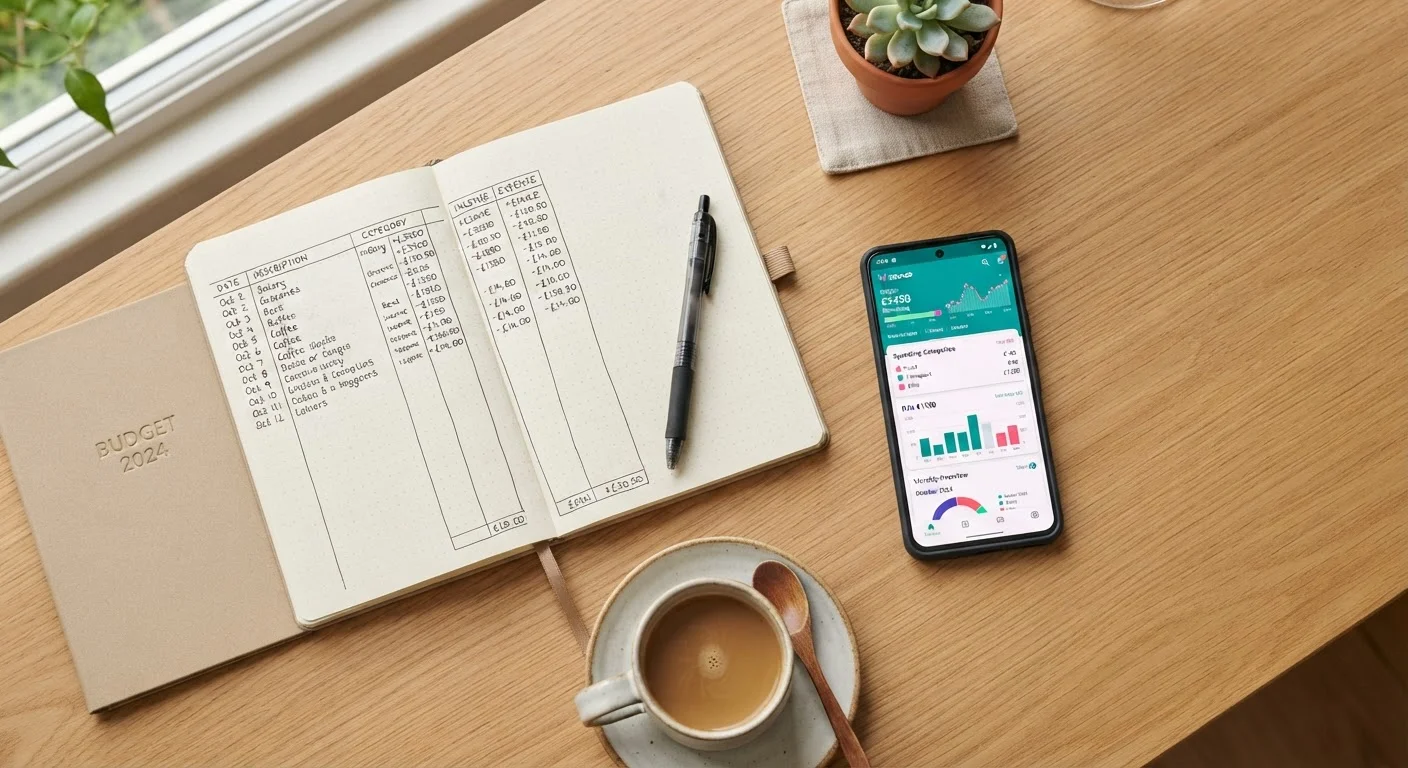
Why the Tracking Method You Choose Actually Matters
A budget that lives only in your head rarely survives contact with real spending. The moment you write down — or digitally log — where your money goes, you create accountability. But the format of that record shapes how likely you are to keep it going.
If you're new to the process, the fundamentals of household budgeting are worth reviewing before committing to any specific tool. The tracking method is only one piece of the picture.
This article focuses specifically on the trade-offs between doing it by hand and using a digital app — so you can make a practical, informed choice rather than defaulting to whatever's popular.
The Case for Manual Tracking
Writing out transactions in a notebook or maintaining a spreadsheet forces you to touch every number. Research in behavioral finance consistently suggests that active engagement — physically recording a purchase — increases awareness of spending patterns more than passive monitoring does.
Deepens awareness through active engagement
Writing or typing each transaction manually forces you to confront spending in real time, which studies in behavioral economics link to stronger financial self-awareness.
No third-party data exposure
Spreadsheets and notebooks keep your financial data entirely local — no app credentials, no synced bank accounts, no exposure to external data breaches.
Fully customizable to your categories
You define every row and column, so the system matches your actual life rather than forcing your spending into preset app categories that may not fit.
No ongoing subscription cost
Free spreadsheet tools like Google Sheets require no paid plan, whereas many full-featured budgeting apps charge monthly or annual fees.
Manual tracking also carries no privacy risk tied to third-party platforms. When you use a spreadsheet, your bank credentials stay with your bank. You're also not dependent on an app's continued existence, pricing changes, or data policies.
The downside is real: manual tracking is time-consuming, and gaps appear quickly during busy stretches. A missed week can turn into a missed month. It also requires more discipline to categorize transactions consistently over time.
Time-consuming data entry
Manually logging every transaction from multiple accounts can take significant time each week, and the burden grows with household complexity.
Easy to fall behind during busy periods
Missing a few days of entries often leads to incomplete records, and reconstructing past transactions from memory or bank statements is tedious and error-prone.
No automated alerts or real-time limits
Without app-style notifications, overspending in a category often isn't noticed until the end of the month during a manual review.
For a structured starting point, the spending tracker setup checklist outlines the categories and fields worth capturing before you build any budget around your numbers.
The Case for Budgeting Apps
Budgeting apps connect directly to your bank and credit card accounts, pulling in transactions automatically. For households juggling multiple accounts, this eliminates the most friction-heavy part of manual tracking: data entry.
~60%
Americans who say they follow a budget
According to Gallup polling data, roughly six in ten U.S. adults report maintaining a household budget, though adherence rates vary considerably.
3 in 10
Budgeters who use a digital app
Consumer surveys from the National Endowment for Financial Education suggest a significant share of budgeters still rely on manual methods like spreadsheets or pen and paper.
Apps typically categorize spending automatically, send alerts when you approach a limit, and generate charts that surface patterns at a glance. These features lower the barrier to staying current, which is why many users report higher consistency with apps than with manual methods.
That said, automation creates its own blind spots. When you're not personally logging a $47 restaurant charge, it's easy to scroll past it in an app dashboard without it registering. Connectivity issues, sync errors, and miscategorizations also require periodic review to catch.
Privacy is a legitimate concern. Linking financial accounts to a third-party app means sharing login credentials or read-access tokens with an outside company. Most established apps use bank-level encryption, but the risk profile is different from a local spreadsheet.
If you're weighing different budgeting systems — not just tools — the budgeting methods comparison covers how approaches like zero-based budgeting and pay-yourself-first interact with different tracking formats.
Making Your Decision: Key Questions to Ask
Rather than chasing the "right" answer, consider the following before deciding:
- How many accounts do you manage? The more sources of income and spending, the more an app's automation saves time.
- How comfortable are you with data sharing? If connecting accounts to a third-party service makes you uneasy, a spreadsheet respects that boundary.
- Do you learn better by doing or by reviewing? Manual entry teaches through friction; app dashboards teach through visualization.
- What's your track record? If you've abandoned manual systems before, the lower effort of an app may actually keep you going.
Hybrid Approaches Are Common
Many financially organized households use both methods together — an app for automatic transaction imports and a spreadsheet for monthly planning and goal-setting. There's no rule that says you must pick only one. The goal is accurate, current visibility into your spending, whatever format gets you there consistently.
Neither format locks you in permanently. Many people start with an app to build the habit, then transition to a spreadsheet once they understand their patterns — or vice versa. The zero-based budgeting vs. envelope method comparison is a useful read if you're also deciding which system to apply once your tracking method is in place.
This article is for general informational purposes only and does not constitute personalized financial advice. Consult a qualified financial professional for guidance specific to your situation.