
Why Insulation Type Matters
Choosing the right insulation isn't just about staying warm in winter. It affects energy efficiency, moisture control, air sealing, and long-term structural health. Different materials behave very differently depending on where they're installed — an attic, a basement wall, and a cathedral ceiling each have distinct demands. Getting the match right means fewer drafts, lower utility bills, and a more durable home.
The four most common insulation types — batts, spray foam, rigid boards, and blown-in — each fill a different niche. Understanding their trade-offs puts you in a much stronger position when talking to contractors or planning a project.
| Fiberglass Batt R-Value | R-2.9 to R-3.8 per inch (U.S. Department of Energy) |
| Closed-Cell Spray Foam R-Value | R-6 to R-7 per inch (U.S. Department of Energy) |
| Cellulose Blown-In R-Value | R-3.2 to R-3.8 per inch (U.S. Department of Energy) |
| Polyiso Rigid Board R-Value | R-5.8 to R-6.5 per inch (U.S. Department of Energy) |
| Most common DIY-friendly type | Fiberglass or mineral wool batts |
| Requires professional installation | Spray foam (both open- and closed-cell) |
Batt Insulation: The Familiar Standard
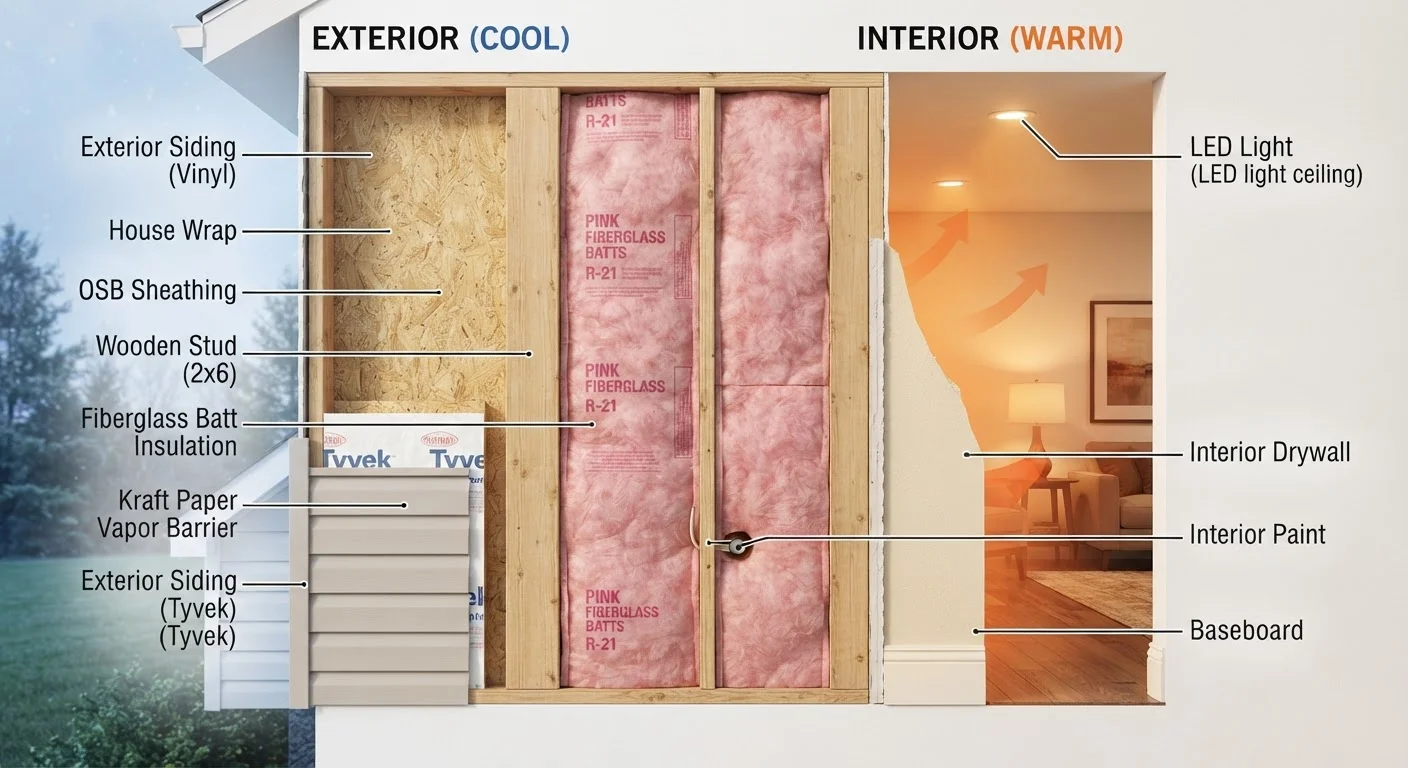
Batts are pre-cut panels or rolls of insulation, most often made from fiberglass or mineral wool (also called rock wool or slag wool). They're the type you most commonly see in hardware stores and in open wall cavities during construction or renovation.
Batts are sized to fit snugly between standard stud and joist spacing — typically 16 or 24 inches on center. When properly installed with no gaps, compression, or voids, they perform close to their rated R-value (a measure of thermal resistance; higher is better). The catch: batts are highly sensitive to installation quality. A gap as small as 4% of the surface area can reduce overall thermal performance by 50%, according to building science research.
Best for: Open wall cavities, floor joists, and attic floors where framing is accessible and moisture levels are controlled. Mineral wool batts also offer some fire resistance and better moisture tolerance than standard fiberglass.
Trade-offs: Batts don't air-seal on their own. They require a separate air barrier or vapor retarder in most climates. Professional installation is recommended for complex or hard-to-reach areas.
Spray Foam: The Air-Sealing Powerhouse
Spray polyurethane foam (SPF) is applied as a liquid that expands rapidly into a solid foam. It comes in two main varieties: open-cell (lower density, softer, more affordable) and closed-cell (denser, rigid, higher R-value per inch, and moisture-resistant).
Spray foam's biggest advantage is that it air-seals as it insulates — filling cracks, gaps, and irregular surfaces that batts and other materials simply can't reach. Closed-cell foam can achieve R-6 to R-7 per inch, making it one of the highest-performing options available by thickness.
Best for: Rim joists, cathedral ceilings, crawl spaces, and any area where air infiltration is a known problem. Closed-cell foam is also used on the exterior face of walls and on flat roofs.
Trade-offs: Spray foam is significantly more expensive than other insulation types. It must be installed by trained professionals using proper protective equipment, and some formulations require curing time before the space is re-occupied. Improperly mixed or applied foam can off-gas chemicals and lose performance. Always verify that your contractor is licensed and follows manufacturer application guidelines.
Rigid Board Insulation: Thin, Tough, and Versatile
Rigid insulation boards — made from expanded polystyrene (EPS), extruded polystyrene (XPS), or polyisocyanurate (polyiso) — offer high R-values in a thin, manageable panel. They're dimensionally stable, resistant to compression, and can be used in locations where soft insulation would be damaged or displaced.
Best for: Exterior wall sheathing, basement walls, under slab foundations, and low-slope roofing assemblies. Rigid boards are especially useful when adding insulation to the outside of an existing structure without reducing interior living space.
Trade-offs: Rigid boards need to be carefully cut and fitted; gaps at edges and seams reduce effectiveness unless taped or foamed. They also vary in moisture resistance — XPS is more moisture-resistant than EPS, while polyiso can absorb moisture at its facing if exposed. Some foam boards are combustible and must be covered with a code-required thermal barrier (such as drywall) on interior applications. Always check local building codes before leaving foam board exposed.
R-Value
A measure of thermal resistance — how well a material resists heat flow. Higher R-values indicate better insulating performance. Required R-values vary by climate zone and building component (wall, attic, floor).
Air Barrier
A material or system that restricts airflow through the building envelope. Unlike insulation, which slows heat conduction, an air barrier stops drafts and air infiltration. Many insulation types require a separate air barrier to perform effectively.
Vapor Retarder
A material that slows the movement of water vapor through walls, floors, or ceilings. Its required location and permeance rating depend on your climate zone — placing it on the wrong side can trap moisture and cause damage.
Thermal Bridge
A path of low thermal resistance through an otherwise insulated assembly — often framing lumber — that allows heat to bypass the insulation. Rigid exterior insulation is one strategy for reducing thermal bridging.
Open-Cell Foam
A type of spray polyurethane foam with a soft, sponge-like structure. It has a lower R-value per inch (around R-3.5) and is vapor-permeable, meaning moisture can pass through it slowly.
Closed-Cell Foam
A denser, rigid spray polyurethane foam with a higher R-value per inch (R-6 to R-7) and very low vapor permeance. It resists moisture and adds structural rigidity to wall assemblies.
Blown-In Insulation: Coverage Where It Counts
Blown-in insulation — also called loose-fill — is made from fiberglass, cellulose (recycled paper fiber), or mineral wool. It's pneumatically blown into place using a hose and machine, allowing it to fill irregular spaces, settle around obstacles, and achieve uniform coverage in hard-to-reach areas.
Best for: Attic floors (especially existing attics without easy access), enclosed wall cavities in retrofit projects, and anywhere complete coverage is difficult to achieve with batts. Cellulose is a popular choice for attics because it's affordable, has good thermal mass, and is treated to be fire- and pest-resistant.
Trade-offs: Blown-in materials can settle over time, reducing effective R-value — cellulose more so than fiberglass. Proper installation depth matters: installers should leave depth markers (rulers) in the attic so you can verify the settled depth over time. Like batts, blown-in doesn't air-seal on its own; combining it with air-sealing measures at penetrations and top plates dramatically improves performance.
For attic work involving electrical fixtures, recessed lights, or other penetrations, consult a qualified contractor before adding insulation. Improperly covering certain fixtures can create fire hazards.
This article is for general informational and educational purposes only. Always consult a licensed contractor and verify local building codes and permit requirements before beginning any insulation project in your home.