
The Core Distinction: Purpose vs. Container
People often use "emergency fund" and "savings account" as if they mean the same thing. They don't — and conflating them is one of the quieter ways savings plans fall apart.
A savings account is a type of bank account designed to hold money you're not spending right now. It earns interest, is federally insured (up to $250,000 through the FDIC at banks and NCUA at credit unions), and is generally accessible without penalty. You can open one for any reason — or no reason at all.
An emergency fund is not an account type. It's a financial goal with a specific job: to cover essential expenses if something goes wrong — sudden job loss, an unexpected medical bill, a major car repair. It typically lives inside a savings account, but the account and the fund are not the same thing.
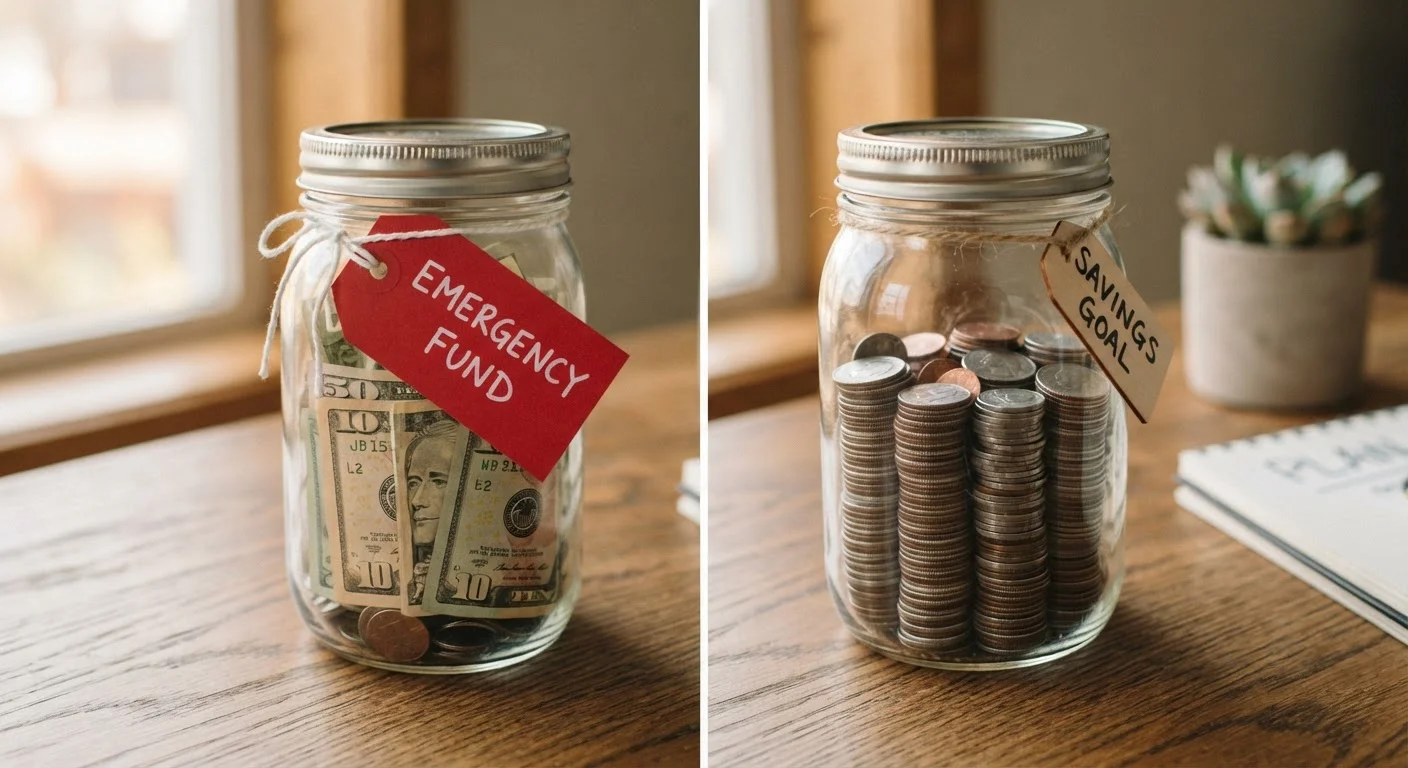
Think of it this way: a savings account is a jar. An emergency fund is what the jar is designated for. You can have multiple jars (accounts) serving different purposes, or one jar holding everything — but the label matters. See common savings patterns that quietly stall financial progress to understand why this distinction matters in practice.
| Criterion | Emergency Fund | Savings Account |
|---|---|---|
| What it is | A financial goal or purpose | A type of bank account |
| Primary job | Cover unexpected essential expenses | Hold money for any savings goal |
| Typical target amount | 3–6 months of living expenses | Whatever your specific goal requires |
| Access | Must be immediately accessible | Accessible; some accounts limit withdrawals |
| Should it earn interest? | Yes — keep in a high-yield account | Yes — rate depends on account type |
| Can it be invested? | No — stability and access required | Depends on timeline and risk tolerance |
| Risk of misuse | High if not kept separate | Lower when labeled for a specific goal |
How Much You Need — and How Each Gets Built
The general guidance for an emergency fund is three to six months of essential living expenses — meaning rent or mortgage, utilities, food, transportation, insurance, and minimum debt payments. Someone with a stable income and low expenses might target three months; a freelancer, single-income household, or anyone with dependents should lean toward six.
A savings account, by contrast, has no universal target. The right amount depends entirely on your goal. Saving for a $3,000 appliance set is different from saving for a $30,000 down payment. The timeline, not a rule of thumb, determines the target.
57%
Americans unable to cover a $1,000 emergency with savings
A 2024 Bankrate survey found that more than half of U.S. adults could not pay for an unexpected $1,000 expense from savings alone.
3–6 months
Recommended emergency fund coverage
Consumer finance educators and federal guidance consistently recommend covering three to six months of essential living costs in an accessible, liquid account.
22%
Americans with no emergency savings at all
The Federal Reserve's Report on the Economic Well-Being of U.S. Households has consistently found that roughly one in five Americans have no savings set aside for emergencies.
Building both at the same time is possible and often sensible. A common approach: direct a small fixed amount to an emergency fund each pay period until you hit a starter threshold (many financial educators suggest $1,000 as a meaningful first milestone), then split contributions — some to emergency savings, some to a goal-based account. For a practical starting point, see how to build a savings habit from zero.
Automation helps both. Setting up automatic transfers removes the temptation to skip a month and turns saving into a default rather than a decision.
Where to Keep Each — and Why Separation Helps
Both your emergency fund and goal-based savings can technically live in the same savings account — but keeping them separate makes it far easier to manage. When everything sits in one pool, it becomes hard to know whether spending from the account is eating into your emergency cushion or your vacation fund.
Many people open two accounts at the same institution: one labeled (even informally) for emergencies, one for goals. Others use accounts at entirely different banks to reduce the temptation to dip in casually.
Where you keep this money matters for how much it earns. A high-yield savings account typically pays significantly more than a standard savings account and still allows penalty-free withdrawals — making it a reasonable home for both. For a deeper look at the trade-offs, see how high-yield and traditional savings accounts compare.
If your goal-based savings have a longer time horizon and you won't need the money for a year or more, you might also consider whether a certificate of deposit (CD) makes sense for that portion. CDs generally offer higher rates in exchange for locking up access for a fixed term. Your emergency fund should never go into a CD — you need it available immediately. Learn more about CDs versus high-yield savings accounts to weigh those trade-offs.
The right structure isn't complicated: one dedicated place for emergencies, another for each meaningful savings goal, and regular check-ins to make sure both are on track. A structured savings audit can help you spot gaps and make adjustments.
This article is for general informational purposes only and does not constitute personalized financial advice. For guidance specific to your situation, consult a qualified financial professional.